Field: Technology
Discovery of Eoceras shaanxiense Illuminates the Origins of Cephalopod Buoyancy Systems
Published | Technical Staff
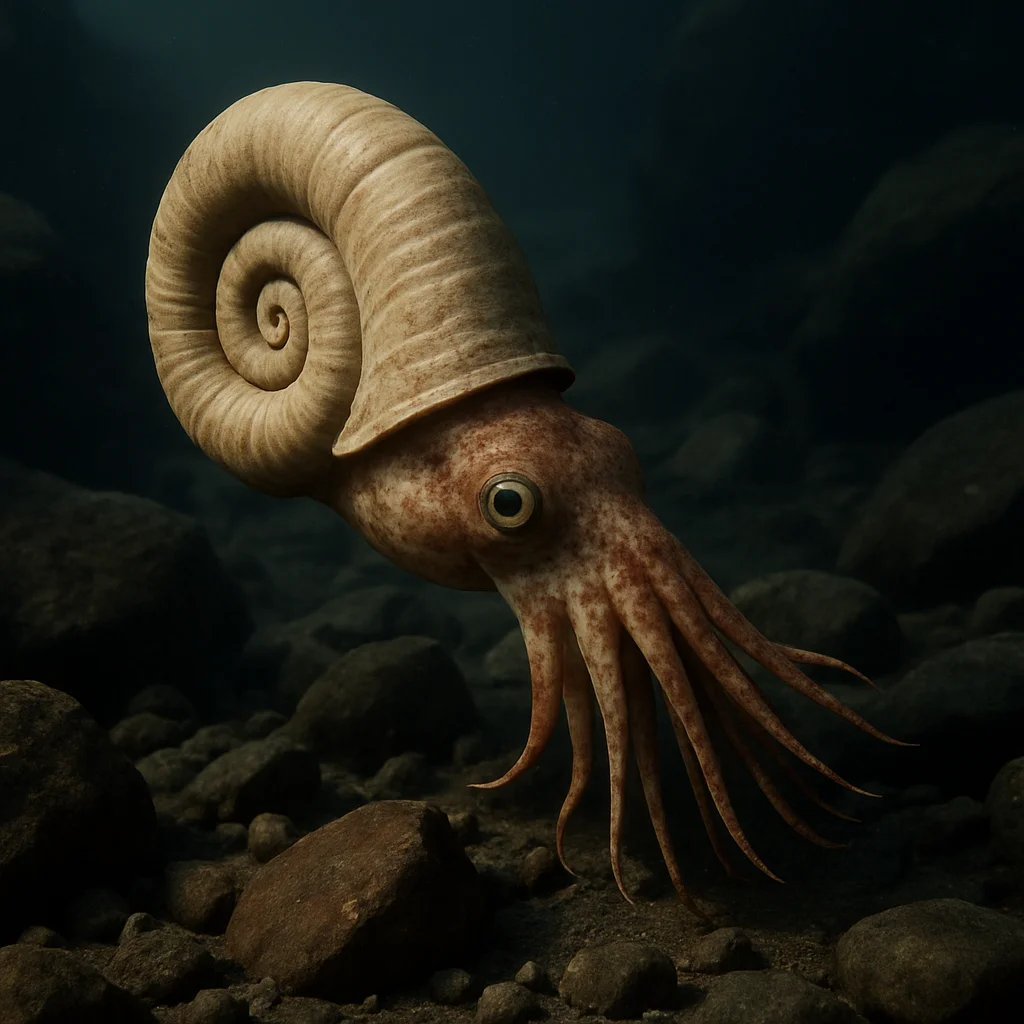
Visualization
In a momentous advance for paleobiology, a team of researchers has unearthed fossil evidence bridging a pivotal gap in the evolutionary narrative of cephalopods. Their findings, published in *Nature* (Z. Song et al., 2026), detail the identification of *Eoceras shaanxiense*—a diminutive, straight-shelled mollusk from the Early Cambrian—within the Shuijingtuo Formation of South China. This animal lived approximately 520 million years ago and may represent the earliest cephalopod yet documented to possess a siphuncle, the essential internal tube that later enabled the exceptional buoyancy regulation characteristic of the group.
Modern cephalopods, a lineage encompassing nautiluses, squid, cuttlefish, and octopuses, are anomalous among mollusks for their sophisticated internal shell architectures and aquatic mobility. At the center of this evolutionary story lies the siphuncle, a tubular extension of the mantle that traverses sequential shell chambers, enabling dynamic control over shell buoyancy through the manipulation of liquid and gas contents. The functional principle exploits the physical relationship:
\[
\Delta P = \rho g h
\]
where pressure difference (\(\Delta P\)) across septa allows selective removal or intake of chamber fluid, thus altering shell mass and density.
Historically, direct fossil evidence for siphuncle-bearing cephalopods was restricted to *Plectronoceras cambria* from the Late Cambrian (~490 Mya), while molecular phylogenies suggested a much earlier divergence between cephalopods and other mollusks, perhaps near the dawn of the Cambrian. Early Cambrian fossil records, however, have been scant, rendering the developmental trajectory of the siphuncle obscure. The recent characterization of *Eoceras shaanxiense* thus re-dates the evolutionary emergence of this innovative apparatus by nearly 30 million years.
Thirty-two *Eoceras* specimens, each measuring only millimeters in length, were subjected to detailed morphological scrutiny. Their shells exhibit a linear, orthoconic geometry; the aperture is gently inclined, while the shell wall is periodically partitioned by septa—transverse walls that delimit chamber spaces within the shell’s phragmocone. Uniquely, a segmented tube, subtending the ventral side of the shell, is traversed by minute radial tubules penetrating each septum. These structures precisely mirror the anatomical configuration of a siphuncle, which in extant nautiloids (and presumably their ancestral forms) allowed for the modulation of chamber contents. The iterative migration of the soft body toward the aperture and the concomitant creation of new chambers, while maintaining siphuncular connectivity with prior chambers, foreshadows the developmental model later perfected by more derived cephalopods.
The implication is profound: *Eoceras shaanxiense* represents a stem cephalopod in which the siphuncle was in its evolutionary nascency, offering the first glimpse of this trait in the fossil record. It suggests a stepwise assembly of the cephalopod buoyancy system, culminating in the elaborately chambered phragmocones and dynamic locomotion seen in subsequent cephalopod radiations. Despite the presence of a siphuncle, the primitive configuration in *Eoceras* likely conferred only limited control over buoyancy, possibly restricting the animal to a predominantly benthic, rather than nektonic, existence.
The discovery not only redefines the temporal boundary of siphuncle evolution but also reshapes hypotheses concerning the origin of cephalopod life habits. Importantly, this fossil material sharpens the congruity between molecular divergence estimates and the paleontological record, strengthening the inference that the fundamental innovations underpinning cephalopod buoyancy originated far earlier than previous direct evidence allowed.
As articulated by lead author Zuchen Song and colleagues, the features of *Eoceras shaanxiense*—multiseptate shell structure, primitive segmented siphuncle, and inferred chamber-construction mechanism—are diagnostic milestones marking a transitional phase between basal chambered mollusks and the fully realized cephalopod condition. In broad evolutionary context, this Cambrian relic not only clarifies the emergence of one of biology’s most successful locomotory and buoyancy strategies but also invites renewed examination of early metazoan evolutionary experiments in the aftermath of the Cambrian explosion.
Modern cephalopods, a lineage encompassing nautiluses, squid, cuttlefish, and octopuses, are anomalous among mollusks for their sophisticated internal shell architectures and aquatic mobility. At the center of this evolutionary story lies the siphuncle, a tubular extension of the mantle that traverses sequential shell chambers, enabling dynamic control over shell buoyancy through the manipulation of liquid and gas contents. The functional principle exploits the physical relationship:
\[
\Delta P = \rho g h
\]
where pressure difference (\(\Delta P\)) across septa allows selective removal or intake of chamber fluid, thus altering shell mass and density.
Historically, direct fossil evidence for siphuncle-bearing cephalopods was restricted to *Plectronoceras cambria* from the Late Cambrian (~490 Mya), while molecular phylogenies suggested a much earlier divergence between cephalopods and other mollusks, perhaps near the dawn of the Cambrian. Early Cambrian fossil records, however, have been scant, rendering the developmental trajectory of the siphuncle obscure. The recent characterization of *Eoceras shaanxiense* thus re-dates the evolutionary emergence of this innovative apparatus by nearly 30 million years.
Thirty-two *Eoceras* specimens, each measuring only millimeters in length, were subjected to detailed morphological scrutiny. Their shells exhibit a linear, orthoconic geometry; the aperture is gently inclined, while the shell wall is periodically partitioned by septa—transverse walls that delimit chamber spaces within the shell’s phragmocone. Uniquely, a segmented tube, subtending the ventral side of the shell, is traversed by minute radial tubules penetrating each septum. These structures precisely mirror the anatomical configuration of a siphuncle, which in extant nautiloids (and presumably their ancestral forms) allowed for the modulation of chamber contents. The iterative migration of the soft body toward the aperture and the concomitant creation of new chambers, while maintaining siphuncular connectivity with prior chambers, foreshadows the developmental model later perfected by more derived cephalopods.
The implication is profound: *Eoceras shaanxiense* represents a stem cephalopod in which the siphuncle was in its evolutionary nascency, offering the first glimpse of this trait in the fossil record. It suggests a stepwise assembly of the cephalopod buoyancy system, culminating in the elaborately chambered phragmocones and dynamic locomotion seen in subsequent cephalopod radiations. Despite the presence of a siphuncle, the primitive configuration in *Eoceras* likely conferred only limited control over buoyancy, possibly restricting the animal to a predominantly benthic, rather than nektonic, existence.
The discovery not only redefines the temporal boundary of siphuncle evolution but also reshapes hypotheses concerning the origin of cephalopod life habits. Importantly, this fossil material sharpens the congruity between molecular divergence estimates and the paleontological record, strengthening the inference that the fundamental innovations underpinning cephalopod buoyancy originated far earlier than previous direct evidence allowed.
As articulated by lead author Zuchen Song and colleagues, the features of *Eoceras shaanxiense*—multiseptate shell structure, primitive segmented siphuncle, and inferred chamber-construction mechanism—are diagnostic milestones marking a transitional phase between basal chambered mollusks and the fully realized cephalopod condition. In broad evolutionary context, this Cambrian relic not only clarifies the emergence of one of biology’s most successful locomotory and buoyancy strategies but also invites renewed examination of early metazoan evolutionary experiments in the aftermath of the Cambrian explosion.