Field: Technology
Dinosaurs May Have Been Snacking on Seaweed 100 Million Years Ago
Published | Technical Staff
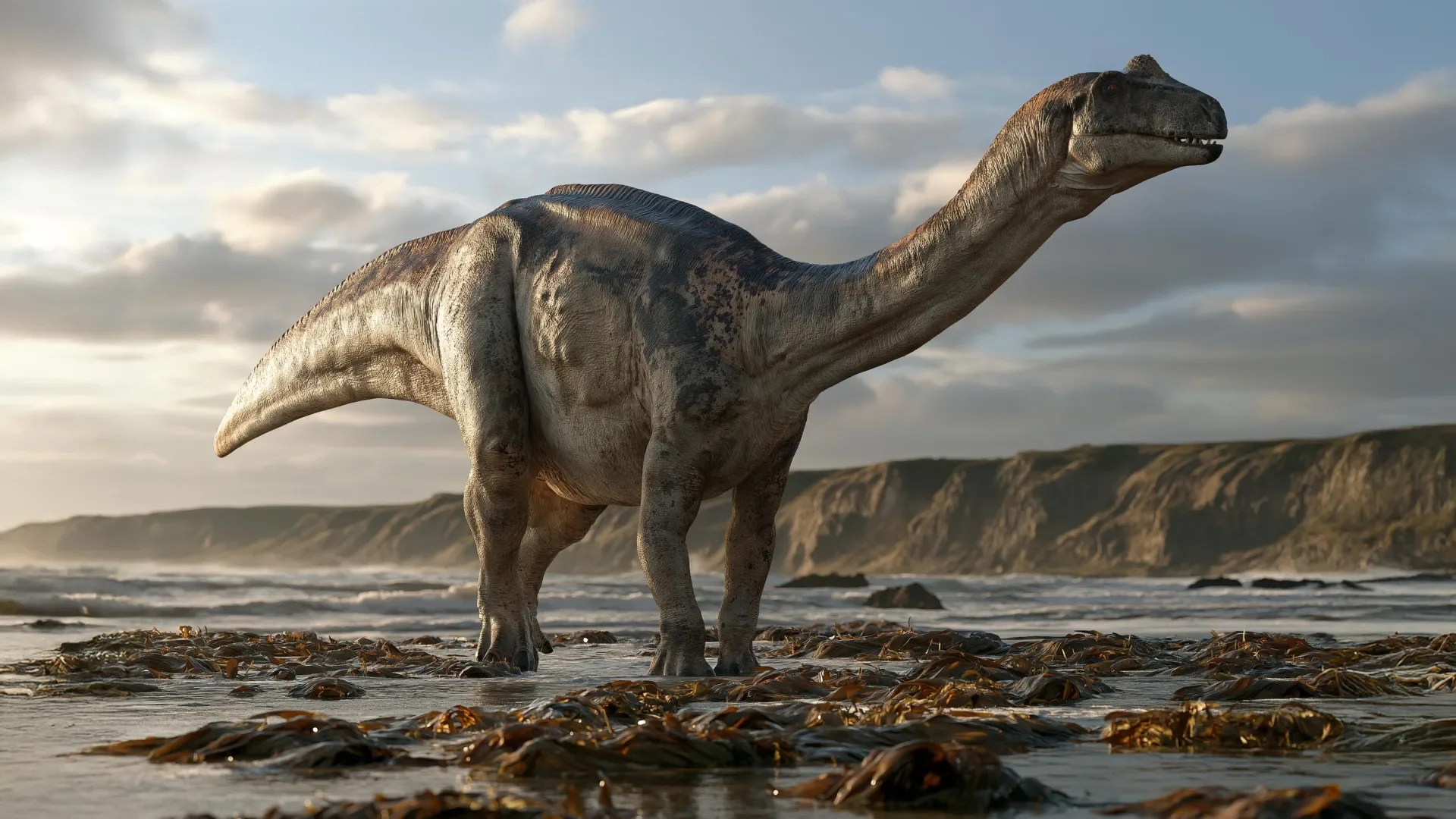
Visualization
In a groundbreaking revelation that rewrites the dietary narrative of prehistoric marine-terrestrial interactions, recent research suggests that dinosaurs along ancient coastlines might have incorporated marine food sources—specifically seaweed—into their diets over 100 million years ago. Published in the journal Frontiers in Ecology and Evolution, the study offers compelling evidence for marine subsidization, a phenomenon where terrestrial ecosystems derive nutrients from the adjacent ocean, proving invaluable in periods of resource scarcity.
The collaborative efforts of researchers led by Dr. Clayton Forster from the University of Arkansas have unveiled vital chemical signatures embedded within the teeth of fossilized dinosaurs, crocodiles, turtles, and other fauna that once roamed the shores of ancient seas. The intricate interplay between marine and terrestrial environments unveils a complex food web, wherein nutrients traveled across the ecological divide, enriching land-based herbivores and the carnivores that preyed upon them.
At the heart of this investigation lies the analysis of carbon isotopes within dinosaur teeth. Plants incorporate two isotopes of carbon: carbon-12 (C-12) and carbon-13 (C-13), the relative amounts of which can serve as a chemical fingerprint reflective of their dietary sources. This signature, represented as δ13C, typically exhibits a higher value in the enamel of feeding animals—an increase from the consumed flora by approximately 11 to 13 parts per thousand. Intriguingly, the fossilized teeth examined in this study displayed significantly elevated δ13C values, surpassing those expected for strictly terrestrial herbivores. This revelation hints at a more diverse dietary repertoire, involving nutrients sourced from the ocean.
The research team meticulously focused on fossil samples from regions that were once coastal, particularly along the Western Interior Seaway and within the Gulf of Mexico, both significant geological features of the Cretaceous Period. This era, characterized by a warm greenhouse climate, instigated an extensive inland sea that bifurcated North America. By analyzing fossilized remains from both coastal and inland sites, the researchers were able to capture a comprehensive dietary picture that spanned from the early Albian (113-107 million years ago) to the early Cenomanian (100-96 million years ago).
Employing techniques that involved grinding powdered fossil material to derive the carbon isotope signatures, the researchers discerned a striking correlation: coastal fossils consistently yielded higher δ13C values than their inland counterparts. Remarkably, these elevated values were uniform across different geographical locations and geological ages, underscoring a persistent flow of marine nutrients into terrestrial ecosystems during the Cretaceous.
As the researchers delved deeper into identifying the potential sources of these chemical signatures, they conjectured that coastal organisms were either directly consuming oceanic organic matter or feeding on other organisms that had themselves grazed upon marine flora. This inference was critical, as the uniform chemical pattern across diverse taxa—from small fish to large herbivorous dinosaurs—indicates that the marine input was likely situated at a foundational level in the food web. Seaweed, or marine macroalgae, emerged as the most plausible contributor, easily accessible in coastal habitats yet rarely found in inland ecosystems.
The parallels between ancient and modern feeding behaviors are notable. Current herbivorous animals residing near coastlines frequently supplement their diets with seaweeds, suggesting that herbivorous dinosaurs might have exhibited similar tendencies. This extrapolation illuminates an intricate network of dietary behaviors and ecological relationships previously underestimated in the context of dinosaur biology.
However, the findings are nuanced; not every dinosaur capitalized on these marine resources. The study notably observed the case of Tenontosaurus tilletti, a sizable herbivore whose δ13C values closely aligned with those found in modern terrestrial herbivores, indicating a diet strictly derived from land-based plants. Such divergent chemical signatures reinforce the interpretation that the variations observed were consistent reflections of genuine dietary behavior rather than mere artifacts of diagenetic processes.
This research not only elucidates the ancient connections between terrestrial and marine ecosystems during the age of dinosaurs but also poses critical questions for future explorations. Without fossil records from other latitudinal segments during the early Albian and early Cenomanian, the researchers could not ascertain the geographic diversity of this feeding behavior. Additional inquiries are needed to determine whether similar marine terrestrial interactions existed in subsequent geological epochs, including the Jurassic Period and early Cenozoic Era.
Ultimately, the explorations into the diets of these magnificent prehistoric creatures reveal an unexpected complexity, calling into question simplistic notions of dinosaur feeding behavior and emphasizing the myriad ways ecosystems can interlink through time and adapt to their environmental circumstances. As the boundaries of paleoecology shift, our understanding of the past will continue to evolve, just as the creatures that once inhabited the Earth did.