Field: Technology
Dead stars break the bounds of physics, revealing new horizons in stellar evolution and supernova mechanics.
Published | Technical Staff
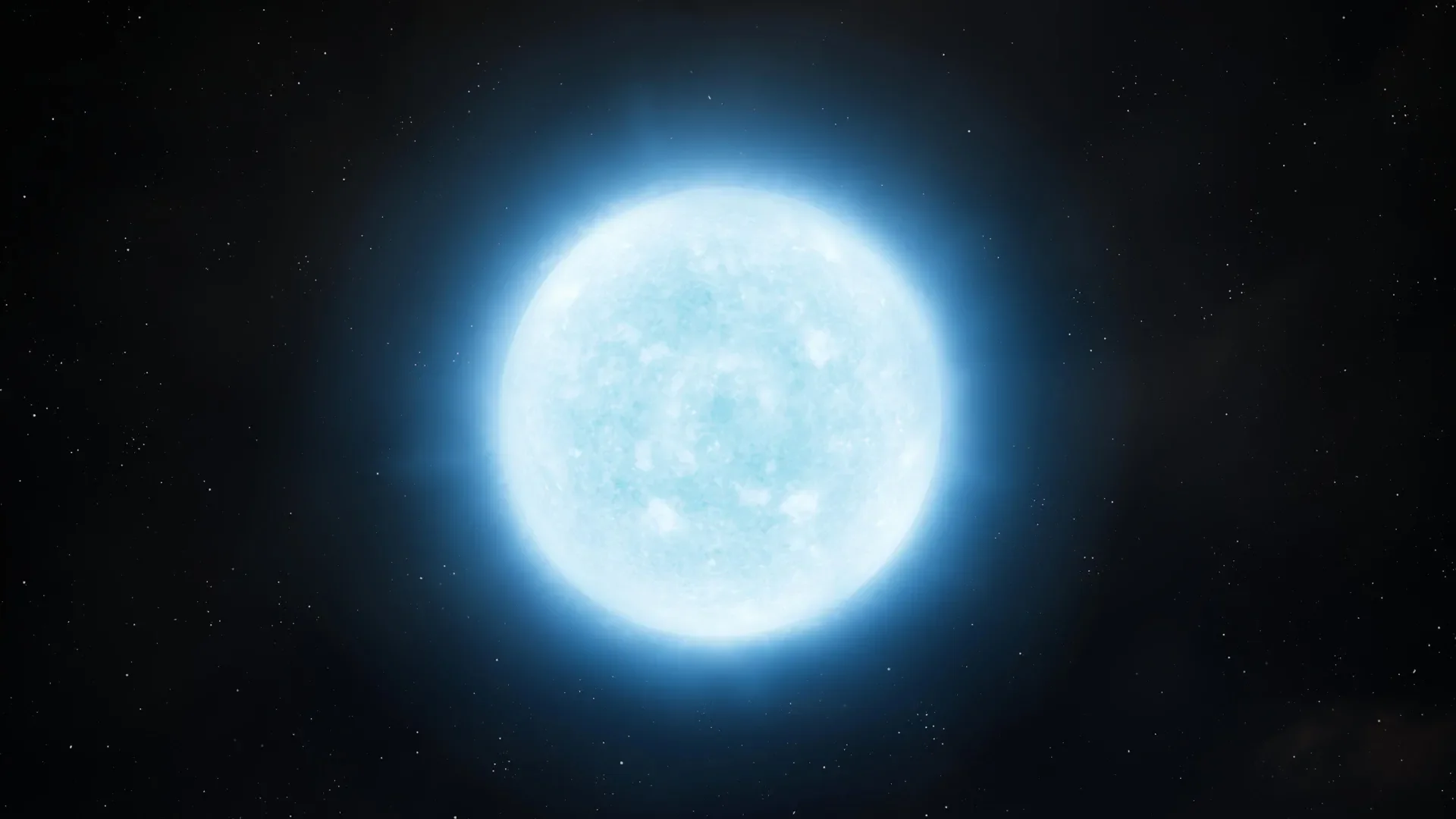
Visualization
The cosmos is continuously unveiling its secrets, and recent advancements in astrophysics threaten to upend long-standing paradigms surrounding white dwarfs—dense remnants of stars that have concluded their nuclear lifecycles. Traditionally, these stellar corpses were thought to be confined to the so-called Chandrasekhar limit, approximately 1.4 solar masses, a threshold that dictated much about their fates and the mechanics of supernovae. However, groundbreaking computer simulations from the Indian Institute of Science now indicate that some white dwarfs may not only exceed this mass boundary but could do so significantly, thanks to the influence of powerful internal magnetic fields.
The conventional understanding of white dwarfs centers around their genesis from stars that exhaust their nuclear fuel. These remnants, sized comparably to Earth, can retain the mass of the Sun or more once they shed their outer layers. As they approach the Chandrasekhar limit, any excess mass leads to an increase in core density and pressure, which can ignite a thermonuclear runaway reaction, resulting in a Type Ia supernova—one of the universe's most luminous events. Yet, the new simulations reveal a tantalizing possibility: powerful magnetic fields can help white dwarfs resist the gravitational forces that would otherwise constrain them to lower mass limits.
Professor Banibrata Mukhopadhyay and his team have developed a series of simulations that suggest magnetized white dwarfs may attain masses as high as 2.4 solar masses, thereby breaking the traditional boundaries set by the Chandrasekhar limit. This notion isn't entirely novel; theoretical discussions regarding "super-Chandrasekhar" white dwarfs have circulated among physicists for decades. Still, the astute observations of astronomers studying anomalously bright Type Ia supernovae indicate a richer tapestry of stellar evolution than previously conceptualized.
Zenia Zuraiq, a PhD candidate and lead author of the research, articulated the evolution of a white dwarf, from its early main-sequence phase where hydrogen fusion occurs, to its final state post-nuclear burning. Addressing the critical question of whether such an extraordinary evolutionary path could occur in nature prompted the team to modify STARS, a stellar evolution model initially conceived at the University of Cambridge, to incorporate magnetic field dynamics and the cooling effects in white dwarfs.
Through innovative simulations, they traced stellar evolution from main-sequence hydrogen burning to the intricate accretion processes in binary systems, where a white dwarf siphons mass from a companion star. Critical to this process was the realization that even a relatively weak magnetic field could amplify as gravitational forces compressed the star during accretion. This amplification of the magnetic field allowed the white dwarf to support an impressive accumulation of mass—challenging the traditional relationship between mass and size in these stellar remnants.
An illustrative simulation traced a carbon-oxygen white dwarf originating from a progenitor star with eight solar masses; as it absorbed material from its companion star at a minute rate of 10⁻⁹ solar masses annually, the inclusion of magnetic forces allowed the white dwarf to surpass the anticipated Chandrasekhar limit, ultimately achieving 2.4 solar masses. The implications of this finding are vast and manifold, potentially revising how we categorize white dwarfs and their end states.
In addition to the constraints imposed on their mass, the study intimates that magnetic pressure may elucidate the phenomena of white dwarfs with unexpectedly large radii for their given mass—an anomaly that has puzzled astronomers. This newfound perspective posits that magnetic fields might serve as a crucial player in defining the structure and evolution of these celestial entities.
The reverberations of this research extend well beyond the confines of white dwarf evolution. Type Ia supernovae are pivotal as "standardizable candles," providing essential data for measuring cosmic distances, and thereby informing our comprehension of the universe's expansion history. However, the prospect of some white dwarfs attaining vastly different masses and internal magnetic configurations before their catastrophic disintegration could mean that the brightness and energy output of these supernovae may not conform to the established norms upheld by the traditional Chandrasekhar framework.
Where the conventional schema suggested predictability in Type Ia explosions, the emergence of super-Chandrasekhar white dwarfs necessitates a reevaluation of their properties and luminosity characteristics. As astrophysical instruments scrutinize these dying stars with unprecedented precision, the potential to unravel the complex interplay of mass, magnetic fields, and stellar dynamics is poised to enhance our exploration of the universe—one stellar remnant at a time. Indeed, the implications of these findings could not only reshape our understanding of supernovae but also illuminate the nuances of cosmic structure itself, nudging astrophysics closer to a more profound comprehension of the forces that govern our universe.