Field: Technology
Crystal Prisms in the Deep: The Optical Mastery of Bioluminescent Bristlemouths
Published | Technical Staff
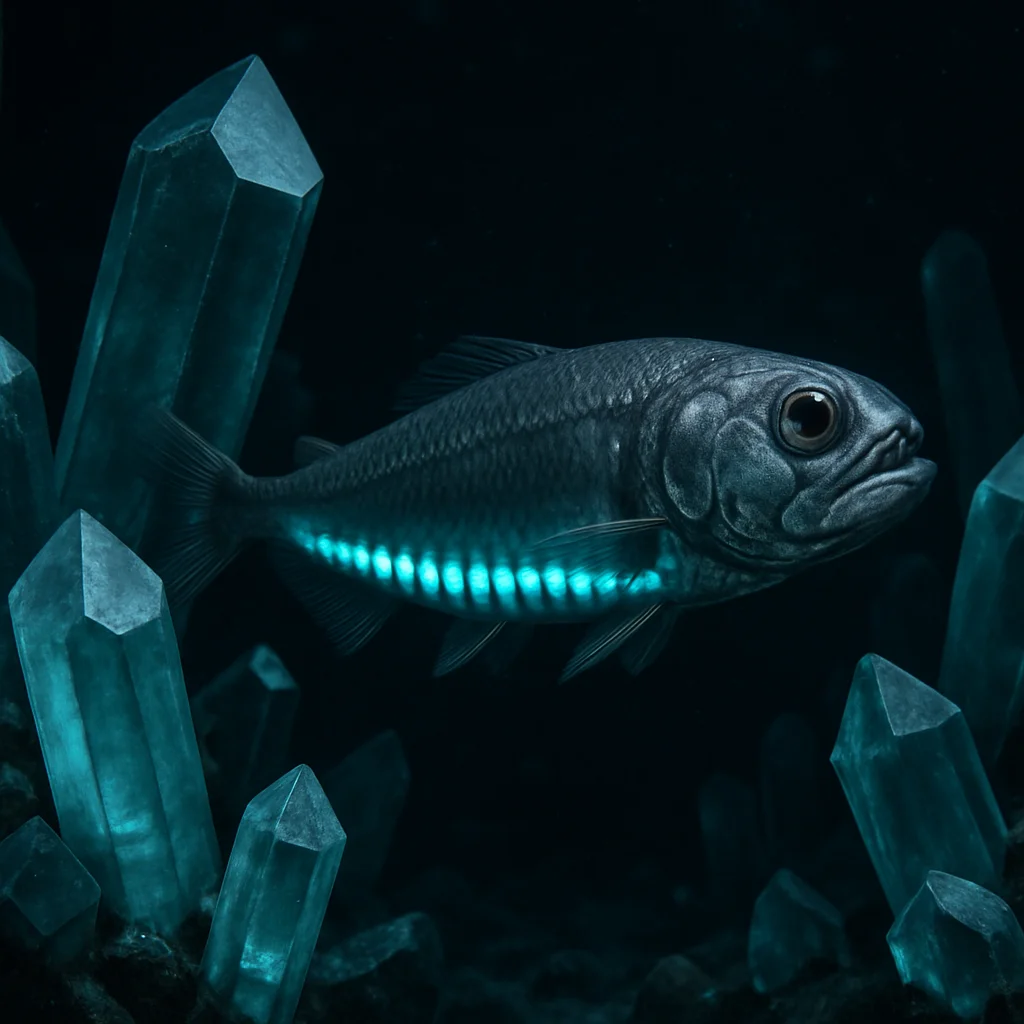
Visualization
In the abyssal expanses of the world's oceans, where sunlight never penetrates, life orchestrates an otherworldly ballet of illumination. Among the 75% of marine denizens that wield bioluminescence as both weapon and lure, few exhibit as sophisticated an optical architecture as the deep-sea bristlemouth, *Sigmops gracilis*. This diminutive fish, long a staple of trawl nets and taxonomies, has recently revealed a strikingly advanced mode of light manipulation—one which may redefine not only our conception of animal photophores, but the future of biomedical and photonic devices.
Marine biologist Masakazu Iwasaka of Hiroshima University has reported a paradigm shift in our understanding of bioluminescent organ function. The photophores of *S. gracilis*—the tiny, ventrally arrayed organs responsible for its nocturnal flares—are enveloped by previously underappreciated structures: needle-shaped guanine crystals. These crystals, as revealed through field observations and bespoke electromagnetically controlled orientation experiments, demonstrate an ability not only to reflect but to scatter and refract light keener than the mere mirrors of analogy would suggest.
Whereas initial studies in goldfish (*Carassius auratus*) photophores characterized guanine platelets as microreflectors, imparting anisotropic (direction-dependent) reflectivity due to their inclined orientations, the higher aspect ratio guanine platelets in *S. gracilis* adopt a distinctly prismatic function. Anisotropy here is accentuated: the reflection of incident light is not simply directionally variable, but can be redirected through complex scattering pathways. Optical physics provides the backdrop: the guanine crystals' geometry—elongate, needle-like, and layered—mimics the periodic dielectric structures of engineered photonic crystals, manipulating the propagation of light via Bragg scattering and refractive interfacial phenomena.
Empirically, Iwasaka and his team employed controlled electromagnetic fields to align the guanine crystals in situ and subjected them to calibrated external illumination. By varying the angle θ of incident light relative to the normal of the platelet surfaces, the resultant scatter patterns were mapped using photodetectors arranged around the photophore microenvironment. The observed intensity, I(θ), departed significantly from the specular reflection predicted by simple Fresnel equations: rather, pronounced lateral and oblique scattering suggested that the platelets act as micrometer-scale prisms, recycling photons through internal reflection and transmission. This has the effect of maximizing the retention and redirection of bioluminescent output—a critical adaptation for survival in the predator-rich, light-starved pelagic zones.
The implications of these findings extend far beyond marine biology. The functional mimicry of such naturally evolved photonic crystals could inform the development of next-generation light management strategies in biomedical implants, where efficiency and photon recycling are at a premium, and in miniaturized optical devices requiring robust performance in fluidic environments. The efficiency with which *S. gracilis* localizes, amplifies, and reuses lost photons may inform architectural principles for tissue-integrated devices where biocompatibility intersects with photon economy.
Dr. Iwasaka's field-forward, biomimetically inspired approach underscores the importance of in situ studies over purely laboratory models, particularly for phenomena at the interface of biological function and physical optics. As his research notes, "Investigating guanine in various fish species will lead to a treasure trove of biomimetics knowledge." Such untapped marine architectures, glimpsed between the glint of trawl nets and shipborne microscopes, may yet illuminate more than the deep: they may light the path toward tomorrow's technological paradigms.
The research, detailed in the journal *Biointerphases* (Iwasaka et al., 2026, Biointerphases 21, 031003; doi: 10.1116/6.0005382), signals a new chapter in the convergence of marine biology, physics, and technological innovation—one written in the language of crystal and light, in the unfathomable dark.