Field: Technology
Cosmic Fossils: Pre-Big Bang Black Holes and the Bouncing Universe
Published | Technical Staff
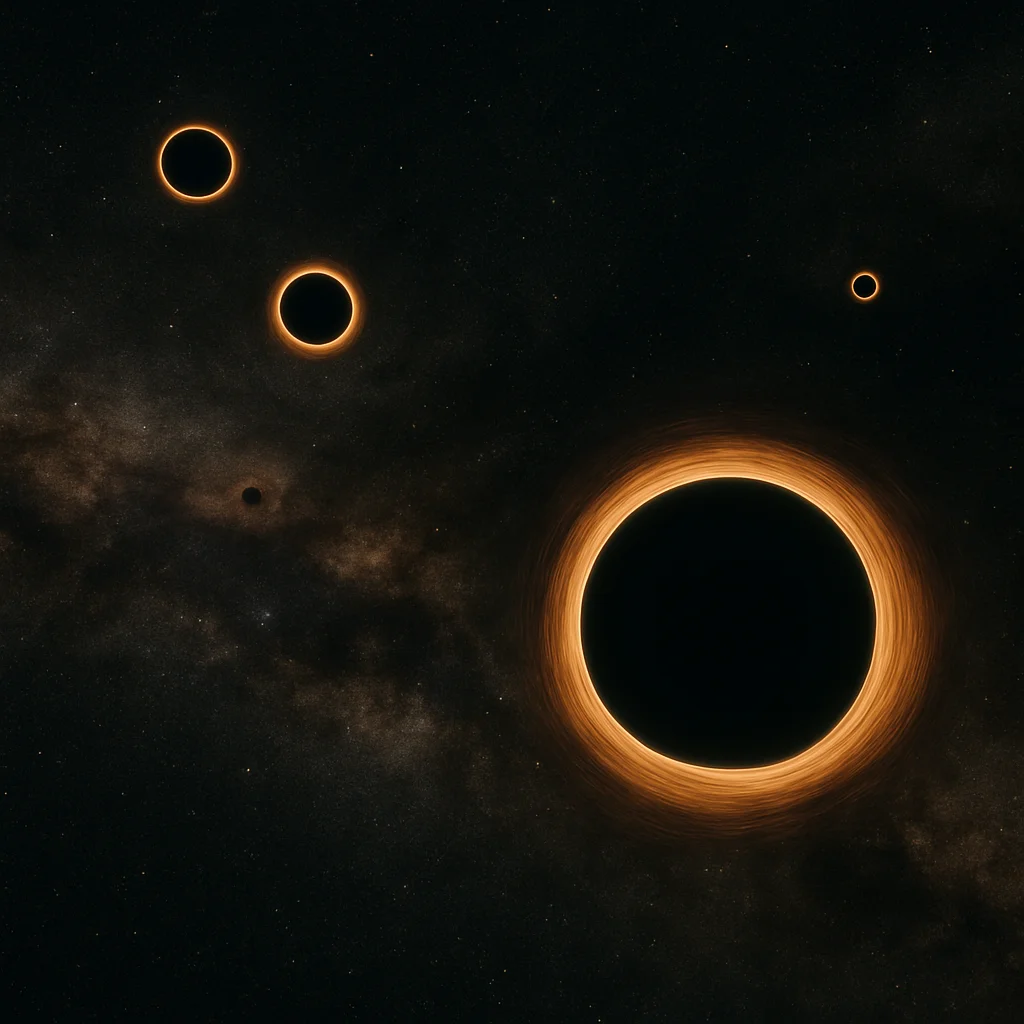
Visualization
For nearly a century, cosmology has orbited around the paradigm of the singular Big Bang—a searing instant when the Universe apparently erupted from an incomprehensibly dense, hot point roughly 13.8 billion years ago, setting into motion a now-familiar script of rapid inflation, cooling, and the gradual assembly of galaxies. The standard cosmological framework based on Einstein’s general relativity, especially in concert with inflationary theory, has not only illuminated the uniform afterglow of the Cosmic Microwave Background (CMB) but also accurately traced the distribution of galaxies across billions of light years. Yet, beneath these triumphs lurk persistent enigmas: What catalyzed the Bang itself? Why was the primordial Universe so finely tuned? What precisely is the nature of dark matter and dark energy, which together outweigh visible matter by more than a factor of five?
A sharply original perspective, advanced by Professor Enrique Gaztañaga of the University of Portsmouth and the Institute of Space Sciences in Barcelona and recently detailed in *Physical Review D* (“Cosmological bounce relics: Black holes, gravitational waves, and dark matter,” 2026), proposes a radical revision to the cosmological timeline. Instead of a singular origin at infinite density—a classical singularity where general relativity breaks down—the nascent Universe may have emerged from a phase of contraction that arrested at an ultra-high but finite density, then rebounded in a “cosmic bounce.” Crucially, in this scenario, some structures extant prior to the bounce, including black holes, could have survived as fossil relics persisting into our expanding cosmos.
The theory rests on the growing willingness among theorists to reject physical singularities as indicators of incomplete physics—similar to how singularities in the equations for stellar collapse are now understood as markers where quantum effects must intervene. Classical general relativity prescribes that the Big Bang—and, for that matter, black holes—contain points of infinite curvature and energy density, denoted by the Ricci scalar \( R \to \infty \). But quantum theories introduce a pressure at extreme densities, related to the Pauli exclusion principle in degenerate matter, which for white dwarfs and neutron stars manifests as electron and neutron degeneracy pressure. At cosmological scales, a similar quantum “bounce” could occur as the Universe’s collapse is arrested not by exotic new physics but by the repulsive consequences of known quantum effects, permitting a rebound at sub-Planckian densities.
Within this framework, the Universe emerges not ex nihilo but cyclically, with the bounce phase mimicking the inflationary expansion observed in the standard model but without invoking an initial singularity or hypothetical inflaton fields. As the pre-bounce Universe contracts, density inhomogeneities—primordial quantum fluctuations—could be amplified, seeding matter and energy clumping at scales far exceeding those possible in classical inflation. These overdense regions, mathematically modeled as peaks in the primordial density perturbation spectrum \( \delta(\vec{x}) = \frac{\rho(\vec{x}) - \bar{\rho}}{\bar{\rho}} \), may cross the collapse threshold for black hole formation (\( \delta_c \sim 0.45 \) for radiation-dominated eras), collapsing gravitationally even before expansion resumes.
A remarkable prediction arises: Black holes and other compact objects larger than a critical scale—estimated at approximately 90 meters in radial extent—could endure the high-curvature transition of the bounce, re-materializing as cosmic fossils in the immediate post-bounce Universe. Instead of being entirely destroyed or deformed during the bounce, these objects survive due to their compactness and the finite, rather than infinite, nature of the bounce transition.
These primordial black holes (PBHs), relics from a Universe that predates the Big Bang, would drift silently through cosmic history. Their cumulative mass and gravitational influence could naturally explain the “missing mass” problem—the dark matter inferred from galaxy rotation curves, cluster dynamics, and CMB anisotropy power spectra. In fact, if the formation probability and initial mass function of these bounce PBHs are sufficiently high, they might comprise most or all of the Universe’s dark matter, a population of non-luminous compact objects detectable only by their gravitational signatures.
This ancestry provides a compelling narrative for other astrophysical puzzles. Recent observations by the James Webb Space Telescope (JWST) of anomalously massive, compact sources at high redshift—the so-called “little red dots”—pose acute challenges for conventional structure formation theory, which cannot easily explain the rapid growth of supermassive black hole seeds within just a few hundred million years after the Big Bang. In the bounce scenario, these black holes would not need to condense from a primordial gas after the emergence of the CMB but could instead be pre-formed relics, dominating galactic centers and accelerating the assembly of the earliest galaxies.
Moreover, the bounce framework encompasses gravitational wave relics. Asymmetric collapses and mergers during the contracting era or at the bounce itself would generate primordial gravitational waves, potentially detectable by next-generation observatories sensitive to frequencies outside the classical LIGO–Virgo–KAGRA range. Distinct signatures in the gravitational-wave energy spectrum \( \Omega_{\text{gw}}(f) \) or subtle, non-Gaussian imprints in the CMB—particularly at small angular scales—could betray the influence of pre-bounce physics.
A cosmic bounce scenario addresses two enduring cosmological mysteries with a single theoretical apparatus. First, quantum pressure–induced rebound could both mimic the isotropic, homogeneous inflation traditionally invoked to explain the CMB and set the stage for the formation of structures with the observed initial conditions. Second, the bounce alters the cosmological equation of state, providing a new context for interpreting dark energy and the currently observed accelerating expansion.
Testing these ideas will push the frontiers of observation and theory. The search for deviation from Gaussianity in the CMB, anomalous gravitational-wave backgrounds, or even “microlensing” events consistent with a preponderance of relic black holes, could supply empirical leverage. If substantiated, the picture of the Universe as an eternal cycle—reborn from collapse, with ancient black holes as its most enduring artifacts—would relegate the Big Bang singularity to a mathematical artifact and elevate cosmic bounce relics to the status of the oldest fossils in existence. While confirmation awaits, Gaztañaga's work opens a new empirical and philosophical frontier: our cosmos may not be a one-time creation, but instead haunted by deep time, its earliest structures lingering as witnesses from a shadowed epoch before creation itself.