Field: Technology
Consciousness Arises in Brainstem, Not Cortex, Neuroscientists Argue
Published | Technical Staff
Visualization
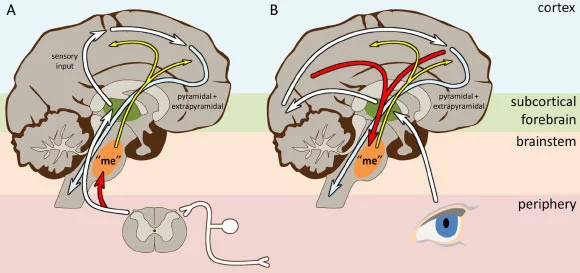
In a groundbreaking hypothesis published in *The Neuroscientist*, a cadre of neuroscientists led by Dr. Marshall Devor from the Hebrew University of Jerusalem is challenging long-held beliefs about the nature of consciousness, positing that the brainstem plays a pivotal role in the emergence of the self, or the "me inside." This theory asserts that raw consciousness, often known as phenomenal or core consciousness—the essence of subjective experience—stems from complex computations conducted within the neural circuitry of the brainstem rather than the cerebral cortex that encapsulates much of human cognitive function.
Central to this argument is the distinction between the experience of consciousness and its underlying mechanisms. Contrary to conventional wisdom that situates self-awareness within the cortical realms, Devor and his colleagues articulate a model where the cortex serves primarily as a generator of experiential content, while the brainstem acts as the adjudicator of consciousness itself. "Close your eyes and cover your ears," the authors urge as an experiment in self-perception; the continuity of personal identity remains intact despite the absence of sensory input. This stark observation underscores their claim: even when sensory experiences are curtailed, a sense of self persists unwaveringly.
The researchers anchor their hypothesis in the realm of pain perception, one of the most primal experiences. Historically, the pursuit of a defined "primary pain cortex" has proven elusive, with studies revealing that of 313 tested sites in the insula—often associated with pain—only eight consistently generated painful sensations. In stark contrast, the brainstem houses ascending pain pathways capable of evoking felt pain with precision. These pathways illuminate an essential aspect of consciousness, as the evolutionary signal of pain—crucial for survival—relies on direct input from nerve fibers rather than convoluted cortical processing.
Empirical observations further bolster this theory. The data reveals that extensive cortical lesions, despite their ability to disrupt cognitive functioning, do not abolish the experience of pain; individuals with severe cortical damage continue to report sentience. In stark juxtaposition, lesions within the brainstem precipitate coma and obliterate consciousness itself, a phenomenon echoed by the effects of general anesthetics administered to mesopontine tegmentum—a diminutive but vital region approximately 3 by 4 mm in size in rats.
The brainstem's role transcends mere sensory adjudication; the authors envision it as a sophisticated computational node that makes decisions regarding which stimuli warrant conscious attention. Drawing an analogy to a self-driving vehicle, the brainstem marks salient experiences while allowing other cognitive processing to proceed in the background. This mechanistic understanding indicates that the mammalian cortex, emerging eons after the evolutionary formations of simpler organisms, did not fundamentally reconstruct consciousness but instead linked to an already functioning system in the brainstem.
The researchers emphasize that this understanding refutes the myth that superficial self-awareness emerged with the advent of complex brain architecture. "Except for pain, advanced sensory feature extraction requires the supercomputer-like capability of the mammalian cerebral cortex, available evolutionarily only eons after reptiles," they assert, implicitly recognizing the brainstem's evolutionary primacy.
In synthesis, the brainstem's unique architecture and its direct connections to pain-processing pathways arrive as critical components in the discourse on consciousness. The implications are profound: the presence of large cortical lesions may obscure specific aspects of conscious experience, yet none can erase the unyielding core of sentience itself. This narrative invites a reevaluation of the essence of human consciousness, offering an illuminating perspective that dissects the complex interplay between neural circuits, sensory experiences, and the overarching sense of self. As neuroscience grapples with the profound questions surrounding consciousness, the insights presented through this brainstem theory could bear potential ramifications for our understanding of the human condition itself, reorienting the focus from mere cognition to the depths of raw, subjective experience.