Field: Technology
Comets may have destroyed life's ingredients instead of delivering them to Earth
Published | Technical Staff
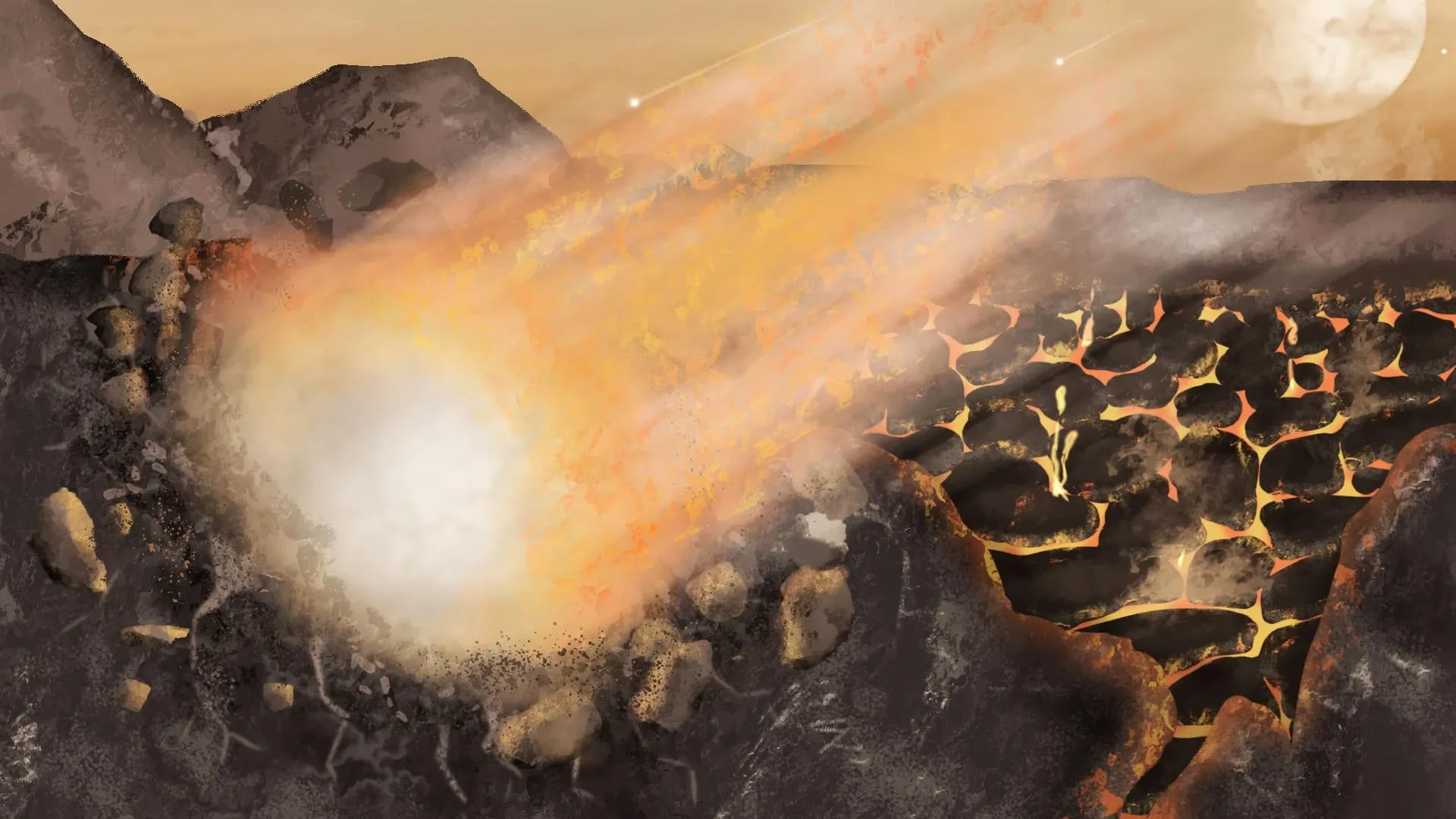
Visualization
For nearly a century, the scientific discourse surrounding the origins of life has been imbued with a romantic notion — the idea that comets, those icy harbingers from the outer reaches of our Solar System, were not mere spectators but active participants in the cosmic ballet that seeded life on Earth. However, recent research spearheaded by a team at the University of Cambridge has cast significant doubt on this paradigm, suggesting that comets were more likely to obliterate life's building blocks than deliver them intact.
Central to this investigation is the role of prebiotic molecules, essential compounds such as hydrogen cyanide (HCN), known for their capacity to engage in complex chemical reactions advancing towards the formation of living organisms. It had long been presumed that comets, laden with these crucial ingredients, collided with a young Earth, providing the necessary raw materials. Yet, advanced computer simulations conducted by Dr. Richard Anslow and his team reveal a more sobering reality. The velocities at which comets traverse the cosmos, typically between 20 to 100 kilometers per second, combined with their impact angles, render the survival of fragile organic molecules highly improbable upon striking Earth.
Using sophisticated modeling techniques, the research team subjected comets to simulated impacts, interactions with planetary atmospheres, and analyzed the evolution of cometary populations as the Solar System formed. The revelations were stark. While certain angles and conditions might hypothetically permit an organic cargo's survival, in practice, those scenarios were exceedingly rare. Statistically, the successful delivery of life's building blocks via comet impact was relegated to near-impossibility, suggesting that, although the potential for organic compounds to arrive was not entirely eliminated, it remained highly improbable.
Dr. Anslow's group notably focused on hydrogen cyanide. Despite its notoriety as a toxic compound, this molecule could act as a precursor in the genesis of life through its inherent carbon and nitrogen components. Simulations indicate that even if hydrogen cyanide were to survive the impact ordeal, another significant hurdle presented itself—the molecule's concentration upon landing. The likelihood that an impact would deposit sufficient quantities in a manner conducive to meaningful chemical activity was minimal.
Adding yet another layer to the complexity, the temporal dynamics of cometary impacts must be taken into account. Commetary bombardment was markedly more frequent in Earth's formative years but tapered off dramatically within the initial 500 million years of its history. Thus, while the window for potential delivery existed, it was temporally constrained, limiting the opportunities for cometary delivery of critical molecules.
Combined, these factors suggest that the scenario necessitating a precisely timed strike at the optimal angle to deliver concentrated hydrogen cyanide—and thus foster conditions for life—would be akin to winning a cosmic lottery. "It would really have to be a one-in-a-million occurrence," Anslow states, emphasizing the improbability of all necessary conditions aligning favorably for the genesis of life through cometary contributions.
The findings yield a crucial inquiry: If comets are unlikely candidates for delivering life's biological precursors, what other sources might account for their emergence on early Earth? The researchers propose two compelling alternative scenarios. The first involves asteroids, which collided with Earth at significantly higher frequencies than comets. Such impacts may have engendered conditions ripe for chemical reactions that could spark the formation of prebiotic molecules vital for life.
The second possibility posits that Earth itself may have been a crucible for life's essential compounds, generated through natural chemical processes intrinsic to the planet's geological and environmental dynamics. This internal synthesis could have yielded the necessary ingredients without reliance on external celestial delivery.
Intriguingly, while the simulations raise serious doubts about the role of comets for the terrestrial narrative, they unearthed a surprising twist with respect to Mars. The smaller mass and far thinner atmosphere of the Red Planet might have afforded a slightly more favorable environment for receiving organic compounds from comets. Although still fraught with challenges, Mars' conditions suggest it may have had an enhanced potential for similar scenarios—an avenue ripe for further exploration.
This shift in understanding not only challenges a century-old doctrine but also reframes the narrative of life's origins within the cosmos. The implications extend beyond Earth, posing new questions about the delivery of life’s building blocks across the Solar System. While the romantic notion of comets as life’s ethereal messengers may fade, the search for the true sources of life's ingredients persists, inviting continued inquiry into our planet's earliest epochs and the cosmic forces that shaped them.