Field: Technology
Colliding Stars in Early Universe May Explain Stellar Monsters, Study Suggests
Published | Technical Staff
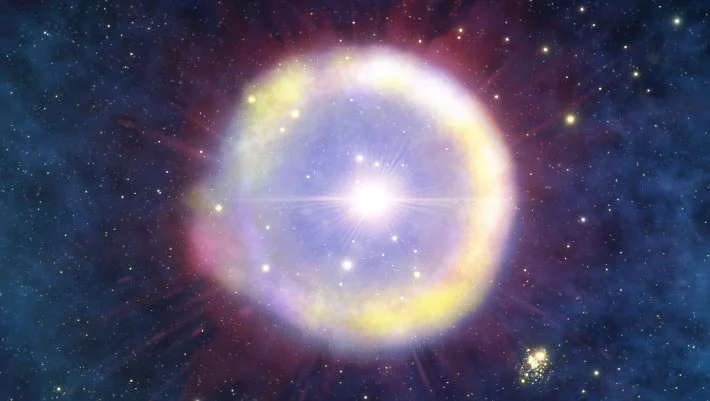
Visualization
In the grand tapestry of cosmic evolution, the interactions of celestial bodies in the early universe illuminate the birth of some of the most mysterious astronomical phenomena we observe today. A pivotal investigation led by Claire Williams, a doctoral student from the University of California, Los Angeles, presents an innovative perspective on how crowded star clusters may yield immense stellar entities—giants that could ultimately seed black holes and contribute to the enigmatic population of little red dots (LRDs) prevalent in the cosmic hinterlands.
The research team embarked on this inquiry with an artistic vision that evokes the universe merely 100 million years post-Big Bang, a time dominated by the emergence of Population III stars. These first-generation stars, forged from primordial hydrogen and helium, were pivotal in laying the foundation for subsequent galactic structures. Williams likens the multifaceted research surrounding LRDs to an allegorical encounter with an elephant: various scientists, akin to blind individuals, touch different parts of the animal, leading to disparate interpretations. Her work aims to unify these varying perspectives, revealing a more comprehensive understanding of cosmic evolution.
To develop their hypothesis, the authors constructed a radially resolved analytic model focused on stellar collisions in dense, high-redshift environments—analogous to the ancestors of globular and nuclear star clusters, the latter exemplified by the Milky Way’s central supermassive black hole. The groundwork for their simulations stemmed from advanced high-resolution cosmological simulations that delineated initial conditions rather than relying solely on observational data.
Upon synthesizing their analytical approach with Monte Carlo simulations, the team observed compelling concordance across essential astrophysical regimes. Their findings confirm that within clusters devoid of a central black hole, stellar interactions tend to be characterized by gentle mergers, rather than devastating collisions. Through the mechanisms of dynamical friction, merger products gravitate into the cluster's nucleus, where subsequent interactions facilitate the formation of what astronomers categorically identify as very massive stars—those exceeding 200 solar masses.
These findings become even more remarkable in environments where stellar density surpasses approximately 100,000 solar masses per cubic parsec. In such cases, nearly all low-mass systems assessed in the study possess the capability to evolve into extraordinarily massive stars, potentially exceeding 100,000 solar masses themselves. Williams articulates the implications of this discovery: “Perhaps the strangest outcome of our simulations is that stars can merge repeatedly within the cluster until they form one gigantic star with a mass equal to that of an entire cluster.” Such colossal entities, upon exhausting their nuclear fuel, are theorized to succumb to gravitational collapse, potentially evolving into intermediate-mass or even supermassive black holes.
The model further penetrates the intricacies of star formation by reflecting on the dynamics present in the Galactic center. When clusters undergo stellar collisions, a complex interplay occurs. On one hand, massive stars that metamorphose into intermediate-mass black holes manifest a configuration reminiscent of the Milky Way’s core: a gravitational singularity enshrined in a dense assembly of stars.
Enhancing the tapestry of this research is the comparison of their model with observations made by the James Webb Space Telescope, particularly regarding lensed star clusters at high redshift. While most of these clusters yield modestly massive stars, the most compact configurations reveal the potential for stellar masses ranging from 1,000 to 10,000 solar masses—dramatically reshaping our understanding of stellar evolution at early epochs.
The gravitational presence of an existing massive black hole shifts the dynamics of stellar collisions. Here, the gravitational forces accelerate stars in the inner regions to such high velocities that collisions result in violent disruptions, dispersing stellar material into the interstellar medium. This phenomenon allows extreme gas accumulation around black holes, creating gaseous environments with densities that meet or surpass the expected conditions for the formation of the elusive LRDs. The authors surmise, “We show that high rates of destructive collisions can rapidly build up extremely dense gaseous environments around massive black holes, potentially providing an analog to the observed population of LRDs.”
As this study, which appeared in the Astrophysical Journal, unveils the mechanisms underlying these stellar monsters and their correlations with black hole formation and cosmic structure, it deepens our understanding of the universe's earliest epochs and the processes that governed stellar evolution. These insights could redefine astronomical models and evoke further research into the intricate web of interactions that populate the cosmos.