Field: Technology
Clay Fragments from Türkiye Point to Pottery Experiments 11,000 Years Ago
Published | Technical Staff
Visualization
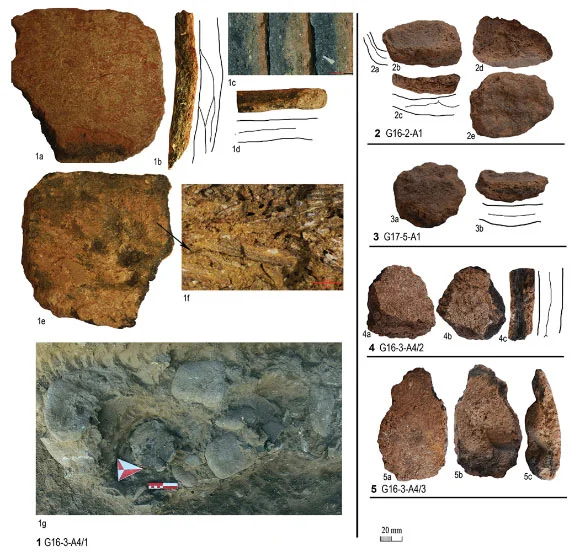
In the tranquil landscapes of Çemka Höyük, situated within the Mardin province of Türkiye, recent archaeological discoveries illuminate a pivotal moment in human history: the dawn of pottery experimentation approximately 11,000 years ago. A meticulously analyzed assemblage of 46 low-fired clay shards has emerged from this Pre-Pottery Neolithic settlement, providing tangible evidence of early endeavors to manipulate clay long before the material evolved into commonplace vessels for cooking and storage.
The study, led by Dr. Ergül Kodaş from Mardin Artuklu University, examined these fragments, revealing that they stem from at least nine distinct objects dated to around 9350 BCE. This temporal placement situates them among the earliest known fired-clay containers in Southwest Asia—a region critical to the emergence of early ceramics. Exploratory excavations of the site have uncovered these shards within the remains of oval and round dwellings partially sunken into the earth, suggesting a community deeply engaged with their environment and its resources.
To uncover the potential processes behind the creation of these artifacts, the researchers adopted a multifaceted approach, employing microscopy to scrutinize the physical structure of the fragments and X-ray diffraction techniques to elucidate their mineral composition. The analysis unveiled that the fired clay fragments had undergone irreversible changes, a signature of intentional thermal manipulation, likely reaching temperatures between 600 to 700 degrees Celsius. Such controlled exposure to heat starkly distinguishes these artifacts from the unfired clay found nearby, reinforcing the hypothesis of a deliberate pottery-making experiment rather than mere serendipitous exposure to fire.
Among the intriguing pieces, certain fragments appear to represent clay coatings meant to encase organic forms, their charred exteriors contrasting with the unburnt interiors—suggestive of a culinary application. Additionally, one unique fragment appears to have been crafted as a clay extension designed for a stone vessel, complete with perforations that may indicate its intended use alongside a lid secured by cordage. The structural integrity of some artifacts, characterized by thick walls built from layered clay infused with crushed plant matter, reveals further insight into the community's innovative use of available resources. Notably, two fragments contained microscopic spherulites of dung, hinting at potential practical applications in cooking or storage.
These artifacts not only testify to a burgeoning understanding of clay manipulation but also indicate a community engaged in a period of experimentation rather than reliance on pottery for daily subsistence. The findings suggest that, while the residents of Çemka Höyük had begun to explore the utility of fired clay, they had not yet fully integrated ceramics into their cultural practices. Dr. Kodaş and colleagues emphasize that this stage of experimentation was crucial for the development of eventually established ceramic traditions in the region, highlighting a landscape marked by regional variability and diverse pathways towards technological innovation.
Contextualizing the findings from Çemka within the broader narrative of the Pre-Pottery and early Pottery Neolithic eras in Southwest Asia allows for a more nuanced understanding of how ceramic technology emerged. The shards from Çemka can be interpreted as emblematic of a mosaic of experimental approaches, each community negotiating the functional and social dimensions of clay manipulation in their unique ways.
In summary, the study published in Antiquity offers compelling insights into the early Neolithic interactions with clay that set the foundation for the fully developed ceramic traditions emerging around the seventh millennium BCE. The research underscores the significance of Çemka Höyük as a transformative stage in human innovation—the translation of nascent constructional knowledge into the production of containers that would ultimately evolve to meet the needs and practices of increasingly complex societies. As such, these early experiments with clay at Çemka not only illuminate the material culture of the time but showcase the interpretive frameworks through which we can understand the dynamic nature of technological progress during one of humanity's most formative periods.