Field: Technology
Circadian Disharmony: How Late-Night Snacking Perturbs Liver Health
Published | Technical Staff
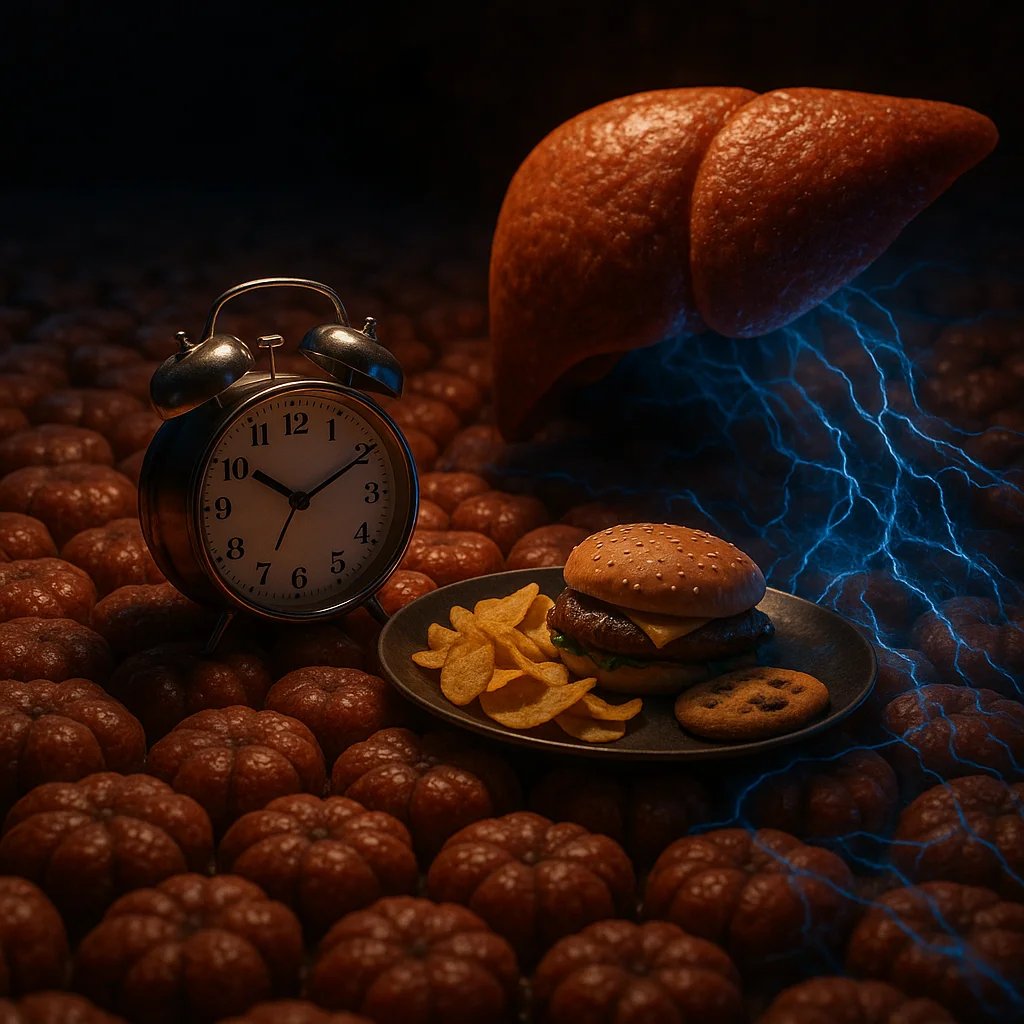
Visualization
A recent investigation led by researchers at Oregon Health & Science University and Massachusetts General Hospital identifies an unsettling link between the late-night consumption of calories and an increased risk of liver pathologies. Leveraging data from three of the most robust longitudinal cohorts in the United States—the Nurses’ Health Study, Nurses’ Health Study II, and the Health Professionals Follow-up Study—the research encompasses nearly 200,000 individuals. Through meticulous extraction and stratification of participants’ dietary logs and lifestyle self-reports, investigators correlated mealtime chronotypes with incidences of metabolic dysfunction-associated steatotic liver disease (MASLD, previously referred to as nonalcoholic fatty liver disease) and clinically diagnosed cirrhosis.
The statistical analysis reveals that individuals reporting caloric intake after conventional dinner hours, or proximal to their habitual sleep onset, encountered a relative increase in risk for liver diseases—specifically, MASLD and cirrhosis—by approximately 20% to 30%, compared to those whose energy intake was confined to daytime feeding windows. This relationship persisted after adjusting for several confounders, including caloric quantity, BMI, and self-reported physical activity levels. The outcomes suggest that meal timing may exert as significant an influence as macronutrient composition on hepatic outcomes.
Dr. Robert Wilechansky, a hepatologist involved in the study, emphasized that nearly a third of the U.S. population currently harbors evidence of fatty liver infiltration. Given this backdrop, even minor lifestyle modifications—such as abstaining from late-night snacking—could hypothetically yield substantive reductions in hepatic morbidity at the population scale. Central to the pathophysiological hypothesis is the intimate relationship between the liver’s metabolic processes and the body's intrinsic circadian rhythm, a stratagem governed by synchronized oscillations of clock genes and hormonal mediators such as melatonin and cortisol. The suprachiasmatic nucleus orchestrates systemic metabolic readiness to align with day-active periods; when this alignment is disrupted by feeding out of phase, hepatic metabolic efficiency—a function that can be quantitatively assessed by respiratory quotient (RQ) and glucose tolerance testing—declines.
From a mechanistic standpoint, late-night eating may provoke a cascade of maladaptations, including impaired insulin signaling, increased de novo lipogenesis, and altered lipid partitioning within hepatocytes. These changes foster the development of hepatic steatosis, as endogenous metabolic machinery resists nocturnal nutrient influx. Previous studies have quantified nocturnally-induced declines in hepatic insulin sensitivity—an effect that may be further compounded in shift workers or individuals with misaligned sleep patterns. “We are consistently observing that temporal alignment of behaviors such as eating, sleeping, and activity amplifies metabolic health,” observed Dr. Andrew McHill, a specialist in circadian physiology. “Our earlier work demonstrated that food intake during the endogenous biological night reduces glucose tolerance and lipid oxidation, thereby elevating risk trajectories for chronic metabolic diseases.”
While the current analysis establishes an associative, rather than causative, relationship—owing to its reliance on self-reported data and the potential influence of unmeasured confounding variables—it nonetheless reinforces the importance of synchronizing dietary patterns with endogenous circadian rhythms. This is especially relevant given contemporary epidemiological trends: over the past decade, MASLD prevalence has ballooned to affect an estimated 30% of U.S. adults, mirroring the rise in erratic meal timing associated with modern work schedules and late-shift labor.
The emerging consensus, then, points to chrononutrition—strategically timing nutrient intake to harmonize with circadian biology—as a crucial, yet often neglected, lever in liver health management. As research into the molecular underpinnings of circadian regulation accelerates, future clinical guidelines may well incorporate the clock as a pivotal determinant of dietary risk, alongside caloric density and nutritional composition. For now, however, the evidence mounts: when it comes to eating, not only what or how much, but precisely when, matters profoundly for the liver’s longevity.