Field: Technology
CERN’s LHCb Collaboration Closes the Doubly Charmed Baryon Puzzle with Discovery of Ω_cc⁺
Published | Technical Staff
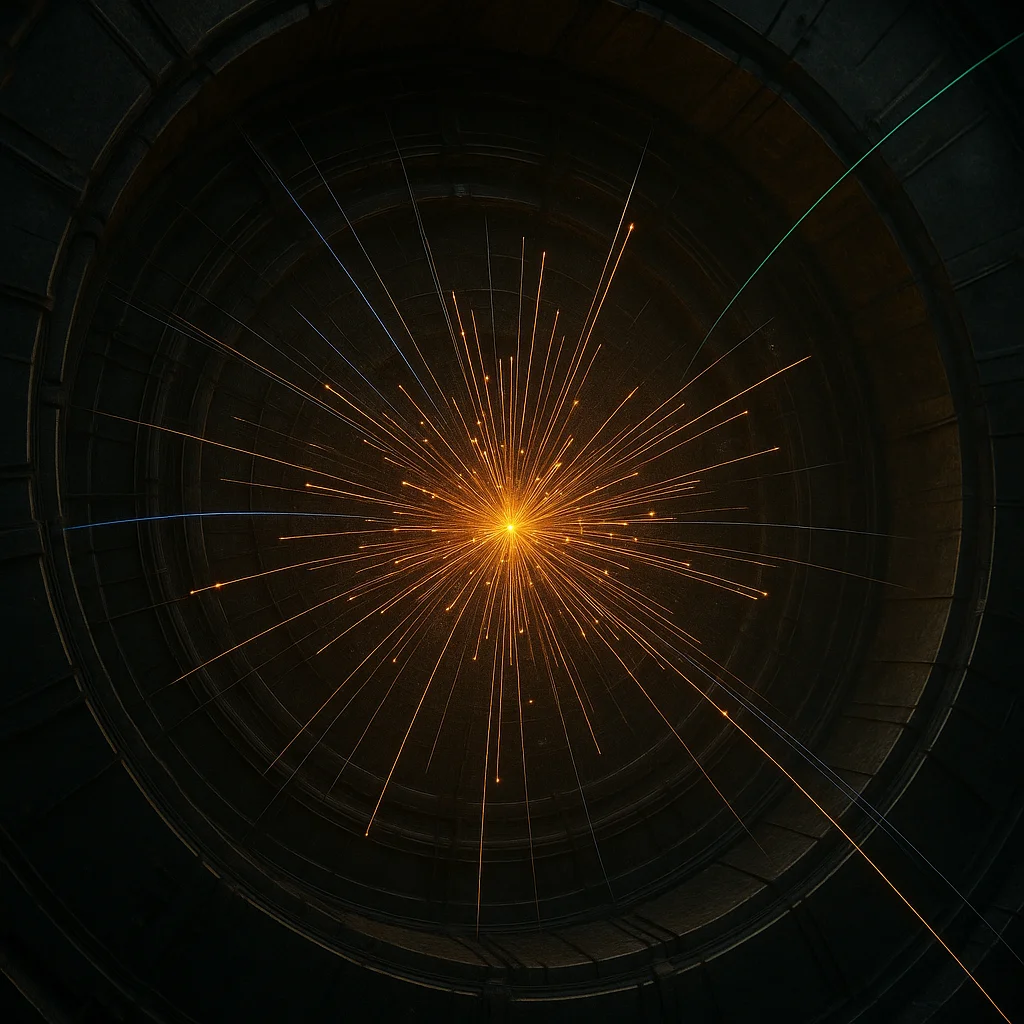
Visualization
After decades of anticipation and incremental progress, the final elusive member of the doubly charmed baryon family—the Ω_cc⁺—has at last emerged in the high-luminosity proton-proton collisions at CERN’s Large Hadron Collider. The LHCb experiment, renowned for its precision in flavor physics, has culminated a journey that began with theoretical musings in the 1960s, through successive experimental and technological revolutions, to the contemporary revelation of composite matter at the most fundamental scale.
Quarks, nature’s sixfold orchestrators—up (u), down (d), charm (c), strange (s), top (t), and bottom (b)—assemble via the strong interaction into mesons (quark-antiquark pairs) and baryons (three-quark triplets). Amongst the possible baryonic configurations, those containing two charm quarks and a lighter quark piqued theorists’ attention as far back as the 1970s, shortly after the experimental unveiling of the charm quark itself. The existence of three doubly charmed baryons—Ξ_cc⁺ (ccu), Ξ_cc⁺⁺ (ccd), and the Ω_cc⁺ (ccs)—was considered an axiom of the emergent quark model. Yet experimental confirmation confronted formidable challenges: such baryons are exceedingly rare, ephemeral, and shrouded by abundant hadronic background.
The pursuit of the doubly charmed baryons is ultimately a quest to scrutinize the strong force—Quantum Chromodynamics (QCD)—in the presence of pronounced mass hierarchies among constituents. The Ω_cc⁺, with its two charm quarks (m_c ≈ 1.27 GeV/c²) and one strange quark (m_s ≈ 0.1 GeV/c²), is anticipated to have a rest mass near 3.7 GeV/c²—more than quadruple that of the proton. According to the QCD-inspired heavy quark effective theory (HQET), such mass disparities create an opportunity to probe how the binding energy and color field reorganize in exotic hadronic states.
Experimental realization required the formidable energies and luminosity of the LHC. In these collisions, high-energy partons can fleetingly coalesce into massive, unconventional baryons, which decay via the weak interaction. The signature decay chain of Ω_cc⁺, with a flight length of several hundred micrometers, creates measurable tracks in the upgraded LHCb detector. Innovations in vertexing and tracking, combined with real-time data selection algorithms, enabled physicists to distinguish the short-lived parent particle from a welter of standard hadronic matter.
The detective work began with identification of decay daughter particles and the reconstruction of the parent’s invariant mass. Through a combination of precision silicon vertexing and particle identification subsystems, the LHCb team assembled events compatible with the sequential weak decay of Ω_cc⁺ (ccs → Λ_c⁺ K⁻ π⁺, among possible channels). By tracing trajectories through millimeter-scale decay vertices and calculating the invariant mass, researchers extracted a sharp, statistically significant peak at around 3.7 GeV/c² in the mass distribution—distinct from known backgrounds and matching the predicted mass window for the Ω_cc⁺.
This new baryon’s existence fulfills a theoretical expectation that has persisted since the dawn of the quark model, echoing the historical pattern established when theorists predicted, and experimenters confirmed, the Omega-minus (Ω⁻) baryon (sss) in 1964. That prior achievement served as an early triumph of symmetry-based classification and set the standard for rigorous prediction and discovery in particle physics.
Dr. Paula Collins, incoming LHCb deputy spokesperson, contextualized the achievement with appropriate gravity: “Out of the 85 composite particles discovered so far at the LHC, these three doubly charmed baryons are unique.” Unlike garden-variety baryons, the doubly charmed states decay solely by the weak force (τ ~ 10⁻¹³ s), granting them the rare experimental advantage of resolvable decay lengths even amid the furnace of high-energy collisions.
The Ω_cc⁺ is not just an experimental trophy. Its study, alongside its isodoublet partners Ξ_cc⁺ and Ξ_cc⁺⁺, offers a window into the mechanisms of color confinement, diquark correlations, and the emergence of hadronic mass. The peculiar interplay of heavy and light quarks within these baryons demands a degree of QCD calculation hitherto reserved for computational lattice simulations and sophisticated perturbative expansions. With the triplet now complete, experimentalists and theorists alike are poised to refine models for heavy quark dynamics and perhaps glimpse physics beyond the Standard Model.
This historical moment is a testament both to CERN’s technical prowess and to the predictive power of the Standard Model. It also underscores the LHCb experiment’s continued ability to illuminate some of the Standard Model’s most subtle corners—a tradition dating back to the earliest quark discoveries which, sixty years on, still shape our evolving picture of matter’s most intimate architecture.