Field: Technology
CERN’s Beauty Meson Deep Dive: Probing the Imbalance Between Matter and Antimatter
Published | Technical Staff
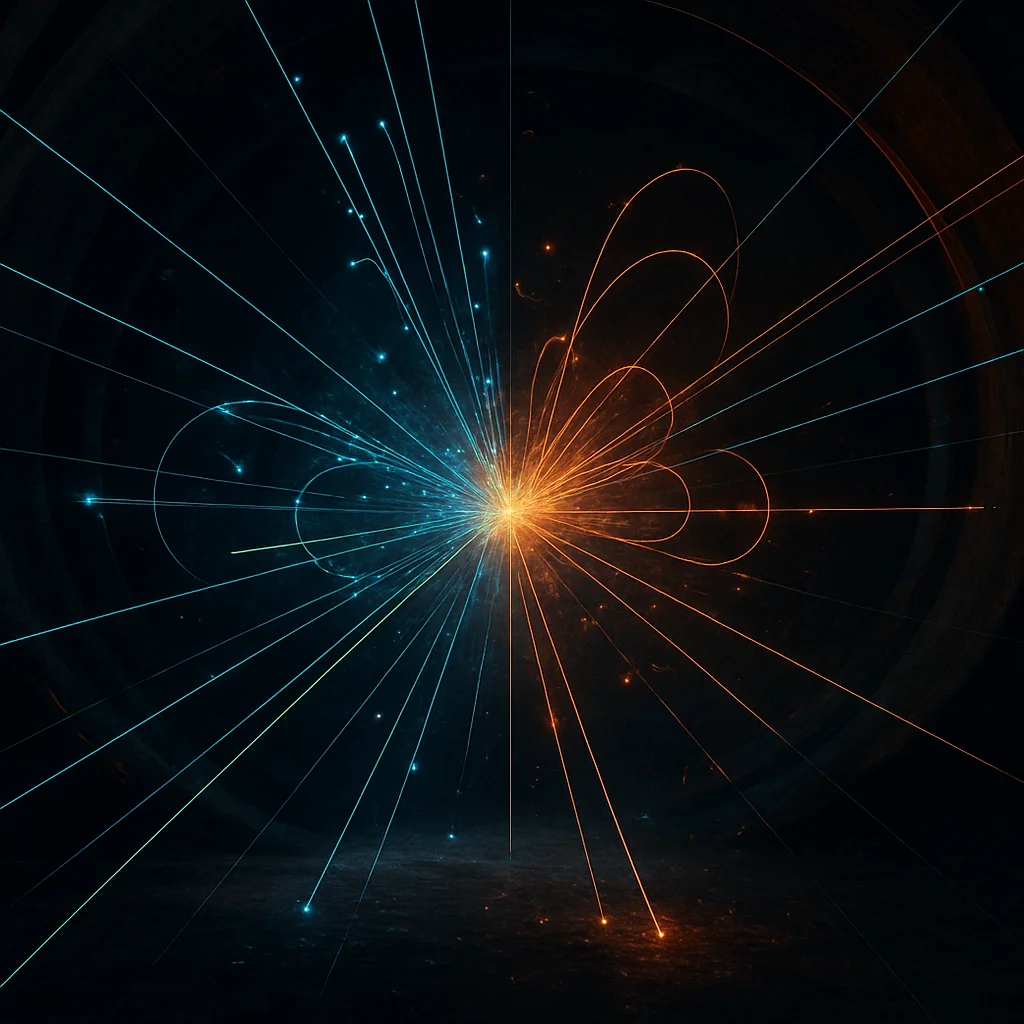
Visualization
Among the most profound enigmas in contemporary physics is the apparent triumph of matter over antimatter in our universe. This asymmetry—responsible for the very existence of stars, planets, and ourselves—stands in sharp contradiction to the expectation that the Big Bang should have yielded equal quantities of matter and its elusive counterpart. While the Standard Model anticipates only a slight excess of matter, the near-absence of primordial antimatter in the cosmos is a riddle that continues to propel experimental inquiry at the highest energies.
A pivotal chapter in this ongoing narrative unfolds with the recent analysis conducted by the CMS Collaboration at CERN’s Large Hadron Collider. Leveraging the largest-ever dataset of neutral beauty mesons (B^0 and B_s^0), researchers have refined their probe into the phenomenon of charge-parity (CP) violation—a minuscule but critical discrepancy in the physical laws governing matter and antimatter. Such violations are essential ingredients in any theoretical framework that endeavors to explain the observed matter dominance.
The experiment focused on neutral beauty mesons, composite particles formed by the binding of a down-type quark with a beauty antiquark (for B^0) or a strange quark with a beauty antiquark (for B_s^0). These mesons are quintessential laboratories for CP violation studies by virtue of their quantum-mechanical property of oscillation: they can spontaneously transmute into their own antiparticles (and vice versa) before decaying. This process, often described through flavor oscillation formalism, is governed by the weak interaction and characterized by minute differences in the decay profiles of matter and antimatter variants over time.
Between 2022 and 2025, the CMS detector amassed collision data sufficient to reconstruct approximately 1.4 million B^0 meson decays and 16,000 B_s^0 meson decays. The analysis centered on the decay channels B^0(s) → J/ψ K_S^0, where the final state consists of a J/ψ meson and a short-lived neutral kaon. The time-dependent rate of these decays, as a function of the proper decay time t, encodes information on the CP-violating phase. Mathematically, for a given meson, the time-dependent asymmetry is described by
A_CP(t) = [Γ(B^0 → f_CP, t) − Γ(\overline{B^0} → f_CP, t)] / [Γ(B^0 → f_CP, t) + Γ(\overline{B^0} → f_CP, t)],
where Γ denotes the decay rate and f_CP is the CP eigenstate J/ψ K_S^0.
A central methodological challenge lies in identifying the flavor (matter or antimatter) of the meson at the moment of production, prior to its oscillation and subsequent decay. Any misidentification would dilute the observed asymmetry and compromise the measurement’s precision. To address this, the CMS physicists deployed an advanced algorithmic approach rooted in artificial intelligence. The system synthesized a vast array of observables—including momentum and trajectory data from detected muons and electrons, the topology of associated jets, and, in the case of B_s^0, correlations with neighboring particles that emerged from the same collision event. By optimizing the classification fidelity, this AI-driven framework substantially enhanced flavor tagging power compared to predecessor experiments.
The outcome of this sophisticated multi-year campaign is the most precise measurement yet of time-dependent CP violation in B_s^0 → J/ψ K_S^0 decays. The results are consistent with the Standard Model’s predictions, indicating that if new physics contributes to the cosmic matter-antimatter imbalance, it continues to evade detection at current sensitivity levels. Nevertheless, each incremental gain in precision narrows the space in which such phenomena might hide. As the LHC continues to deliver unprecedented datasets, and as machine learning methods further evolve, the collaborative pursuit of the CP puzzle remains one of the most compelling quests at the heart of high-energy physics.
A pivotal chapter in this ongoing narrative unfolds with the recent analysis conducted by the CMS Collaboration at CERN’s Large Hadron Collider. Leveraging the largest-ever dataset of neutral beauty mesons (B^0 and B_s^0), researchers have refined their probe into the phenomenon of charge-parity (CP) violation—a minuscule but critical discrepancy in the physical laws governing matter and antimatter. Such violations are essential ingredients in any theoretical framework that endeavors to explain the observed matter dominance.
The experiment focused on neutral beauty mesons, composite particles formed by the binding of a down-type quark with a beauty antiquark (for B^0) or a strange quark with a beauty antiquark (for B_s^0). These mesons are quintessential laboratories for CP violation studies by virtue of their quantum-mechanical property of oscillation: they can spontaneously transmute into their own antiparticles (and vice versa) before decaying. This process, often described through flavor oscillation formalism, is governed by the weak interaction and characterized by minute differences in the decay profiles of matter and antimatter variants over time.
Between 2022 and 2025, the CMS detector amassed collision data sufficient to reconstruct approximately 1.4 million B^0 meson decays and 16,000 B_s^0 meson decays. The analysis centered on the decay channels B^0(s) → J/ψ K_S^0, where the final state consists of a J/ψ meson and a short-lived neutral kaon. The time-dependent rate of these decays, as a function of the proper decay time t, encodes information on the CP-violating phase. Mathematically, for a given meson, the time-dependent asymmetry is described by
A_CP(t) = [Γ(B^0 → f_CP, t) − Γ(\overline{B^0} → f_CP, t)] / [Γ(B^0 → f_CP, t) + Γ(\overline{B^0} → f_CP, t)],
where Γ denotes the decay rate and f_CP is the CP eigenstate J/ψ K_S^0.
A central methodological challenge lies in identifying the flavor (matter or antimatter) of the meson at the moment of production, prior to its oscillation and subsequent decay. Any misidentification would dilute the observed asymmetry and compromise the measurement’s precision. To address this, the CMS physicists deployed an advanced algorithmic approach rooted in artificial intelligence. The system synthesized a vast array of observables—including momentum and trajectory data from detected muons and electrons, the topology of associated jets, and, in the case of B_s^0, correlations with neighboring particles that emerged from the same collision event. By optimizing the classification fidelity, this AI-driven framework substantially enhanced flavor tagging power compared to predecessor experiments.
The outcome of this sophisticated multi-year campaign is the most precise measurement yet of time-dependent CP violation in B_s^0 → J/ψ K_S^0 decays. The results are consistent with the Standard Model’s predictions, indicating that if new physics contributes to the cosmic matter-antimatter imbalance, it continues to evade detection at current sensitivity levels. Nevertheless, each incremental gain in precision narrows the space in which such phenomena might hide. As the LHC continues to deliver unprecedented datasets, and as machine learning methods further evolve, the collaborative pursuit of the CP puzzle remains one of the most compelling quests at the heart of high-energy physics.