Field: Technology
CERN Teams Edge Closer to Observing Higgs Boson Self-Interaction
Published | Technical Staff
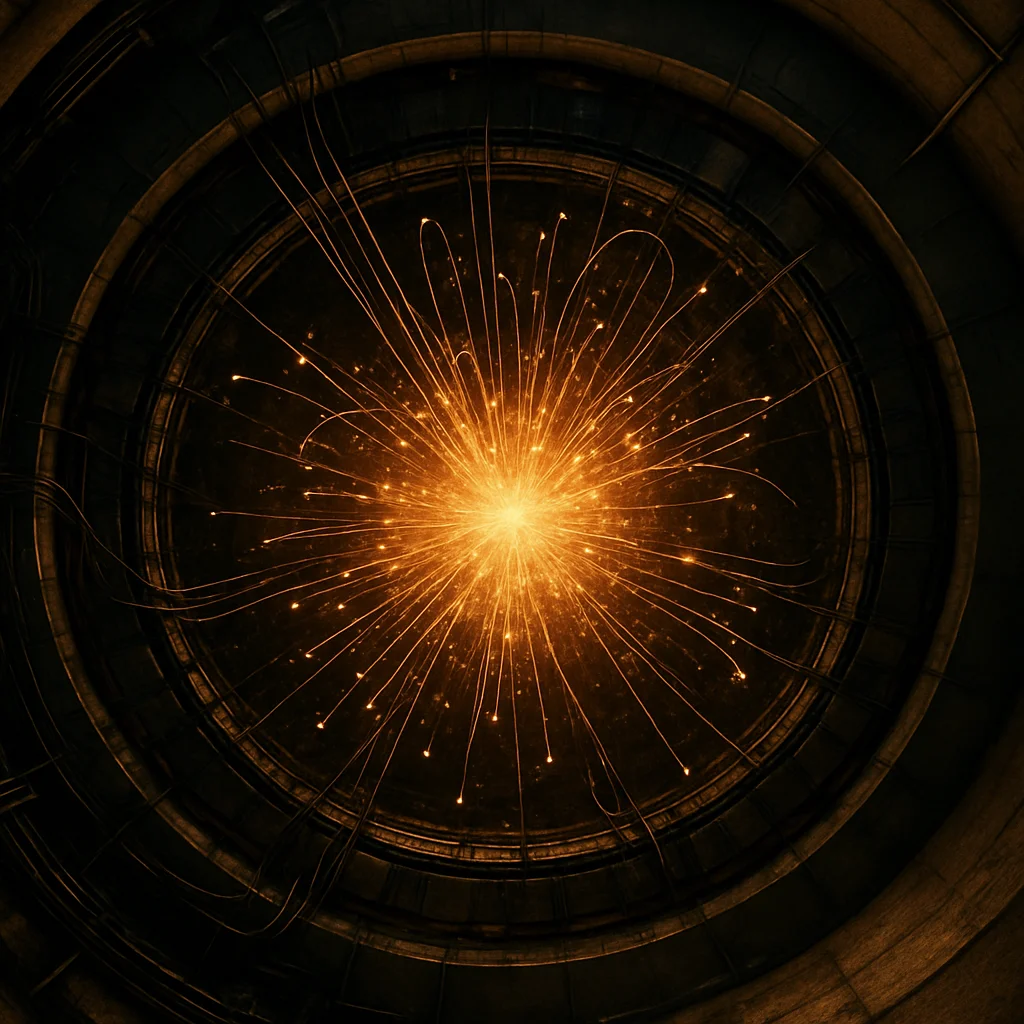
Visualization
At the high-energy frontier of modern physics, CERN’s immense Large Hadron Collider (LHC) continues to probe the bedrock of our understanding of the universe, offering increasingly precise tests of the Standard Model and searching for new phenomena. Among the most elusive processes predicted by current theory is the direct self-interaction of the Higgs boson—a subtle quantum process with profound implications for fundamental physics and cosmology.
Since the Higgs boson's discovery at the LHC in 2012, both the ATLAS and CMS collaborations have worked tirelessly to characterize its properties and interactions. The Higgs field bestows mass upon elementary particles, but a cornerstone prediction of the Standard Model is the Higgs boson’s capacity to interact with itself through a "self-coupling" term in its potential, usually written as \( V(\phi) = \lambda (|\phi|^2 - v^2/2)^2 \), where \(\lambda\) governs the Higgs self-interaction strength and \(v\) is the vacuum expectation value. Experimentally verifying this non-linear term requires observation of double-Higgs (HH) production—processes where two Higgs bosons are simultaneously created in a single high-energy proton-proton collision.
Yet, the probability for this phenomenon is vanishingly low. Standard Model calculations predict an HH production cross-section (\(\sigma_{HH}\)) of only about 32 femtobarns (fb) at \(\sqrt{s} = 13\,\mathrm{TeV}\), compared to roughly 44 picobarns (pb) for single Higgs. That implies that for every 1,500 Higgs bosons produced, only a single Higgs-pair event is expected—even before accounting for detection inefficiencies and the challenge of distinguishing such rare events from overwhelming backgrounds.
To maximize sensitivity, ATLAS and CMS have focused on the \( b\bar{b}\tau^+\tau^- \) decay channel: one Higgs decays to a pair of bottom quarks (\(b\bar{b}\), branching ratio ~58%), while the other decays to tau-lepton pairs (\(\tau^+\tau^-\), branching ratio ~6%). This final state offers a manageable balance of detectable decay products and relatively low Standard Model background, especially when sophisticated identification algorithms are employed.
Both collaborations recently augmented their analyses by combining legacy datasets from earlier LHC runs with data from the ongoing Run 3, exploiting a total integrated luminosity approaching 140 fb\(^{-1}\). They further enhanced their signal extraction using advanced machine-learning classifiers—neural networks trained on multivariate event features, including jet kinematics, transverse momenta, invariant mass distributions, and tau-identification variables—to better separate genuine double-Higgs signals from the dominant background processes, such as \( t\bar{t} \) (top-antitop) and single-Higgs events.
These efforts have yielded tantalizing results: ATLAS reports a 2.6\sigma excess—meaning the number of observed candidate events in the \( b\bar{b}\tau^+\tau^- \) channel exceeds the background expectation by 2.6 standard deviations. This is consistent with an early sign of double-Higgs production but still below the 5\sigma statistical threshold required in particle physics to claim a definitive observation. CMS, meanwhile, set an upper limit, excluding production rates for double-Higgs events that are more than four times the Standard Model expectation at 95% confidence level. In both cases, these constraints allow physicists to refine direct limits on the Higgs self-coupling coefficient, typically parameterized as \( \kappa_{\lambda} = \lambda_{HHH} / \lambda_{HHH}^{\text{SM}} \) (the ratio of observed to Standard Model prediction).
The physical significance of these searches extends far beyond the parameters of Higgs sector phenomenology. The self-coupling governs the shape of the Higgs potential and thus has direct consequences for the stability of the universe’s vacuum. A deviation from the expected value could point to new physics—perhaps unseen scalar fields, remnants of high-energy symmetry breaking, or even connections to the nature of dark energy and cosmic inflation.
Looking forward, both collaborations anticipate substantial advances as the LHC continues to accumulate data. The forthcoming High-Luminosity LHC upgrade is projected to increase integrated luminosity by a factor of six, which would bring the bar for observing double-Higgs production within reach and potentially enable a measurement of \(\kappa_{\lambda}\) with precision sufficient to reveal departures from the Standard Model. Such an achievement would not only mark a technical masterpiece of experimental physics but might also open a window into hitherto unexplored realms of fundamental reality—a fitting testament to the continuing power of the LHC as a probe of the subatomic world.
Since the Higgs boson's discovery at the LHC in 2012, both the ATLAS and CMS collaborations have worked tirelessly to characterize its properties and interactions. The Higgs field bestows mass upon elementary particles, but a cornerstone prediction of the Standard Model is the Higgs boson’s capacity to interact with itself through a "self-coupling" term in its potential, usually written as \( V(\phi) = \lambda (|\phi|^2 - v^2/2)^2 \), where \(\lambda\) governs the Higgs self-interaction strength and \(v\) is the vacuum expectation value. Experimentally verifying this non-linear term requires observation of double-Higgs (HH) production—processes where two Higgs bosons are simultaneously created in a single high-energy proton-proton collision.
Yet, the probability for this phenomenon is vanishingly low. Standard Model calculations predict an HH production cross-section (\(\sigma_{HH}\)) of only about 32 femtobarns (fb) at \(\sqrt{s} = 13\,\mathrm{TeV}\), compared to roughly 44 picobarns (pb) for single Higgs. That implies that for every 1,500 Higgs bosons produced, only a single Higgs-pair event is expected—even before accounting for detection inefficiencies and the challenge of distinguishing such rare events from overwhelming backgrounds.
To maximize sensitivity, ATLAS and CMS have focused on the \( b\bar{b}\tau^+\tau^- \) decay channel: one Higgs decays to a pair of bottom quarks (\(b\bar{b}\), branching ratio ~58%), while the other decays to tau-lepton pairs (\(\tau^+\tau^-\), branching ratio ~6%). This final state offers a manageable balance of detectable decay products and relatively low Standard Model background, especially when sophisticated identification algorithms are employed.
Both collaborations recently augmented their analyses by combining legacy datasets from earlier LHC runs with data from the ongoing Run 3, exploiting a total integrated luminosity approaching 140 fb\(^{-1}\). They further enhanced their signal extraction using advanced machine-learning classifiers—neural networks trained on multivariate event features, including jet kinematics, transverse momenta, invariant mass distributions, and tau-identification variables—to better separate genuine double-Higgs signals from the dominant background processes, such as \( t\bar{t} \) (top-antitop) and single-Higgs events.
These efforts have yielded tantalizing results: ATLAS reports a 2.6\sigma excess—meaning the number of observed candidate events in the \( b\bar{b}\tau^+\tau^- \) channel exceeds the background expectation by 2.6 standard deviations. This is consistent with an early sign of double-Higgs production but still below the 5\sigma statistical threshold required in particle physics to claim a definitive observation. CMS, meanwhile, set an upper limit, excluding production rates for double-Higgs events that are more than four times the Standard Model expectation at 95% confidence level. In both cases, these constraints allow physicists to refine direct limits on the Higgs self-coupling coefficient, typically parameterized as \( \kappa_{\lambda} = \lambda_{HHH} / \lambda_{HHH}^{\text{SM}} \) (the ratio of observed to Standard Model prediction).
The physical significance of these searches extends far beyond the parameters of Higgs sector phenomenology. The self-coupling governs the shape of the Higgs potential and thus has direct consequences for the stability of the universe’s vacuum. A deviation from the expected value could point to new physics—perhaps unseen scalar fields, remnants of high-energy symmetry breaking, or even connections to the nature of dark energy and cosmic inflation.
Looking forward, both collaborations anticipate substantial advances as the LHC continues to accumulate data. The forthcoming High-Luminosity LHC upgrade is projected to increase integrated luminosity by a factor of six, which would bring the bar for observing double-Higgs production within reach and potentially enable a measurement of \(\kappa_{\lambda}\) with precision sufficient to reveal departures from the Standard Model. Such an achievement would not only mark a technical masterpiece of experimental physics but might also open a window into hitherto unexplored realms of fundamental reality—a fitting testament to the continuing power of the LHC as a probe of the subatomic world.