Field: Technology
Carbon Isotope Chemistry Illuminates the Enigma of Beta Pictoris b’s Birthplace
Published | Technical Staff
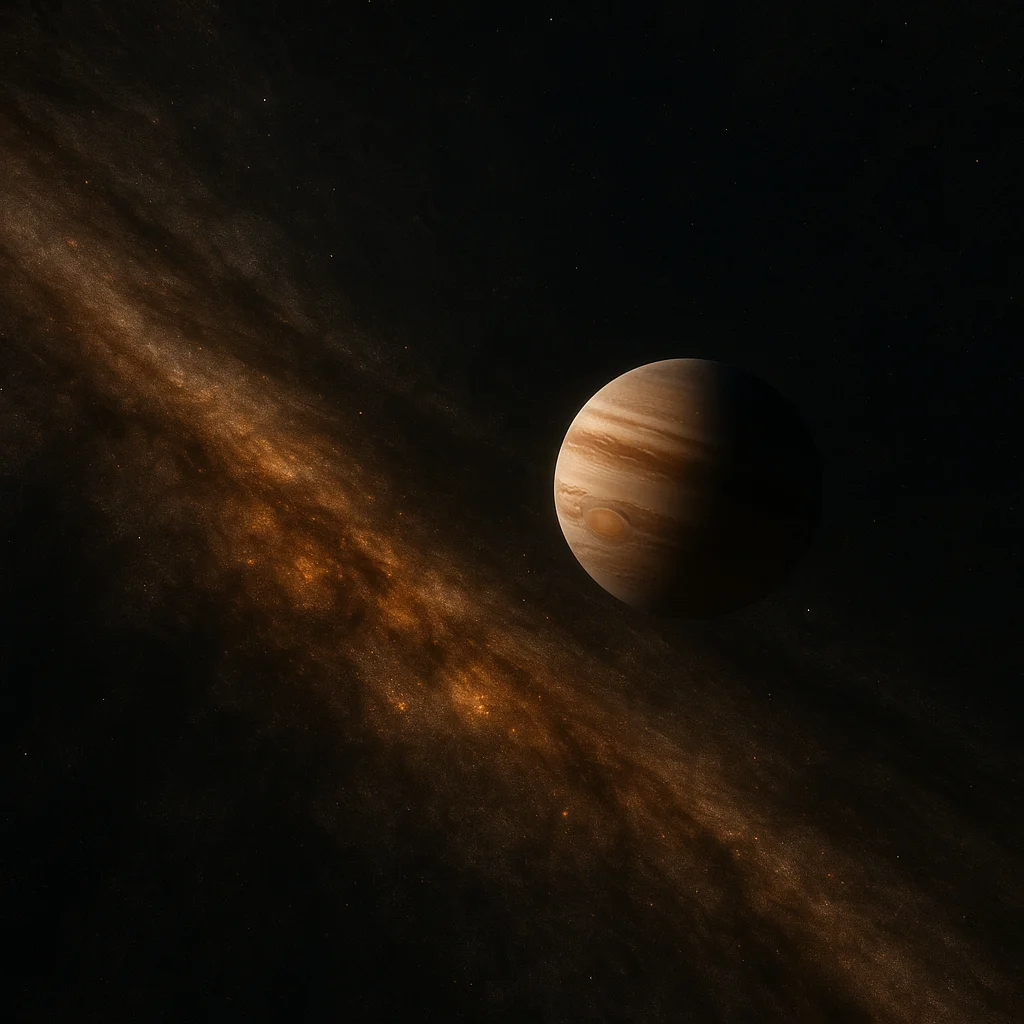
Visualization
Astronomers wielding the upgraded GRAVITY+ instrument at ESO’s Very Large Telescope Interferometer (VLTI) have unveiled fresh insights into the chemistry—and possibly the birthplace—of Beta Pictoris b, a super-Jovian exoplanet orbiting a young A-type star merely 63 light-years away. The quest: to decipher the ratio of carbon isotopes ^12C and ^13C in atmospheric CO and thus test prevailing models of giant planet formation. However, as the new results underscore, the fingerprint of isotopes offers as many questions as answers.
Beta Pictoris b, first resolved via direct imaging in 2008 by the VLT, occupies a dynamic system—its host, Beta Pictoris, is encircled by a prodigious circumstellar debris disk and is attended by at least two exoplanets. The gas giant itself, a colossus up to 13 times the mass of Jupiter, traces an orbit presently about 8 AU from its star, deeply embedded within this turbulent environment.
Unraveling the origin of such a massive planet involves reconstructing where, and under what chemical conditions, its accretion began. In protoplanetary disks, the so-called “snowline”—the radius at which volatiles like carbon monoxide (CO) condense from gas to ice—has profound implications for composition and growth mechanisms. Isotopic ratios, particularly ^12CO/^13CO, have been posited as a tool to differentiate between inner, warmer gas-dominated regions and the cold, ice-rich outer disk by revealing whether volatiles were accreted as solid or gaseous materials.
The chemistry of carbon is straightforward in principle: both ^12C (six protons, six neutrons) and ^13C (six protons, seven neutrons) behave nearly identically in molecular associations but diverge subtly in mass, affecting condensation temperatures and reaction kinetics. If a planet forms beyond the CO snowline, it is expected to accrete material with a higher enrichment of ^13C preserved in ices, shifting the ^12CO/^13CO ratio downward relative to primordial values measured in the interstellar medium or the solar nebula.
Previous attempts to resolve this ratio in Beta Pictoris b—using the baseline GRAVITY instrument—hinted at anomalously low ^12CO/^13CO, challenging to reconcile with the planet’s orbit, which lies interior to the present-day snowline. These earlier data, possibly handicapped by spectral resolution and instrument sensitivity, suggested the planet might have formed in the cold outer reaches and migrated sunward, a process invoking dynamic disk-planet interactions and large-scale migration scenarios.
The arrival of GRAVITY+ has decisively sharpened the observational toolkit. Antonia von Stauffenberg and collaborators leveraged the enhanced sensitivity and spectral resolving power to obtain refined measurements of the ^12CO and ^13CO line fluxes. Their revised abundance ratio now situates Beta Pictoris b firmly within canonical Solar System and interstellar medium values—approximately ^12CO/^13CO ~ 70, typical for galactic molecular clouds—negating evidence for significant isotopic fractionation or migration-derived anomalies.
This outcome is at once clarifying and quietly frustrating. Across roughly a dozen young gas giants, these isotope ratios persistently echo galactic norms. Such uniformity weakens the case for isotopic ratio as a diagnostic marker of formative locale within protoplanetary disks. If physical or chemical differentiation is present, the instrumental precision and theoretical models currently available are insufficient to isolate it; any signatures of planetesimal accretion beyond the CO snowline could well be erased or diluted by subsequent atmospheric mixing or additional delivery mechanisms.
The study also teases with observations of modest periodic variability in the exoplanet’s flux, potentially modulated on an 8.7-hour timescale—suggesting rotationally induced changes, perhaps linked to cloud structures or disequilibrium chemistry. However, statistical significance remains marginal, demanding future campaigns with still higher sensitivity and temporal resolution.
Taken together, these results illustrate how the ^12CO/^13CO isotopic probe, as currently implemented, falls short of providing a definitive narrative of planetary formation environments, at least for massive giants on wide orbits like Beta Pictoris b. The data imply a need for models that incorporate subtle isotopic exchange, atmospheric processing, and the complex interplay of migration and accretion in circumstellar disks.
As the hunt for more discriminating tracers continues, the upgraded GRAVITY+ stands poised for further discoveries. Its contributions, while revealing the limits of isotopic methods, set the stage for new strategies to unravel the chemical archeology of planetary birth—advancing the pursuit of questions that, for now, remain tantalizingly out of reach.
[Published: A. von Stauffenberg et al., "13CO and potential variability in β Pictoris b with GRAVITY+," Astronomy & Astrophysics, 711, L2 (2026); doi: 10.1051/0004-6361/202660275.]