Field: Technology
Caltech robot makes history by building a structure in space
Published | Technical Staff
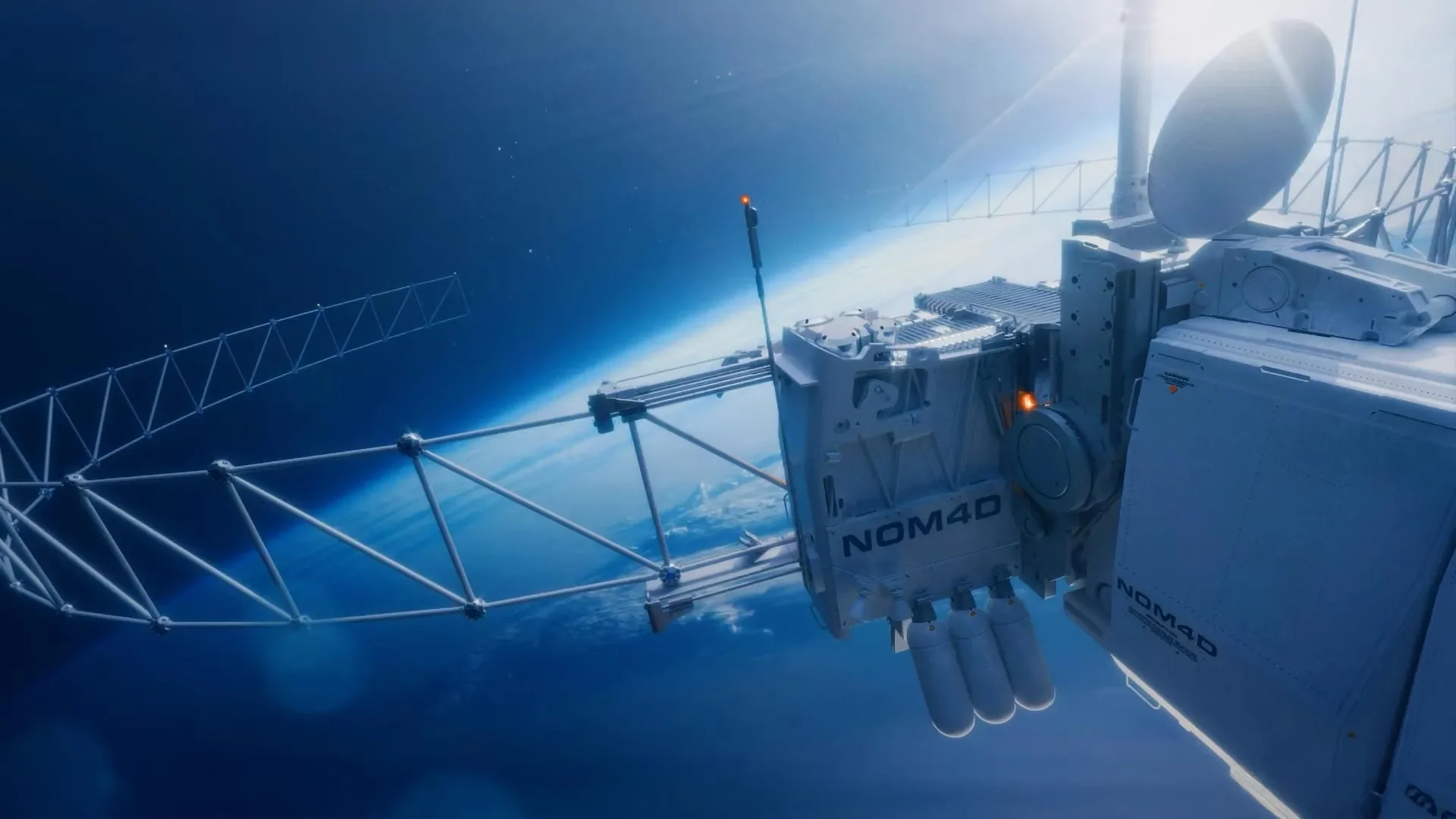
Visualization
In a remarkable leap for aerospace engineering and robotic automation, a team of researchers at the California Institute of Technology (Caltech) has achieved a significant milestone in the domain of space exploration: the autonomous construction of a structural component in the unforgiving environment of low Earth orbit. This groundbreaking accomplishment is poised to redefine the paradigms of assembling large-scale structures in space, paving the way for new scientific instruments, extensive communication systems, and solar power stations that far exceed current design limitations imposed by terrestrial rocket transport.
The ambitious endeavor was funded in part by the Defense Advanced Research Projects Agency (DARPA) as a part of its Novel Orbital and Moon Manufacturing, Materials, and Mass-efficient Design (NOM4D) program, which aims to revolutionize manufacturing processes in space. The robotic system, known as the Autonomous In-Space Tensioned Reflector Assembly (ASTRA), is essentially an advanced robotic assembly platform that employs sophisticated engineering principles to streamline the assembly of structures that would otherwise be impossible to transport intact on Earth.
Central to this effort is a robotic arm that methodically collects structural components—specifically, tubes and connecting joints—from designated storage dispensers. Through a series of well-coordinated movements, the robot constructs these elements into modular sections termed bays, which compose a larger supporting framework known as a truss. The elegance of this approach prompts comparisons to childlike construction sets such as K'Nex or Tinkertoys; however, the real-world application demands precision and resilience under the harsh conditions of space.
Sergio Pellegrino, a leading figure in this project and a professor of Aerospace and Civil Engineering at Caltech, emphasizes the historic nature of the achievement, stating, "This is the first time that a structure has been autonomously constructed in space." The robotic platform embarked on its mission on March 30, 2026, as part of SpaceX's Transporter-16 mission and was designed to assemble a reflector antenna measuring 1.4 meters across, crafted from composite fiber tubes, aluminum connectors, and a lightweight reflective material known as Kapton—a durable polymer widely utilized in aerospace applications.
While technical challenges and time constraints prevented the completion of the entire antenna during the six-month mission, the successful assembly of an initial section serves as a stirring indication that such robotic construction methodologies can indeed be viable in orbit. The implications are staggering; with this proof of concept, researchers envision scaling these concepts to create expanses of reflective surfaces, possibly enabling superlative astronomical observations or even vastly improved communication networks.
The ASTRA mission is notably the third phase of DARPA's NOM4D initiative, following rigorous research stages that included concept development, thorough engineering design, and extensive terrestrial testing. The transition from laboratory to orbital execution was fraught with complexity, as Pellegrino reflects on the tight timeline to manufacture and deploy the payload aboard Momentus Inc.'s Vigoride 7. The culmination of their labor was met with emotional resonance; team members, including Jaden Suh, expressed immense gratification as their childhood dreams of space exploration converged with reality.
The establishment of autonomous robotic construction additionally addresses the longstanding challenge of payload accommodations. Conventional spacecraft design often relies on folding structures into compact forms or necessitating human assembly post-launch, both of which inherently limit the scale and sophistication of the structures. In contrast, deploying raw materials to orbit and allowing robotic systems to assemble them could unleash the potential for kilometer-scale constructions—objects spanning vast distances that could revolutionize our approach to space-based energy generation and astronomical observation.
The future of astronomical instrumentation, vast radio antennas, and solar energy platforms could hinge on such innovations. As stated by Andrew Detor, DARPA program manager for NOM4D, “By ‘very large,’ I mean hundreds of meters or kilometers in scale. Nothing approaching that scale can be achieved today.” Proponents of this research foresee structures extending for miles, fundamentally altering our capabilities in space.
The journey into this new frontier of space manufacturing continues with ongoing efforts to implement these robotic technologies. The successful launch and initial operational phase of ASTRA marks not just an important stepping stone for Caltech and DARPA, but for the entire field of aerospace engineering, indicating that a future where autonomous robotic assembly becomes the norm in space exploration is not merely a distant ambition but an accelerating reality. As the potential for expansive, sophisticated structures develops, so too does our capacity to leverage the cosmos for scientific inquiry and practical energy solutions—forever altering the trajectory of human creativity and exploration.
The ambitious endeavor was funded in part by the Defense Advanced Research Projects Agency (DARPA) as a part of its Novel Orbital and Moon Manufacturing, Materials, and Mass-efficient Design (NOM4D) program, which aims to revolutionize manufacturing processes in space. The robotic system, known as the Autonomous In-Space Tensioned Reflector Assembly (ASTRA), is essentially an advanced robotic assembly platform that employs sophisticated engineering principles to streamline the assembly of structures that would otherwise be impossible to transport intact on Earth.
Central to this effort is a robotic arm that methodically collects structural components—specifically, tubes and connecting joints—from designated storage dispensers. Through a series of well-coordinated movements, the robot constructs these elements into modular sections termed bays, which compose a larger supporting framework known as a truss. The elegance of this approach prompts comparisons to childlike construction sets such as K'Nex or Tinkertoys; however, the real-world application demands precision and resilience under the harsh conditions of space.
Sergio Pellegrino, a leading figure in this project and a professor of Aerospace and Civil Engineering at Caltech, emphasizes the historic nature of the achievement, stating, "This is the first time that a structure has been autonomously constructed in space." The robotic platform embarked on its mission on March 30, 2026, as part of SpaceX's Transporter-16 mission and was designed to assemble a reflector antenna measuring 1.4 meters across, crafted from composite fiber tubes, aluminum connectors, and a lightweight reflective material known as Kapton—a durable polymer widely utilized in aerospace applications.
While technical challenges and time constraints prevented the completion of the entire antenna during the six-month mission, the successful assembly of an initial section serves as a stirring indication that such robotic construction methodologies can indeed be viable in orbit. The implications are staggering; with this proof of concept, researchers envision scaling these concepts to create expanses of reflective surfaces, possibly enabling superlative astronomical observations or even vastly improved communication networks.
The ASTRA mission is notably the third phase of DARPA's NOM4D initiative, following rigorous research stages that included concept development, thorough engineering design, and extensive terrestrial testing. The transition from laboratory to orbital execution was fraught with complexity, as Pellegrino reflects on the tight timeline to manufacture and deploy the payload aboard Momentus Inc.'s Vigoride 7. The culmination of their labor was met with emotional resonance; team members, including Jaden Suh, expressed immense gratification as their childhood dreams of space exploration converged with reality.
The establishment of autonomous robotic construction additionally addresses the longstanding challenge of payload accommodations. Conventional spacecraft design often relies on folding structures into compact forms or necessitating human assembly post-launch, both of which inherently limit the scale and sophistication of the structures. In contrast, deploying raw materials to orbit and allowing robotic systems to assemble them could unleash the potential for kilometer-scale constructions—objects spanning vast distances that could revolutionize our approach to space-based energy generation and astronomical observation.
The future of astronomical instrumentation, vast radio antennas, and solar energy platforms could hinge on such innovations. As stated by Andrew Detor, DARPA program manager for NOM4D, “By ‘very large,’ I mean hundreds of meters or kilometers in scale. Nothing approaching that scale can be achieved today.” Proponents of this research foresee structures extending for miles, fundamentally altering our capabilities in space.
The journey into this new frontier of space manufacturing continues with ongoing efforts to implement these robotic technologies. The successful launch and initial operational phase of ASTRA marks not just an important stepping stone for Caltech and DARPA, but for the entire field of aerospace engineering, indicating that a future where autonomous robotic assembly becomes the norm in space exploration is not merely a distant ambition but an accelerating reality. As the potential for expansive, sophisticated structures develops, so too does our capacity to leverage the cosmos for scientific inquiry and practical energy solutions—forever altering the trajectory of human creativity and exploration.