Field: Technology
Betelgeuse’s Atmosphere is Back to Normal after Great Dimming Event, New Radio Observations Show
Published | Technical Staff
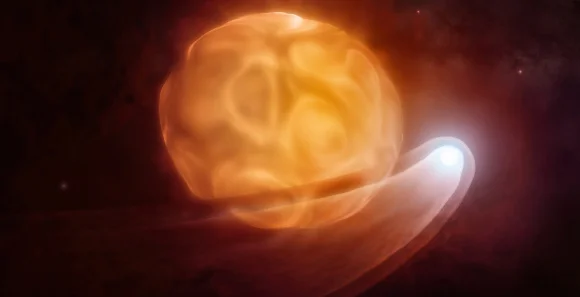
Visualization
In a remarkable resurgence following the enigmatic Great Dimming event that captivated astronomers worldwide, Betelgeuse—a colossal red supergiant residing approximately 724 light-years from Earth—has seen its atmosphere return to its usual state. The Great Dimming, documented extensively between 2019 and 2020, marked an unprecedented decrease in the star's brightness, leading to speculations about its cause, which included surface mass ejections affecting its visible luminosity.
Recent findings from the National Science Foundation's Karl G. Jansky Very Large Array (VLA) and the Atacama Large Millimeter/submillimeter Array (ALMA) underscore this recovery. A team led by Dr. Lynn Matthews from MIT Haystack Observatory conducted a sophisticated series of radio observations at various frequencies from 2021 through 2026, compiling data that heralds a new understanding of Betelgeuse's complex stellar atmosphere.
Betelgeuse, also cataloged as HD 39801 or Alpha Orionis, is distinguished not only for its dazzling brightness—outshining more than 100,000 suns—but also for its formidable size, being approximately 1,400 times the radius of our Sun. Its vastness and age of about 8 million years further illustrate its status as one of the most awe-inspiring stars in the constellation of Orion.
Prior to the Great Dimming, observational data noted a significant cooling within Betelgeuse's outer atmosphere, as evidenced by VLA measurements at a frequency of 44 GHz in August 2019, indicating the star's atmosphere was at its coolest phase in three decades. The latest observations reveal an intriguing return to typical brightness temperature values, peaking at approximately 3,500 K at a radius of 2.7 stellar radii. This elevated temperature now coincides with the established photospheric temperature, signifying alterations in the atmospheric structure.
With the ability to probe deeper atmospheric layers, ALMA data provided a detailed temperature gradient analysis, illustrating a steady decline in brightness temperature from roughly 3,500 K at 2.7 radii to around 2,220 K at 1.2 radii. This gradient elucidates the atmospheric configuration between the star's visible surface and the overlying hotter chromospheric region.
Intriguingly, the study not only reaffirms Betelgeuse's established 2,100-day periodic variability—previously linked to a companion star dubbed Siwarha—but also hints at the direct influence Siwarha might exert on Betelgeuse's atmospheric dynamics. The orbiting companion, although not directly observed, influences Betelgeuse’s shape as indicated by variations in ellipticity detected in radio images. The data show that Betelgeuse tends to exhibit less than 10% ellipticity across observed frequency bands, with the most pronounced elliptical distortion occurring when Siwarha is positioned at its greatest apparent separation from the supergiant star.
These findings hint that the companion star, amid its orbital pass through Betelgeuse’s extended atmosphere, generates atmospheric perturbations akin to the bow wave encountered by a vessel moving through water. Dr. Matthews aptly compares Siwarha's trajectory to "a jet boat tearing through a lake," suggesting it likely leaves a disruptive wake as it traverses the outer layers of Betelgeuse's gaseous envelope. The implications are profound; such interactions provide a fertile ground for deeper atmospherical understanding and potentially unravel the processes governing stellar evolution in red supergiants.
Consequently, the new observations not only signify Betelgeuse's atmospheric recovery but also usher in a paradigm shift in our comprehension of its relationship with an elusive companion star, indicating that the cosmic ballet of these celestial giants is far more intricate than previously appreciated. The findings, accessible to the scientific community through publication in the Astronomical Journal, are poised to inspire future inquiry into the dynamics of stellar atmospheres, supergiant stability, and their interactions with surrounding companion bodies—a realm that remains ripe for exploration.