Field: Technology
Beta Pictoris d: A Dim New World Illuminates the Architecture of a Benchmark Exoplanetary System
Published | Technical Staff
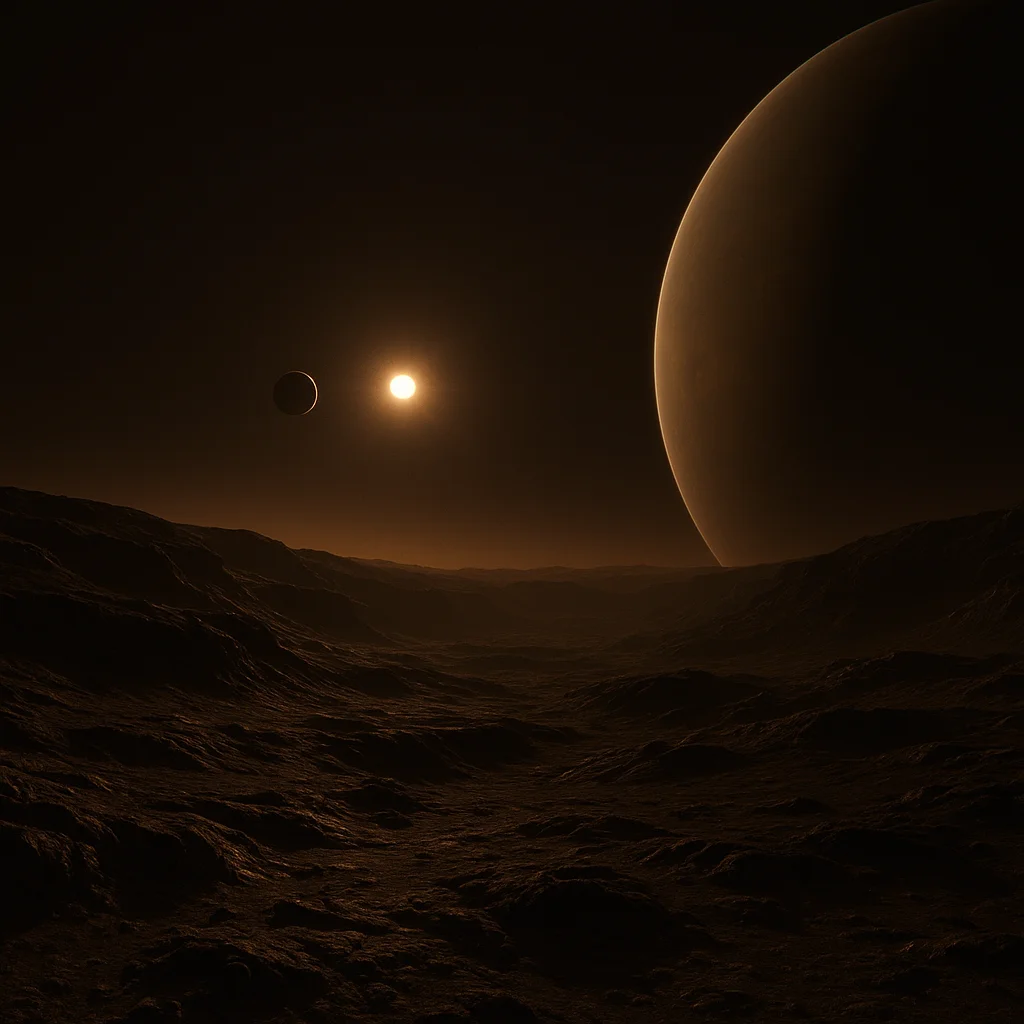
Visualization
Astronomers analyzing data from the European Southern Observatory’s Very Large Telescope (VLT) have directly imaged a third giant planet orbiting Beta Pictoris, a luminous, young A5-type star just 63 light-years distant. The discovery, designated Beta Pictoris d, offers a striking advance in exoplanetary direct imaging: with a mass only 2.4 times that of Jupiter (MJ) and luminosity fully two orders of magnitude lower than the system’s previously imaged planet, Beta Pictoris b, it is among the faintest, lightest exoplanets ever resolved through ground-based instrumentation.
Beta Pictoris itself is a compelling focal point for studies of planetary genesis and disk evolution. At merely 20 million years of age, and with a mass of approximately 1.8 M☉, this stellar system has long been a natural laboratory: extensive observations have mapped a massive circumstellar disk of gas and dust, the presence of numerous small cometary bodies, and a pair of gas giant planets—Beta Pictoris b and c—both of which challenge and inform current models of planet-disk interactions and planetary migration.
The identification of Beta Pictoris d originated almost by happenstance. Dr. Ben Sutlieff and colleagues at the University of Edinburgh, intent upon tracking the orbital evolution of Beta Pictoris b, scrutinized high-contrast images collected with the VLT’s ERIS instrument. Post-processing meant to subtract the overwhelming glare of the parent star instead unveiled a persistent point source, spatially separated from the bright Beta Pictoris b, but clearly distinct. Realizing the possible significance of the detection, the team initiated a meticulous archival search, unearthing additional images of the same object as far back as 2013. In some of these, Beta Pictoris d was barely distinguishable within the luminous envelope of its more massive planetary sibling.
This new exoplanetary denizen is a gas giant, but its orbit diverges sharply from those of the previously known Beta Pictoris b and c. The innermost of the trio, Beta Pictoris c, revolves at 2.7 AU from its host on a ~1,200-day orbit, tipping the scales at 8.2 MJ. Beta Pictoris b, with a mass between 9 and 13 MJ, pursues a wide 22-year circuit at 9.8 AU. In contrast, Beta Pictoris d appears in a yet wider, cooler, and dimmer orbit, challenging observers to unpick its orbital parameters from incomplete arcs; early constraints nonetheless affirm its status as the least massive and faintest imaged companion in the system—100 times fainter than the iconic first planet imaged, Beta Pictoris b.
From a technical perspective, the achievement is non-trivial. At near-infrared wavelengths, the faintness ratio (ΔL) between Beta Pictoris b and Beta Pictoris d approaches ΔL ≈ 5 magnitudes, necessitating advanced point spread function subtraction and contrast optimization in both ground-based adaptive optics and space-based coronagraphic imaging. The ERIS instrument on the VLT provided the first unequivocal detection, later independently confirmed by a parallel effort led by Aidan Gibbs at UC San Diego utilizing the James Webb Space Telescope’s NIRSpec—a testament to the maturation of high-contrast exoplanet imaging.
The implications for planetary system formation are profound. Beta Pictoris d’s low mass (Md = 2.4 MJ) and direct observability sharpen the suite of empirical constraints on the system’s initial mass function and accretion dynamics. The trio of giant planets supports the hypothesis that planet-disk interactions can produce tightly packed architectures even in massive, young disks; meanwhile, the long observational baseline (≥ 11 years) for Beta Pictoris d affords an unprecedented opportunity to invert Keplerian motion and gravitational perturbations, potentially constraining both system coplanarity and the role of dynamical instabilities in sculpting giant planet orbits.
Notably, Beta Pictoris now joins the meager company of HR 8799 as only the second exoplanetary system with a directly imaged configuration of at least three giant planets. The collective body of research furnishes a living narrative of planetary system assembly, dust evolution, and the subtleties of migration, scattering, and resonant trapping. As Dr. Jayne Birkby of the University of Oxford remarked, “Beta Pictoris d, it seems, has been playing a game of hide-and-seek with us for over a decade and only now can we say ‘found you!’” The intricate choreography of these Jovian worlds—witnessed in the act through the most sensitive instruments Earth and space have to offer—continues to yield critical empirical data to test and refine the prevailing theoretical matrix that governs planetary system formation and evolution.
Two complementary studies, published in Astrophysical Journal Letters (ApJL 1006, L10 and L11), document the convergent independent detections and underscore Beta Pictoris’s enduring role as a Rosetta stone for understanding young, dynamically evolving planetary systems. With each increment in sensitivity and temporal coverage, astronomers move one step closer to a comprehensive mechanistic explanation of planetary system diversity and origin.