Field: Technology
Beta Pictoris b Emits First Confirmed Exoplanetary Radio Signal
Published | Technical Staff
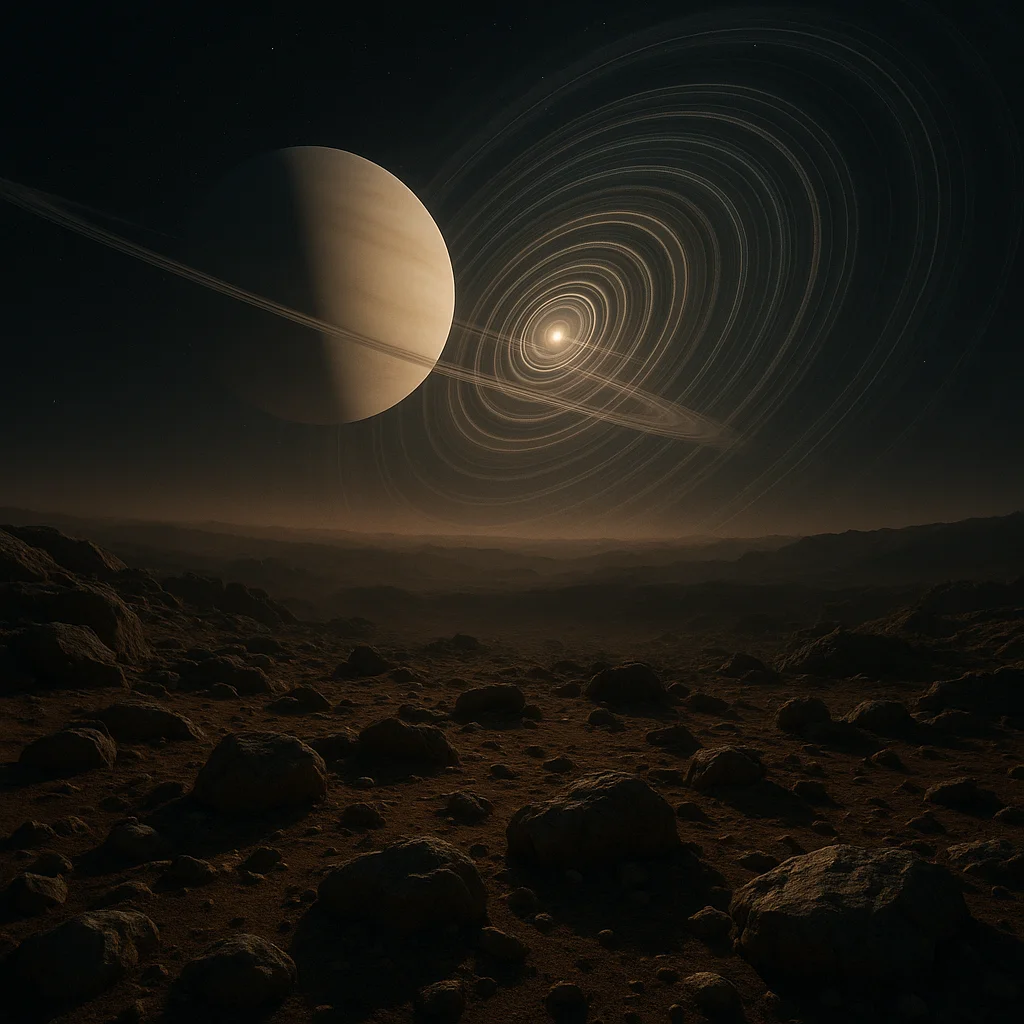
Visualization
In an unprecedented astronomical breakthrough, researchers have directly detected radio emission from Beta Pictoris b, an exoplanet orbiting the young star Beta Pictoris—establishing the first unambiguous identification of radio signals from an exoplanet outside our Solar System. This gas giant, whose mass has been constrained to the range 9–13 M_J (where M_J denotes Jupiter masses), orbits its bright, A-type host at a semi-major axis of roughly 8 AU, making a complete revolution every 24 years. Located approximately 19.44 parsecs (63 light-years) away in the constellation Pictor, the Beta Pictoris system is both youthful (≈23 Myr) and dynamic, also hosting a prominent circumstellar debris disk and at least two other planetary companions.
The compelling opportunity to probe this system with radio astronomy arises from two fortuitous astrophysical conditions: Beta Pictoris b achieves a maximum projected angular separation of 0.55 arcseconds during its orbit, affording relative isolation from the stellar background at relevant resolutions, and its host star is magnetically quiescent. These properties mitigate stellar radio noise, allowing the planet's magnetospheric signature to stand out.
Utilizing the advanced capabilities of MeerKAT, South Africa’s 64-dish radio interferometer array operating in the 580 MHz to 1.67 GHz range, astronomers led by Kevin Ortiz Ceballos observed auroral radio bursts that could be directly associated with Beta Pictoris b. The detected radio emission corresponds to a mechanism known as the electron cyclotron maser instability (ECMI), a fundamental process generating intense, coherent radio waves in planetary magnetospheres. ECMI operates when energetic electrons spiral along magnetic field lines, emitting at the local cyclotron frequency, \( f_{ce} = \frac{e B}{2\pi m_e} \), where e is electron charge, B is the magnetic field strength, and \( m_e \) is the electron mass.
For context, similar auroral emissions—driven by interactions between magnetospheres and ionospheric currents—are well documented in the Solar System, most notably at Jupiter, as well as at Saturn, Uranus, and Neptune. Certain brown dwarfs, occupying the mass range between gas giants and stars, also display this radio phenomenon, but until this observation, a direct detection from a canonical exoplanet in another stellar system had remained elusive.
From the highest frequency component of the detected emission, the team inferred a minimum surface magnetic field at the exoplanet of approximately 1.25 kilogauss (\(B_{min} \simeq 1.25\, \mathrm{kG}\)), a value several thousand times stronger than the average geomagnetic field at Earth’s surface (~0.3–0.6 G). This measurement not only constitutes a novel, direct empirical constraint on the magnetospheric environment of an extrasolar planet, but also aligns with dynamo scaling laws developed for rapidly rotating, massive gas giants with partially convective interiors. The observation supports theoretical frameworks in which young, massive exoplanets robustly generate strong dynamo-driven magnetic fields, influenced by their rapid rotation, internal structure, and elevated heat fluxes.
Moreover, the nature and detection of the radio emission suggest an active coupling between the planet’s magnetosphere and its ionosphere, analogous to magnetosphere-ionosphere interactions observed at Jupiter. This coupling, which likely fuels the observed ECMI radio bursts, may also influence the physical evolution of the planet’s upper atmosphere, and could play a role in shielding potential nascent satellites or ring systems from intense stellar winds in such young planetary systems.
The implications of this detection extend significantly: not only does it offer a method for probing the magnetic fields of exoplanets—an important, heretofore mostly theoretical aspect of exoplanetary science—but it also opens a new, radio-centric window on the atmospheric and magnetospheric dynamics of far-flung worlds. With the continued development of sensitive radio arrays and long-baseline interferometers, auroral radio searches may soon become a key diagnostic for characterizing planetary magnetism, space weather, and even the habitability potential of exoplanetary systems.
The team’s results, detailed in a newly released preprint on arXiv.org (Kevin N. Ortiz Ceballos et al., 2026, arXiv:2609.16720), mark a watershed moment in the direct observation of exoplanetary magnetic fields and demonstrate the extraordinary potential of radio astronomy in revealing the magnetic and atmospheric architecture of worlds beyond our own.