Field: Technology
Batwing Helmets of the Devonian: The Hydrodynamic Story of Bataspis crux
Published | Technical Staff
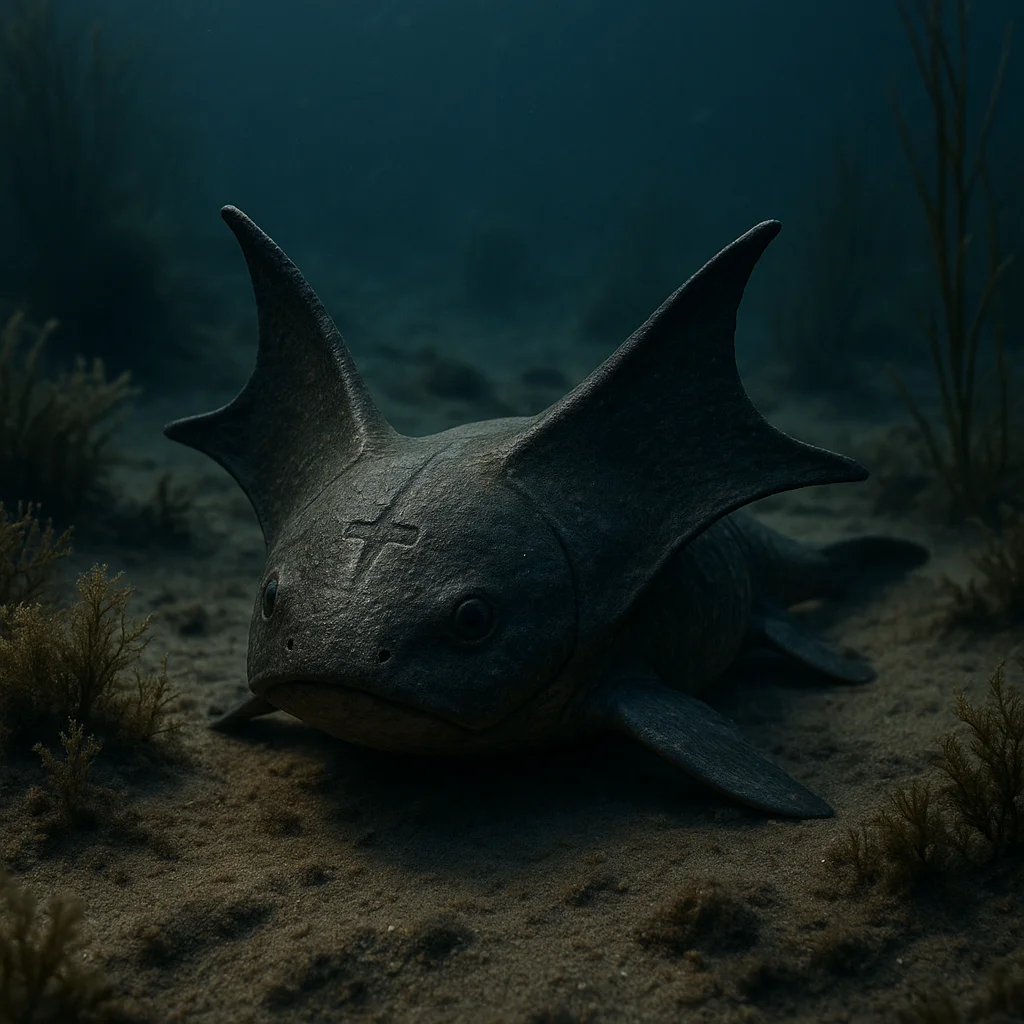
Visualization
A remarkable chapter in the narrative of early vertebrate evolution has emerged from the Early Devonian strata of China’s Yunnan province, where paleontologists have described Bataspis crux, a jawless fish whose distinctive cranial architecture redefines our understanding of primitive gnathostome motility. Discovered in sandstones of the Xishancun Formation and dated to approximately 419 million years ago (Lochkovian epoch), Bataspis crux exemplifies the morphological inventiveness that characterized the now-extinct clade Galeaspida, a pivotal group in the quest to untangle the origins of jawed vertebrates.
Galeaspids have long tantalized paleontologists as perhaps the closest jawless relatives to crown-group gnathostomes, specifically situated among stem-gnathostomes at the root of the vertebrate phylogenetic tree. While extant analogues for these organisms are virtually nonexistent, their paleobiology remains crucial for reconstructing the anatomical and ecological groundwork from which jawed vertebrates arose. The majority of previously identified galeaspids present morphotypes reminiscent of benthic or nektonic habits—interpretations derived largely from comparison with modern jawed fishes and shaped by bias in the fossil record; yet, these analogies only scratch the surface, as galeaspids often lack direct functional counterparts in living faunas.
Phylogenetic analyses employing both parsimony and probabilistic algorithms positioned Bataspis crux unambiguously within the family Tridensaspidae (order Eugaleaspiformes), closely allied with genera such as Pterogonaspis and Tridensaspis. However, the morphoanatomical trajectory of B. crux diverges strikingly from its forebears. The holotype specimen, meticulously curated by the Institute of Vertebrate Paleontology and Paleoanthropology at the Chinese Academy of Sciences, portrays an evolutionary experiment in cranial design: the headshield eschews the familiar spikes, domes, or crests of other galeaspids in favor of a duo of membrane-like, posteriorly-swept extensions—structurally evocative of bat wings rather than piscine armor.
To rigorously probe the adaptive function of this unprecedented cephalic morphology, the research team constructed a high-resolution, digital 3D model and subjected it to computational fluid dynamics (CFD) simulations, analyzing water flow interactions at varying angles of attack. The datasets derived from these simulations illuminate a compelling hydrodynamic phenomenon: the “batwing” projections of B. crux conferred a lift-to-drag (L/D) ratio surpassing all previously measured galeaspids. Specifically, at low angles of attack, the cranial “wings” generated a pressure differential analogous to that of an airfoil, with accelerated laminar flow over the convex dorsal surface and retarded flow ventrally. This gradient results in net lift (L), calculated by the customary formula L = Cl × (½) × ρ × V² × S, where Cl is the coefficient of lift, ρ the density of the fluid, V the velocity, and S the planform area—implying that the headshield itself functioned as a primary hydroplaning surface.
The significance of this adaptation extends beyond hydrodynamics: Bataspis crux expands the documented phenotypic range of the galeaspid lineage, offering direct evidence that even in the absence of flexible paired fins, jawless stem-gnathostomes could exploit a broad ecological spectrum. The existence of a lift-optimized morphotype implies a locomotor strategy more akin to gliding or efficient low-energy cruising than to benthic crawling, and it destabilizes the prevailing paradigm which equated limited appendicular mobility with constrained ecological opportunity.
Published in the journal *Palaeontology* (Meng et al., 2026; DOI: 10.1111/pala.70081), these findings challenge preconceived notions of stem-gnathostome ecomorphology and highlight the evolutionary ingenuity that foreshadowed the vertebrate radiation. As the galeaspid fossil record continues to unfold, it becomes increasingly evident that Devonian seas harbored an unexpected diversity of locomotor innovations—heralded by the silent, batwinged glide of Bataspis crux.
Galeaspids have long tantalized paleontologists as perhaps the closest jawless relatives to crown-group gnathostomes, specifically situated among stem-gnathostomes at the root of the vertebrate phylogenetic tree. While extant analogues for these organisms are virtually nonexistent, their paleobiology remains crucial for reconstructing the anatomical and ecological groundwork from which jawed vertebrates arose. The majority of previously identified galeaspids present morphotypes reminiscent of benthic or nektonic habits—interpretations derived largely from comparison with modern jawed fishes and shaped by bias in the fossil record; yet, these analogies only scratch the surface, as galeaspids often lack direct functional counterparts in living faunas.
Phylogenetic analyses employing both parsimony and probabilistic algorithms positioned Bataspis crux unambiguously within the family Tridensaspidae (order Eugaleaspiformes), closely allied with genera such as Pterogonaspis and Tridensaspis. However, the morphoanatomical trajectory of B. crux diverges strikingly from its forebears. The holotype specimen, meticulously curated by the Institute of Vertebrate Paleontology and Paleoanthropology at the Chinese Academy of Sciences, portrays an evolutionary experiment in cranial design: the headshield eschews the familiar spikes, domes, or crests of other galeaspids in favor of a duo of membrane-like, posteriorly-swept extensions—structurally evocative of bat wings rather than piscine armor.
To rigorously probe the adaptive function of this unprecedented cephalic morphology, the research team constructed a high-resolution, digital 3D model and subjected it to computational fluid dynamics (CFD) simulations, analyzing water flow interactions at varying angles of attack. The datasets derived from these simulations illuminate a compelling hydrodynamic phenomenon: the “batwing” projections of B. crux conferred a lift-to-drag (L/D) ratio surpassing all previously measured galeaspids. Specifically, at low angles of attack, the cranial “wings” generated a pressure differential analogous to that of an airfoil, with accelerated laminar flow over the convex dorsal surface and retarded flow ventrally. This gradient results in net lift (L), calculated by the customary formula L = Cl × (½) × ρ × V² × S, where Cl is the coefficient of lift, ρ the density of the fluid, V the velocity, and S the planform area—implying that the headshield itself functioned as a primary hydroplaning surface.
The significance of this adaptation extends beyond hydrodynamics: Bataspis crux expands the documented phenotypic range of the galeaspid lineage, offering direct evidence that even in the absence of flexible paired fins, jawless stem-gnathostomes could exploit a broad ecological spectrum. The existence of a lift-optimized morphotype implies a locomotor strategy more akin to gliding or efficient low-energy cruising than to benthic crawling, and it destabilizes the prevailing paradigm which equated limited appendicular mobility with constrained ecological opportunity.
Published in the journal *Palaeontology* (Meng et al., 2026; DOI: 10.1111/pala.70081), these findings challenge preconceived notions of stem-gnathostome ecomorphology and highlight the evolutionary ingenuity that foreshadowed the vertebrate radiation. As the galeaspid fossil record continues to unfold, it becomes increasingly evident that Devonian seas harbored an unexpected diversity of locomotor innovations—heralded by the silent, batwinged glide of Bataspis crux.