Field: Technology
Average Human Genome Carries Millions of Variants, New Research Shows
Published | Technical Staff
Visualization
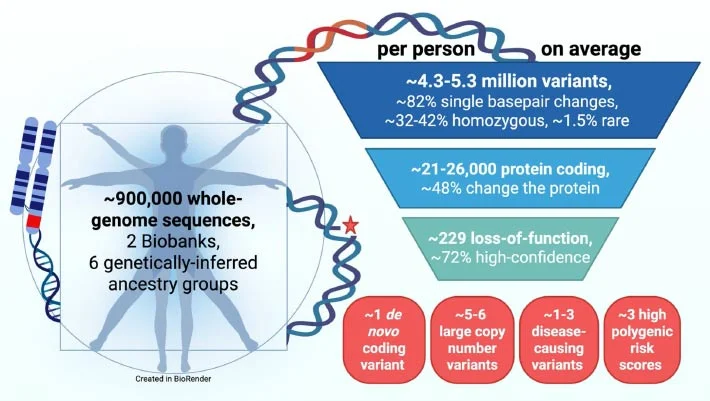
In a groundbreaking exploration of human genomic diversity, researchers from the University of Exeter Medical School have unveiled a comprehensive depiction of the typical human genome, derived from the expansive whole-genome sequences of nearly 900,000 adults participating in the UK Biobank and the US-based All of Us program. This study delineates for the first time the average genomic landscape, characterized by an astonishing 4.3 to 5.3 million variants per individual. These findings, recently published in the journal Genome Medicine, significantly enhance our understanding of genetic diversity and its implications for health and disease.
The study's lead, Professor Caroline Wright, emphasizes the transformative role of whole genome sequencing in the diagnostic sphere, asserting, “Whole genome sequencing has become such an important tool in diagnosing genetic disease, and we’re increasingly moving towards genetic screening for predicting disease.” Yet, she notes, there exists a societal gap in awareness regarding the sheer volume of genetic variation intrinsic to every genome. Their research provides a crucial reference point for clinicians and patients alike, enabling better interpretation and contextualization of genomic data in clinical settings.
The analysis reveals that most of the genomic variants identified are prevalent within the population and predominantly reside in non-coding regions, suggesting a limited impact on individual health profiles. Only about 1.5% of the identified variants are classified as rare, a statistic that resonates with broader genetic theories on population-specific variation. Intriguingly, individuals of African ancestry exhibited an average of one million additional variants compared to other racial groups, an observation linked to the composition of the reference genome, which was primarily established using samples from individuals of European descent.
Diving deeper into the functional implications of these variants, the researchers discovered that an individual carries an average of 229 variants that are predicted to disrupt gene function. However, the robustness of these predictions varies, with only approximately 72% classified as high-confidence calls. Notably, among genes associated with Mendelian disorders, the typical individual possesses anywhere from one to three variants labeled as pathogenic or likely pathogenic within the ClinVar database. The majority of these are said to correspond to recessive traits, positioning them as healthy carriers rather than symptomatic individuals.
Moreover, the study indicates that the human genome is not a static entity; it is continuously evolving. Using data from 2,334 parent-child trios, the researchers estimated that each individual is born with approximately 61 new mutations, alongside an additional two mutations that emerge in the early stages of development. Significantly, paternal age at the time of conception contributed more substantially to these novel mutations, with each additional year linked to roughly 1.2 new mutations, compared to 0.4 from maternal age. Such findings underscore the multifaceted interplay between genetic inheritance and mutational processes across generations.
Exploring the relationship between genetic variants and disease susceptibility, the researchers employed polygenic risk scores, which aggregate the cumulative effects of numerous small variants to approximate the risk of common conditions. Their findings revealed that the average individual ranked within the top 10% for approximately three out of 28 prevalent conditions, while around 20% of participants with European ancestry scored in the top 1% for at least one condition—a contrast to the figure of one in three for participants of other ancestries. This disparity may reflect the limitations of risk models developed predominantly from European cohorts rather than underlying biological differences in disease risk.
Ultimately, these revelations clarify that the carrying of genetic variants tied to diseases is a universal aspect of human genetics; however, the mere presence of these variants does not necessarily precipitate adverse health outcomes. As Professor Wright concludes, "It is therefore crucial to consider context when interpreting findings from genetic testing, including symptoms or family history of disease, as well as other clinical and environmental risk factors.” This comprehensive investigation offers significant insights not only for genomic research but also for clinical practices in genetics—the results serve to inform genetic counseling and risk assessment, reinforcing the necessity of contextualizing genetic information in personalized medicine approaches.
The study's lead, Professor Caroline Wright, emphasizes the transformative role of whole genome sequencing in the diagnostic sphere, asserting, “Whole genome sequencing has become such an important tool in diagnosing genetic disease, and we’re increasingly moving towards genetic screening for predicting disease.” Yet, she notes, there exists a societal gap in awareness regarding the sheer volume of genetic variation intrinsic to every genome. Their research provides a crucial reference point for clinicians and patients alike, enabling better interpretation and contextualization of genomic data in clinical settings.
The analysis reveals that most of the genomic variants identified are prevalent within the population and predominantly reside in non-coding regions, suggesting a limited impact on individual health profiles. Only about 1.5% of the identified variants are classified as rare, a statistic that resonates with broader genetic theories on population-specific variation. Intriguingly, individuals of African ancestry exhibited an average of one million additional variants compared to other racial groups, an observation linked to the composition of the reference genome, which was primarily established using samples from individuals of European descent.
Diving deeper into the functional implications of these variants, the researchers discovered that an individual carries an average of 229 variants that are predicted to disrupt gene function. However, the robustness of these predictions varies, with only approximately 72% classified as high-confidence calls. Notably, among genes associated with Mendelian disorders, the typical individual possesses anywhere from one to three variants labeled as pathogenic or likely pathogenic within the ClinVar database. The majority of these are said to correspond to recessive traits, positioning them as healthy carriers rather than symptomatic individuals.
Moreover, the study indicates that the human genome is not a static entity; it is continuously evolving. Using data from 2,334 parent-child trios, the researchers estimated that each individual is born with approximately 61 new mutations, alongside an additional two mutations that emerge in the early stages of development. Significantly, paternal age at the time of conception contributed more substantially to these novel mutations, with each additional year linked to roughly 1.2 new mutations, compared to 0.4 from maternal age. Such findings underscore the multifaceted interplay between genetic inheritance and mutational processes across generations.
Exploring the relationship between genetic variants and disease susceptibility, the researchers employed polygenic risk scores, which aggregate the cumulative effects of numerous small variants to approximate the risk of common conditions. Their findings revealed that the average individual ranked within the top 10% for approximately three out of 28 prevalent conditions, while around 20% of participants with European ancestry scored in the top 1% for at least one condition—a contrast to the figure of one in three for participants of other ancestries. This disparity may reflect the limitations of risk models developed predominantly from European cohorts rather than underlying biological differences in disease risk.
Ultimately, these revelations clarify that the carrying of genetic variants tied to diseases is a universal aspect of human genetics; however, the mere presence of these variants does not necessarily precipitate adverse health outcomes. As Professor Wright concludes, "It is therefore crucial to consider context when interpreting findings from genetic testing, including symptoms or family history of disease, as well as other clinical and environmental risk factors.” This comprehensive investigation offers significant insights not only for genomic research but also for clinical practices in genetics—the results serve to inform genetic counseling and risk assessment, reinforcing the necessity of contextualizing genetic information in personalized medicine approaches.