Field: Technology
Astronomical Insights Unveil 27 Potential Planets Orbiting Binary Stars, Echoing 'Star Wars' Iconic Tatooine
Published | Technical Staff
Visualization
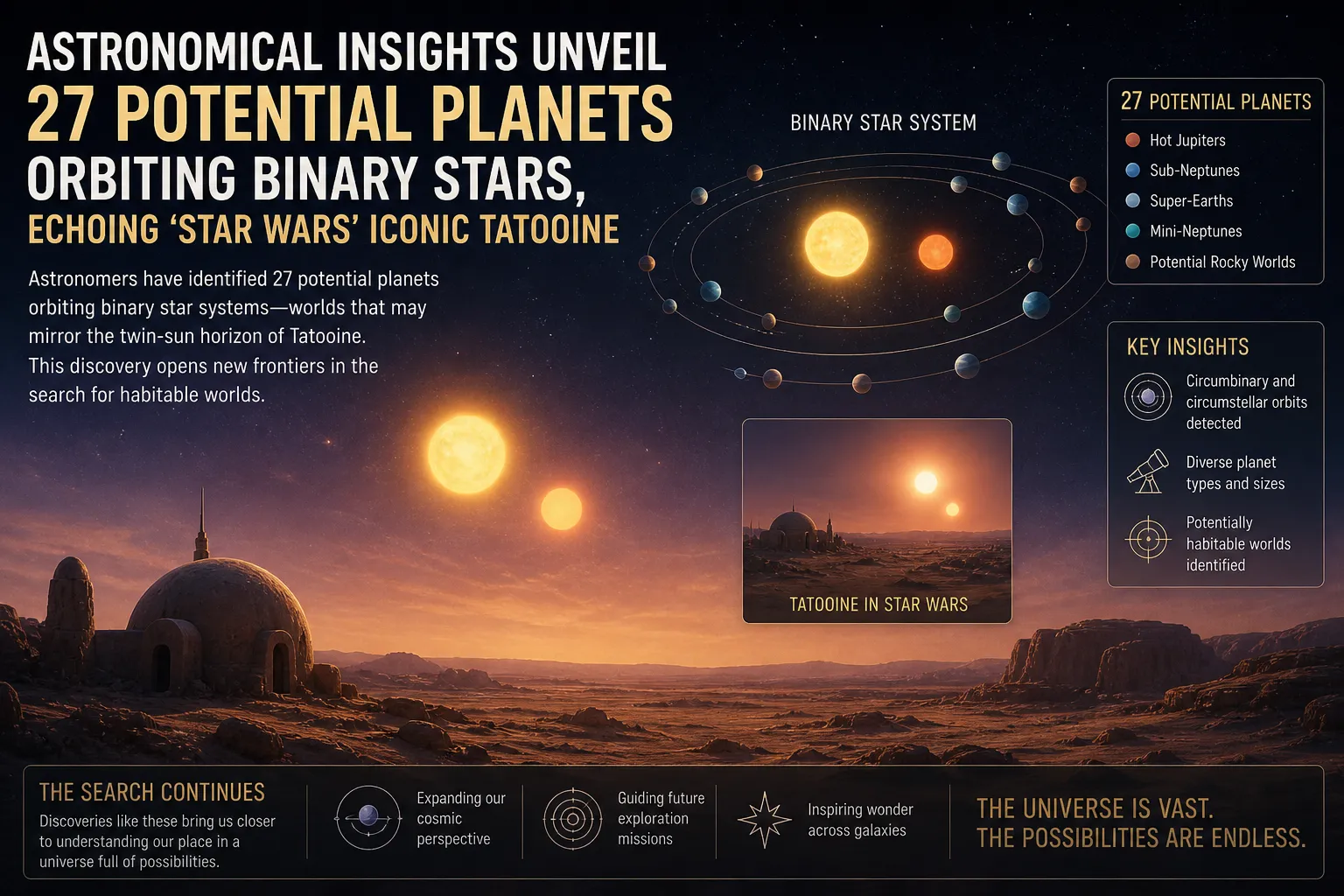
In a revelation that mirrors the imaginative landscapes of 'Star Wars', astronomers have recently identified 27 potential planets, each ensconced in the gravitational embrace of two stars. This discovery, highlighted in the journal Monthly Notices of the Royal Astronomical Society, expands our understanding of circumbinary planets, a segment of celestial bodies once thought purely the domain of science fiction.
The cinematic portrayal of Tatooine, with its dual sunsets, became emblematic of the limitless possibilities of space. However, real-world astronomy had yet to encounter such phenomena when 'Star Wars: Episode IV–A New Hope' debuted in 1977. The recent findings thus bridge the chasm between fantastical speculation and scientific validation.
The existence of more than 6,000 confirmed exoplanets has been cataloged to date, among which fewer than 20 are known to orbit binary star systems. Binary star systems present considerable challenges for traditional planet detection methods, primarily because of their complex gravitational interactions and irregular planetary orbits. Planets in such systems are less likely to transit across the stars in a manner that aligns with our observational instruments.
The primary technique employed in the detection of these exoplanets, known as the transit method, involves monitoring the dimming of a star's light as an orbiting planet passes in front of it. According to Joshua Carter, involved in the discovery of Kepler-16b—a gas giant resembling Saturn but about 250 light-years away—the approach typically leverages the minute declines in luminosity caused by the transiting object. Kepler-16b, detected in 2011, was the first confirmed planet to circle a binary star system and marked a pivotal moment in circumbinary planet research.
For the newly identified candidates, researchers utilized a subset of data from 1,590 binary star systems observed by NASA's Transiting Exoplanet Survey Satellite (TESS). Innovative analysis techniques were applied to detect slight perturbations in the stars' movements, suggesting the gravitational influence of additional planetary bodies. This approach, combined with the observation of apsidal precession—wherein the orbital ellipse of the stars shifts over time due to gravitational interactions—provided indirect evidence of planetary masses.
Among the 27 planetary candidates, more than half are believed to possess less mass than Jupiter. However, to confirm these planets' true nature and characteristics, further analysis involving spectroscopy is required, which will allow astronomers to study the light emitted by these systems and garner more detailed information on their atmospheric and physical properties.
Despite the advanced methods deployed, the chaotic dynamics of binary star systems imply a harsh environment for the potential planets. As noted by Mohammad Farhat from the University of California, Berkeley, planets within these systems face significant risks, including tidal disruptions or ejection from the system due to intense gravitational forces.
The implications of these findings are profound, as they suggest that our understanding of planet formation and stability in binary systems needs profound reevaluation. Furthermore, these discoveries could revolutionize the search for exoplanets by prompting more tailored techniques sensitive to the complexities of multi-star systems.
This research not only enriches our scientific knowledge but also deepens the cultural impact of astronomy, illustrating yet again how artistic imaginings like those seen in 'Star Wars' can presage real-world scientific discoveries. The quest to understand our universe continues to be a source of both wonder and insight, demonstrating the interconnectedness of human creativity and scientific inquiry.