Field: Technology
Astronomers Unravel the Direct Signature of Interstellar Turbulence by Tracking Quasar Light Across the Milky Way
Published | Technical Staff
Visualization
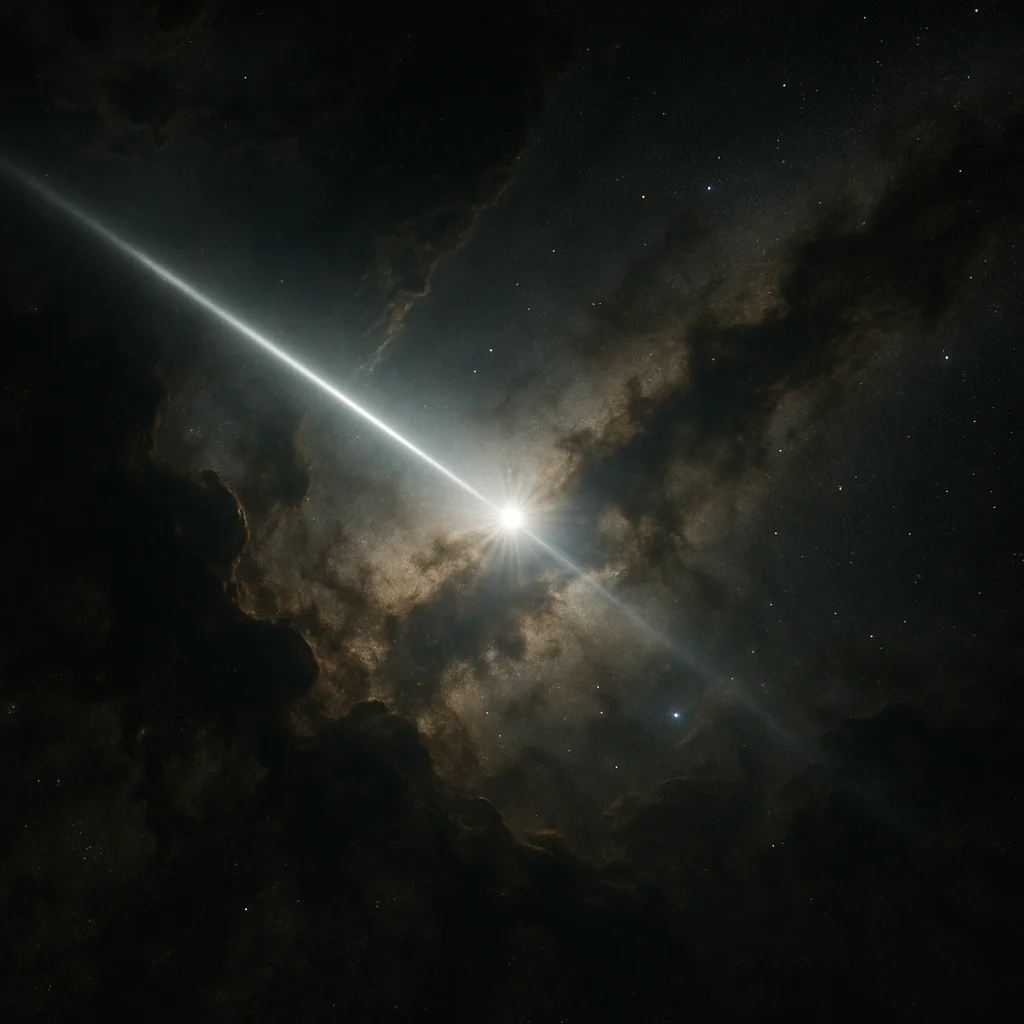
A recent investigation by astronomers at the Harvard & Smithsonian Center for Astrophysics has yielded the first direct measurement of how turbulent clouds in the interstellar medium (ISM) warp and scatter radio signals from distant cosmic sources. This breakthrough centers on the quasar TXS 2005+403, whose radio emission, after a journey spanning nearly 10 billion light-years, punctures the tumultuous Cygnus region of our galaxy before reaching Earth-based receivers.
The ISM, long characterized as a diffuse tapestry of gas and plasma, acts as an invisible lens, distorting the passage of electromagnetic waves. While indirect evidence has hinted at this turbulence, constraining its spatial structure has proven elusive. The analogy is akin to watching candle flames shimmer behind a pane of hot air—light is refracted, revealing the presence of an otherwise invisible medium.
Dr. Alexander Plavin and his colleagues delved into almost a decade (∼2014–2023) of archival observations from the National Science Foundation’s Very Long Baseline Array (VLBA), a network of radio telescopes capable of resolving cosmic structures on parsec scales through very long baseline interferometry (VLBI). The choice of TXS 2005+403 was strategic: this luminous quasar, powered by a supermassive black hole at z ≈ 1.2, serves as a cosmic beacon, but its sightline slices directly through one of the Milky Way’s most notorious scattering environments.
The expectation, rooted in classical radio propagation theory, was that such a path would induce uniform angular broadening—a smooth, Gaussian blur described by the spatial coherence function φ(r) = exp[−(r/r_0)^(5/3)] for a Kolmogorov spectrum of turbulence, with r_0 representing the diffractive scale at which phase fluctuations become order unity. In this regime, signal intensity is predicted to decrease rapidly at projected baselines exceeding r_0, erasing any possibility of sharp structural information.
Yet the VLBA data confounded this expectation: not only did the most distant antenna pairs (with baselines ≳10,000 km) continue to detect the quasar, but the received signal contained fine, patchy structures inconsistent with simple diffusive scattering. The angular broadening, quantified by measurements of the quasar’s apparent size as a function of observing frequency, displayed persistent, highly structured fluctuations. These must arise from refractive substructure imposed by discrete turbulent inhomogeneities within the Cygnus region—a scenario predicted by refractive scattering theory but rarely observed directly.
Dr. Plavin notes, “Most of what we see in the radio data isn’t coming from the quasar itself, it’s coming from the scattering caused by the turbulence in this region of the Milky Way.” The implication is clear: the ISM here does not act as a uniform phase screen, but rather imparts spatially and temporally coherent structures onto the traversing wavefront. The temporal stability of the scattering pattern, persisting over years, provides critical evidence for the static nature of these turbulent “clumps” on astronomical timescales.
The observational signatures were dissected by modeling the propagation of radio waves through a turbulent plasma: as the electric field E is refracted, the resulting intensity I at the observer is modulated according to the phase structure function D_φ(r) ≈ (r/r_0)^(5/3), with the observed visibilities decaying as V(b) ∝ exp[−½ D_φ(b)] for interferometer baselines b. Where a simple, isotropic Kolmogorov turbulence would predict total attenuation of visibilities at the largest baselines, the detection of “faint glow” implies the presence of sub-diffraction-scale refractive caustics or “scintillation arcs,” a phenomenon hitherto inaccessible except through indirect means.
The repercussions echo beyond an improved census of the ISM: precision timing of pulsars, imaging of extragalactic sources, and even searches for extraterrestrial intelligence must all now contend with an ISM whose turbulence not only blurs, but imprints organized structure onto traversing signals. The findings are detailed in the Astrophysical Journal Letters (Plavin et al., 2026, ApJL 1003, L4; doi: 10.3847/2041-8213/ae60f4), marking a milestone in our empirical grasp of galactic plasma physics.
In sum, the direct detection and characterization of turbulence-induced refractive substructure along one of the Milky Way’s most turbulent sightlines confirm theoretical expectations developed over half a century, and inaugurate a new era of “turbulence tomography” using cosmic background sources as diagnostic probes. Each photon from TXS 2005+403 carries with it the shuffled fingerprint of the ionized universe, granting astronomers unprecedented access to the invisible whorls and eddies permeating the galactic night.