Field: Technology
Astronomers Unravel Mysteries of a Pair of Stars Generating Unexplained Radio Pulses
Published | Technical Staff
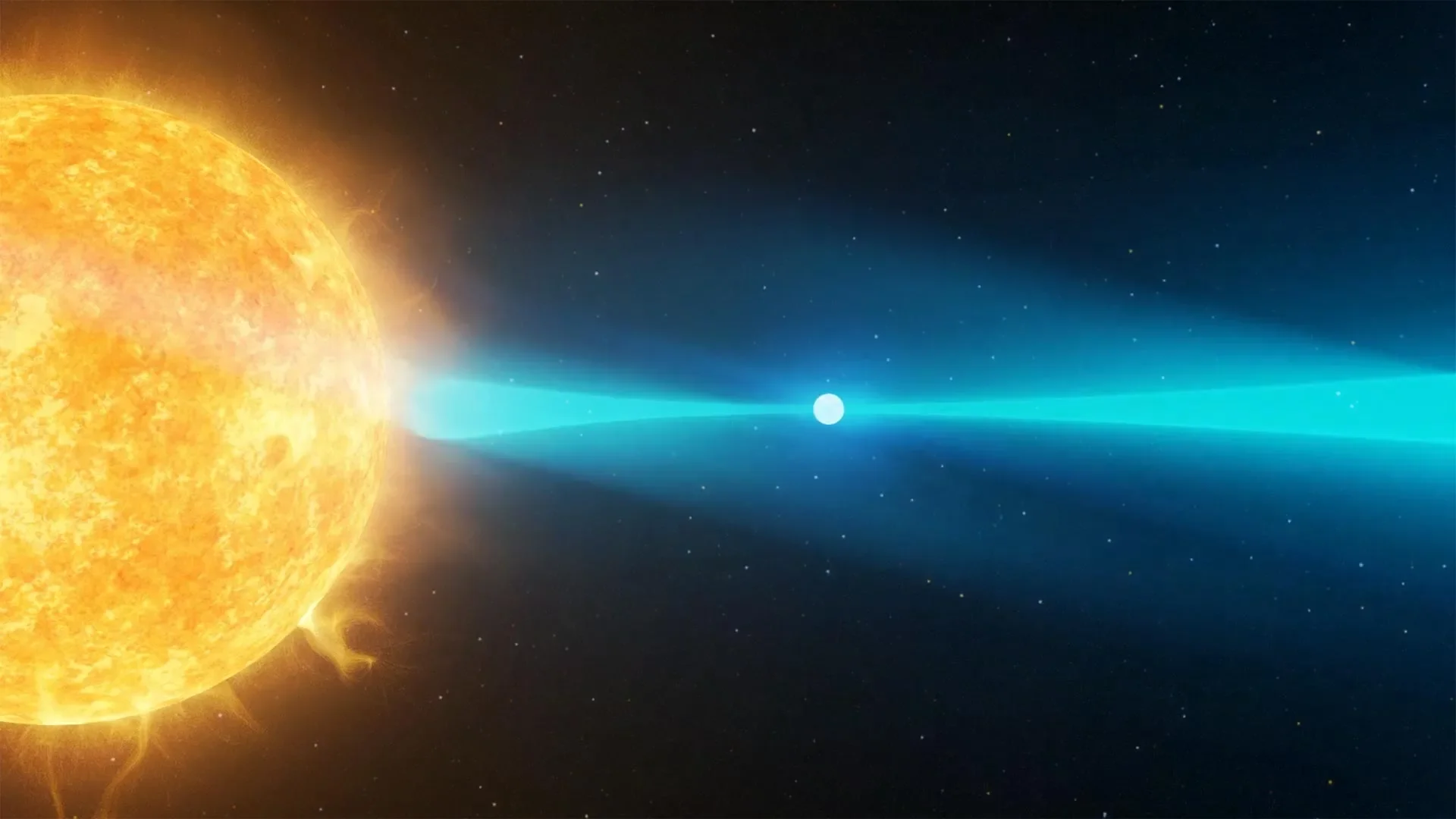
Visualization
A groundbreaking discovery in the field of astronomy has emerged from the depths of space, over 5,000 light-years away, where a peculiar binary system captures the attention of researchers. This stellar duo comprises a white dwarf, a remnant of a once-vibrant star, relentlessly spinning every eight minutes, and a companion star classified as a G-type star, akin to our Sun. The findings, presented by a team from the Curtin University segment of the International Centre for Radio Astronomy Research (ICRAR), unveil insights into the enigmatic nature of long-period transients (LPTs) and the magnetic phenomena occurring on the Sun-like star.
The binary system is identified as GPM J071507−114153 and represents a critical milestone in high-energy astrophysics. A white dwarf, the dense core left behind after a star has exhausted its nuclear fuel and expelled its outer layers, is now demonstrated to emit structured radio pulses in a manner previously undocumented in systems containing G-type stars. This discovery marks a significant leap from prior observations of white dwarfs paired exclusively with cooler red dwarfs, presenting an intriguing case for how such pulsations may arise in more massive stellar environments.
With the white dwarf rapidly completing its rotation, the intensity of these radio emissions varies, revealing a pulsed signal detectable in advanced radio spectrum studies. This phenomenon was classified with remarkable precision; the team’s observations used over 100 hours of radio data, meticulously processed through computing resources at the Pawsey Supercomputing Research Centre. The technique employed allows researchers to scrutinize the orbital mechanics of the white dwarf, leading to a deeper understanding of its interaction with the stellar companion.
The newfound capabilities permit astronomers to determine whether the source of the radio pulses aligns with the white dwarf's own vicinity, thereby establishing a direct association. Lead author Dr. Sam McSweeney articulated the significance of this revelation, stating that for the first time, the constellation of radio pulses is closely linked to the orbiting white dwarf, providing clarification on the origins of these signals.
In parallel, the radio emissions yielded unexpected observational data regarding the magnetic landscape of the companion star. Co-author Associate Professor Natasha Hurley-Walker emphasized the capabilities of modern radio astronomy, akin to the analysis of magnetic storms on our Sun, which can provoke auroral displays on Earth. The detection included flares corresponding to fierce magnetic disturbances reminiscent of solar activity, offering a fascinating glimpse into the stellar dynamics within this binary system.
Moreover, the data suggested the white dwarf’s passage through a region rich in magnetic field strength, possibly indicating the presence of a stellar prominence—an eruption of electrically charged plasma held aloft by formidable magnetic forces. Such prominences can span vast distances above a star's surface, essentially painting the stellar landscape with intricate interactions of plasma and electromagnetic fields, further illuminating the mechanisms governing stellar atmospheres across astronomical distances.
The confluence of state-of-the-art telescopes played an instrumental role in this discovery. The Murchison Widefield Array (MWA) initiated the detection as part of an expansive survey of the Milky Way, scoping for transient radio sources. Subsequent localization efforts were performed using MeerKAT—a sophisticated radio telescope situated in South Africa—to refine the coordinates, followed by optical observation that connected the radio emissions to the G-type star. The complexity of these interstellar relations showcases the intricate tapestry of cosmic structures demanding advanced observation techniques as precipitated by initiatives like the Square Kilometre Array, a project poised to revolutionize our understanding of such phenomena.
As telescopic technology continues to evolve, with enhanced sensitivity and capabilities on the horizon, the prospect of uncovering more star systems like GPM J071507−114153 seems tantalizingly achievable. Dr. McSweeney predicts that the ongoing development of the Square Kilometre Array Observatory (SKAO) will broaden the scope of high-energy astrophysics, essentially amplifying the frequency and clarity of discoveries regarding the cosmic orchestra of radio emissions that punctuate the universe.
The full implications of this research stretch far beyond the immediate findings; they hold the potential to reframe current understandings of stellar evolution, binary interactions, and the exotic astrophysical processes intertwined within the confines of gravitational cataclysms and electromagnetic forces. This recent exploration echoes previous scholarly contributions while paving the way for novel inquiries into the interplay between magnetic forces and stellar lifecycles, contributing meaningfully to the corpus of knowledge in contemporary astronomy.