Field: Technology
Astronomers uncover new secrets of the Universe’s first five minutes
Published | Technical Staff
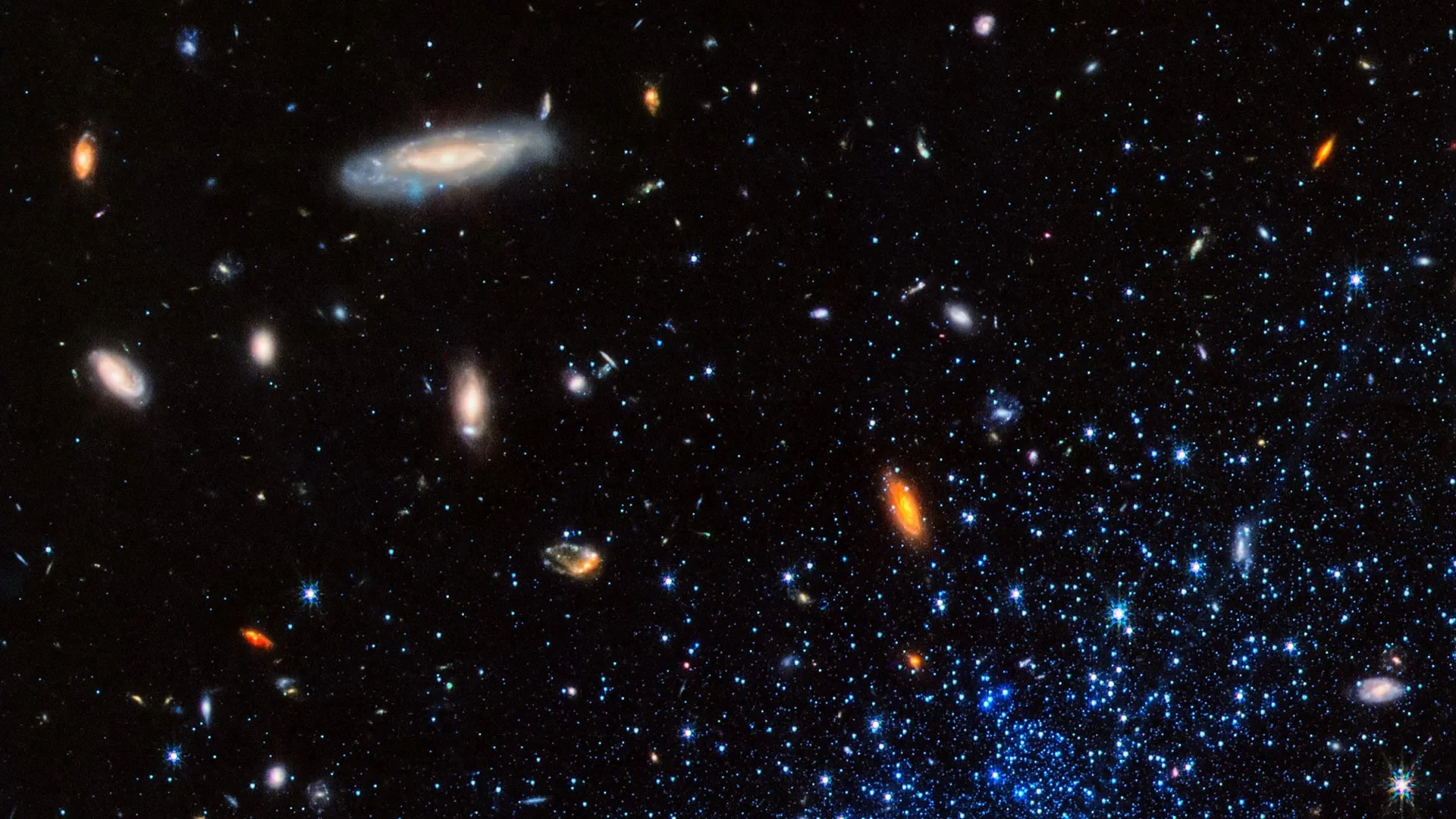
Visualization
In a groundbreaking study, an international team of astronomers has unveiled an extraordinarily precise measurement of primordial helium produced in the universe's initial moments, a finding that may reshape our understanding of the laws governing cosmic evolution. Utilizing the formidable capabilities of the Large Binocular Telescope (LBT), the collaboration meticulously examined 15 pristine galaxies, remnants of a time almost 13.8 billion years ago, to refine our comprehension of the Big Bang.
The essence of this research lies in its application of precision cosmology to ascertain the helium abundance shortly after the Big Bang, a critical parameter in cosmic evolution theories. This pursuit resulted in a remarkable reduction of measurement uncertainty to a mere 0.5%, three times more accurate than previous estimates. The implications of this achievement resonate across multiple domains in physics, enabling astute investigations into the conditions present during the universe’s nascent moments.
For context, the Big Bang theory posits that the universe began from a profoundly hot and dense singularity, rapidly expanding into the vast cosmos we observe today. Three key observations underpin this hypothesis: the universe's ongoing expansion, the cosmic microwave background radiation, and the primordial abundances of light elements—namely helium and deuterium. While the former two parameters have received extensive attention in cosmological studies, the primordial helium abundance remained relatively less explored, despite its critical relevance to the early universe's physical conditions.
To reach their groundbreaking measurement, the researchers diverged from conventional methods that entail broad extrapolations from less pristine galaxy samples. Instead, they meticulously selected 15 of the most pristine small galaxies discovered to date. These galaxies, with little chemical alteration over time, serve as time capsules, preserving the cosmological conditions existing in the universe’s infancy.
The research team, which includes notable scholars from the University of Minnesota Twin Cities, Ohio State University, and several other prestigious institutions, implemented advanced spectroscopic techniques. They employed state-of-the-art spectrographs crafted over 12 years at Ohio State University, meticulously capturing over ten distinct helium spectral lines alongside 15 hydrogen lines simultaneously. This dual analysis allowed for the identification and mitigation of potential measurement errors that previous studies might have overlooked, a feat essential for achieving the unprecedented precision now reported.
The refinement of helium abundance measurements also facilitates a critical test of the Standard Model of particle physics. The primordial helium generation rate is intricately linked to the types of elementary particles present at that epoch, including neutrinos—ultra-light particles that play a pivotal role in nuclear interactions. By applying their precise measurements of helium, the team was able to calculate key parameters, such as the number of neutrino families extant during the universe's formative seconds.
Evan Skillman, a distinguished professor in the School of Physics and Astronomy at the University of Minnesota and a co-author of the study, articulated the significance of the findings, stating, "This is a physics experiment on a grand scale and one of the biggest findings in my entire 40-year career. It has diagnostic power that speaks directly to the Standard Model of Physics." Indeed, with each advance in understanding the primordial composition, scientists inch closer to solidifying or challenging the foundational theories that underpin our comprehension of the universe.
Such a level of precision—now at 0.5%—will not only substantiate existing models but also catalyze further inquiry into areas of particle physics and astronomy. As Skillman stated, "We promised a half-percent uncertainty in our proposal, and we got there. In the unpredictable world of science, that doesn't happen very often."
Collectively, this collaborative effort has propelled the field forward, paving the way for new paradigms in cosmology and beyond, reinforcing the interconnections between empirical observation and theoretical physics in our quest to decode the fabric of the cosmos.