Field: Technology
Astronomers may have discovered the first moon beyond our Solar System
Published | Technical Staff
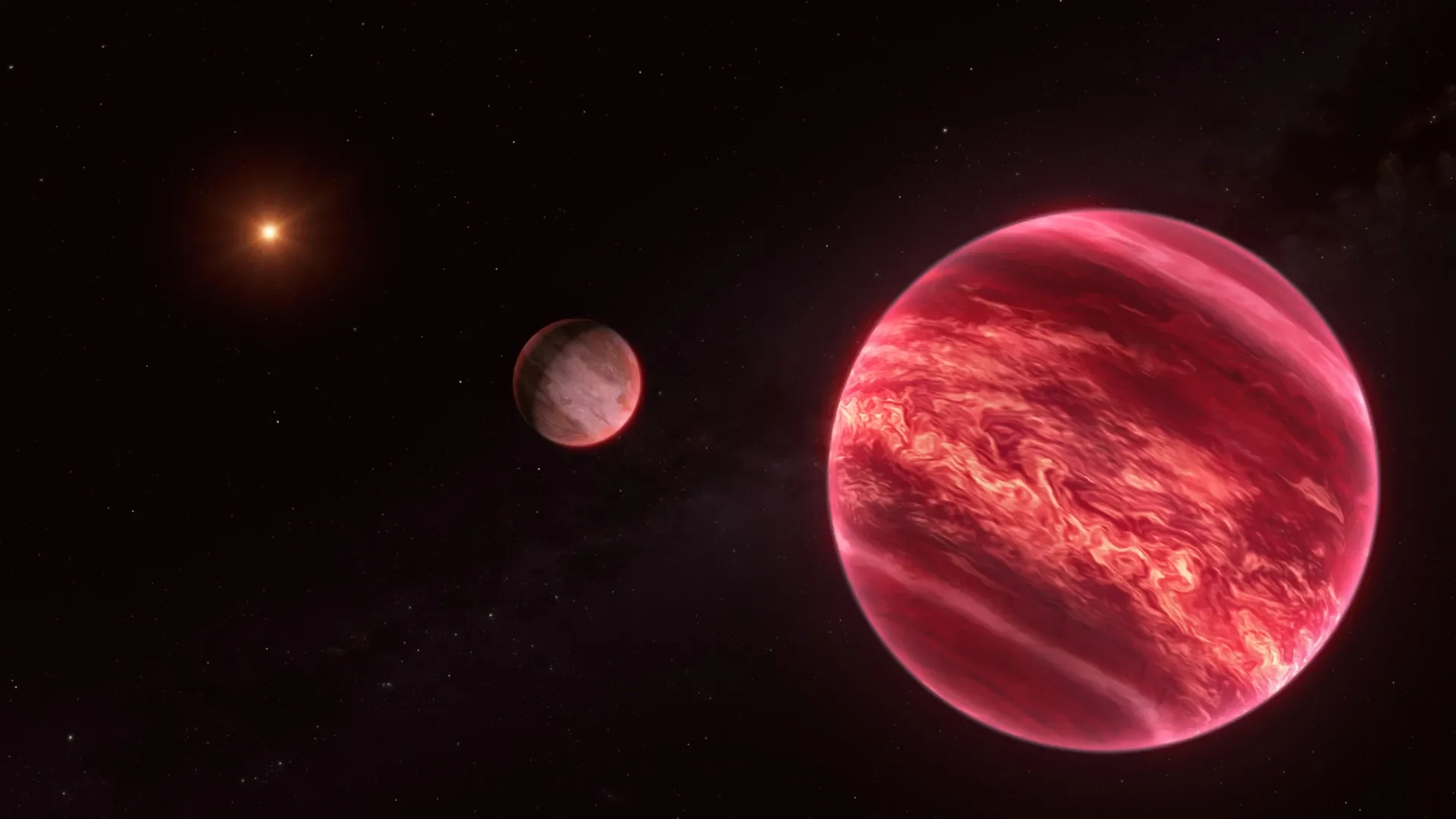
Visualization
In an extraordinary revelation that may redefine our cosmic lexicon, astronomers have potentially unearthed the first moon detected outside our Solar System. Nestled within the CD-35 2722 star system, this enigmatic moon-like body presents a striking contrast to any celestial object within our own Solar System due to its imposing mass, estimated to rival that of Jupiter. Notably, this oversized satellite orbits a brown dwarf, a peculiar celestial class that lies between planets and stars, creating an unprecedented arrangement that raises compelling questions about the nature of moons and their classification across the universe.
At the heart of the CD-35 2722 system lies a star approximately half the mass of our Sun, demonstrating a youthful vibrancy that fascinates the scientific community. Here, one encounters a brown dwarf, a cosmic enigma with a mass exceeding 37 times that of Jupiter. While brown dwarfs possess insufficient mass to initiate hydrogen fusion—the critical reaction that fuels true stars—they surpass the mass thresholds of conventional planetary bodies. Thus, the brown dwarf in this system orbits its stellar progenitor while hosting a massive exosatellite that intriguingly circumvents the conventional definitions associated with moons as we know them.
Kevin Hoy, an ESO-student and the lead author on the recent study, reflects on the intricacies of the CD-35 2722 system, labeling its configuration as “super weird” relative to our own Solar System. Hoy, collaborating with researchers from the Universidad Diego Portales in Chile and the Millennium Nucleus of Young Exoplanets and their Moons (YEMS), excavated through layers of observational data from the European Southern Observatory's Very Large Telescope (VLT). Using long-term monitoring, they cherry-picked evidence hinting at the existence of what they classify as an exosatellite—one that fundamentally challenges established categorizations of celestial bodies.
This newly identified satellite possesses attributes that place it at the dramatic intersection of celestial classification systems. A significant factor that complicates its designation is its mass; with at least as much mass as Jupiter, it teeters on the threshold of planetary classification while still adhering to the orbit of a brown dwarf instead of a star. "The exosatellite is clearly massive enough to be a planet, but it does not orbit a star, though it orbits an object that orbits a star," states Hoy, delving into the paradox of its classification.
The researchers faced a terminology conundrum as they attempted to categorize this immense moon, labelling it as an exosatellite while grappling with the implications of redefining our understandings of moons. The term "exomoon," traditionally reserved for satellites orbiting planets beyond our Solar System, now seems at odds with the actuality of this cosmic structure. "We have a clear delineation between the planets and the Sun in the Solar System, so defining things like moons is simple. In the CD-35 2722 system, where we are blurring the lines between stars, planets, and moons, the whole thing becomes more complicated to describe,” explains Alice Zurlo, the director of YEMS, adding that this instance is unlike traditional moons throughout our Solar System.
The astronomical community has long eyed the quest for exomoons with a focus that underscores their rarity. Despite cataloging over 6,000 exoplanets, only a few candidates for exomoons have been identified, each marred by uncertainties and unvalidated observations. Previous studies, such as those by Quentin Kral into the HD 206893 star system, have indeed hinted at moon-like companions, yet definitive proof remains elusive. The CD-35 2722 system emerges as a compelling candidate, buoyed by meticulous observations reflecting the impact of the hypothesized exosatellite on the dynamics of its larger brown dwarf companion.
Employing the advanced capabilities of the CRIRES+ instrument on the VLT, the research team applied the radial velocity method—an established technique that has successfully identified exoplanets. This method measures any minuscule variations in the orbital motions where two celestial bodies influence one another due to gravitational attraction, illustrating the delicate dance between them. As the brown dwarf subtly wobbles from the gravitational pull of the exosatellite, this nuanced motion becomes demonstrable through precise measurements, culminating in a strong case for the existence of this remarkable exosatellite.
With these findings, the astrophysical community stands at the precipice of a new era in exoplanetary studies. Should the existence of moons beyond our Solar System become validated, beyond simply augmenting our cosmic catalogs, such discoveries may significantly broaden our comprehension of planetary system formation, analysis of celestial interactions, and the evolution of structures within these systems that starkly contrast those found in our own planetary neighborhood.
The future holds further potential for these explorations, particularly with the anticipated capabilities of the Extremely Large Telescope (ELT). Armed with a staggering 39-meter mirror combined with state-of-the-art instruments, the ELT promises to unearth smaller and more subtle exomoons tucked within distant planetary systems—entities circumscribed by cosmic definitions yet yearning for classification amid the backdrop of an expanding universe. As astronomers pursue additional celestial satellites, they may discover that the distinctions we hold dear—between stars, planets, and moons—are not the rigid separations we once believed them to be, inviting a transformative reconceptualization of cosmic realities beyond our Solar System.