Field: Technology
Astronomers Discover Record-Breaking Quasar Pair in Early Universe
Published | Technical Staff
Visualization
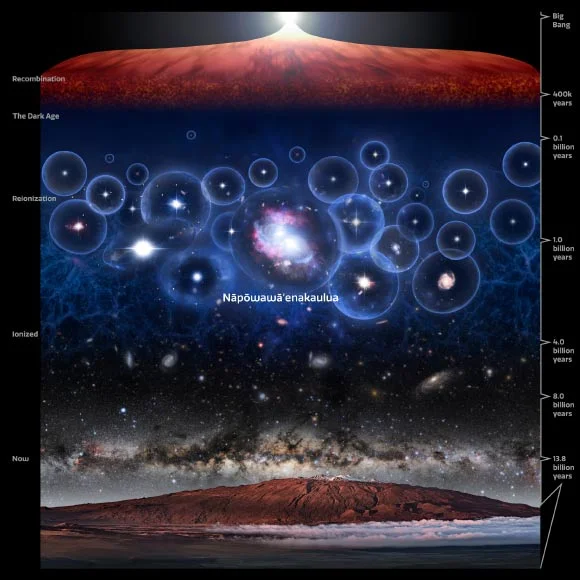
In a groundbreaking revelation that extends our understanding of the nascent cosmos, astronomers have identified a remarkable pair of quasars, designated Nāpōwawāʻenakaulua (or J1602+4228AB), situated at a strikingly early epoch. Approximately 900 million years post-Big Bang, this compact duo of supermassive black holes challenges the prevailing paradigms of black hole formation, illuminating the chaotic yet formative years of the universe.
Separated by a mere 18,100 light-years, equivalent to roughly one-fifth of the Milky Way's diameter, the two quasars exhibit astonishing masses of 1.5 billion and 400 million solar masses. This discovery not only contributes to our catalogue of early cosmic structures but also substantially questions the theoretical frameworks that delineate how these immense entities could have coalesced shortly after the universe's inception. The presence of such considerable masses in a period when the cosmos was merely a thirteenth of its current age beckons a critical reassessment of existing astrophysical models.
Dr. Silvia Onorato, a postdoctoral researcher at the National Science Foundation’s NOIRLab, articulates the enigma posed by this discovery, remarking, “There is no definitive theoretical explanation for how a single one of these giant quasars exists so early in the age of our Universe, much less two.” This observation catalyzes exciting discourse about the processes that enable supermassive black holes to form and flourish in relative isolation when galactic structures themselves were still in their infancy.
The quintessence of this revelation lies in the methodologies employed to observe Nāpōwawāʻenakaulua. Data collected by the Near-Infrared Spectrograph Integral Field Unit aboard the NASA/ESA/CSA James Webb Space Telescope laid the foundational groundwork for this discovery. Subsequent analyses, facilitated by the Gemini North telescope’s Gemini Near-Infrared Spectrograph (GNIRS), enabled astronomers to disentangle the two quasars, providing insights into their individual characteristics. Additional metrics harvested through the Gemini Multi-Object Spectrograph (GMOS) further refined the quasar pair's properties, enhancing our grasp of these colossal cosmic entities.
The researchers postulate that Nāpōwawāʻenakaulua may serve as a rare signpost indicative of an extreme peak in the matter density field of the early universe. In this context, the simultaneous growth of black holes alongside vigorous star formation points to a period rife with galactic interactions, indicative of a dynamic interplay between stellar evolution and supermassive black hole accretion. Dr. Onorato emphasizes the uniqueness of the environment offered by Nāpōwawāʻenakaulua: “It’s a laboratory for astronomers to study how the very first massive galaxies and their central black holes assembled together through direct galaxy interactions during these early times.”
Furthermore, the implications of this discovery extend well beyond mere observation. The findings, published in Astrophysical Journal Letters, underscore the pressing need for a reevaluation of model frameworks that address the formative processes which govern high-redshift quasar assembly. The presence of such massive black holes in the early universe not only raises questions about their formation but also impacts our comprehension of the evolution of galaxies and the matter distribution within the cosmos.
As our observational capabilities continue to evolve, the investigation of astronomical phenomena like Nāpōwawāʻenakaulua stands as a testament to the richness of the universe's early epochs. As discoveries emerge from the cosmic depths, they challenge us to redefine our understanding of the cosmos—a journey that fundamentally bridges the bounds of time, space, and the very nature of what we consider to be the building blocks of our universe.