Field: Technology
Armored Amphibian from Triassic Period is First Known to Have Lived Entirely in the Sea
Published | Technical Staff
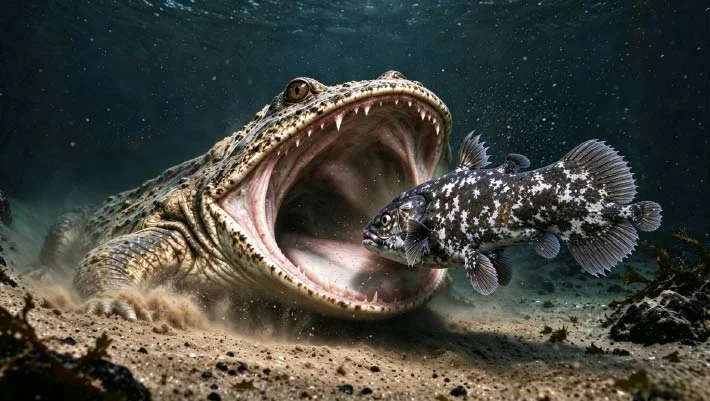
Visualization
In a pioneering examination of Triassic marine ichthyofauna, paleontologists have unveiled the discovery of Gerrothorax maritimus, a remarkable stem amphibian that ostensibly forsook terrestrial habitats for an entirely aquatic existence. This groundbreaking revelation emerges from the analysis of two almost intact skeletons unearthed in China's Guizhou province, dating back approximately 237 million years to the Late Triassic epoch.
The discovery is particularly poignant, as it accentuates amphibians' long-standing reluctance to explore marine environments—out of the existing 8,000 amphibian species, none can claim an oceanic lifestyle. The predominant sophistication of contemporary frogs, salamanders, and caecilians lies in their reliance on freshwater ecosystems, with a mere 2% exhibiting any degree of salinity tolerance. Consequently, Gerrothorax maritimus stands as a significant outlier, a paradigm shift that introduces the possibility of adaptations that allowed amphibians to colonize marine ecosystems.
Measuring an impressive length of 73.7 cm (29 inches), Gerrothorax maritimus exhibited a robust and flattened morphology—its body structure likely serving multifaceted functions. The heavily armored physique, a legacy characteristic of its lineage, may have played a dual role in minimizing desiccation while sustaining buoyancy in saline elixirs. The structural adaptations also hint at a specialized physiological framework that dealt with hyperosmotic pressure, suggesting an evolutionary solution where gills and digestive tracts adapted to process ingested seawater.
Professor Ryosuke Motani of the University of California, Davis, articulated the species' distinctive heft and aforementioned morphology. While the size of Gerrothorax maritimus approaches that of extant giant salamanders, it notably diverges due to its “chunky” form, eschewing the elongation found in its modern counterparts. This evolutionary divergence raises intriguing questions about ecological niches that might have driven the emergence of such unique adaptations.
Motani posited that Gerrothorax maritimus was likely a bottom-dwelling suction feeder, subsisting on nearby prey that drifted into its realm—this feeding mechanism finds a modern counterpart in the wobbegong shark, known for its ambush tactics. The sedimentary context of the fossilized remains bolsters this theory; the skeletal remains were excavated from strata that had formed dozens of kilometers from any substantial landmass, with isotope analyses indicating a strontium signature consistent with Late Triassic seawater. This isotopic data was pivotal, aligning with geological precepts that suggest the animal was fully marine, thriving far from the constraints of terrestrial interplay.
As articulated by the study's authors in the journal Nature Ecology & Evolution, the pronounced physical adaptations observed in Gerrothorax maritimus are indicative of a lineage that had evolved extensive body armor. This morphology not only relegated traditional amphibian gas and ion exchange through the skin to secondary importance but also hinted at the advent of specialized physiological mechanisms that accommodated salt tolerance through the gills and gut. Such adaptations paved the way for what could eventually become the pioneering forays of amphibians into oceanic ecosystems, unraveling a significant chapter in evolutionary history.
Thus, while the shadows of evolutionary stasis seem to loom large over amphibians, the story of Gerrothorax maritimus reveals a time when these remarkable stem amphibians began to rewrite their narrative, potentially laying the groundwork for future marine adaptations in the kingdoms of life. In illuminating this first fully marine amphibian, paleontologists not only challenge previously held notions but also inspire a renewed inquiry into the complexity and variability of life forms that have traversed our planet's historical epochs.