Field: Technology
Antarctica’s Hidden Fan: Geophysical Synthesis Unveils a Giant Rotational Basin beneath the Ice Sheet
Published | Technical Staff
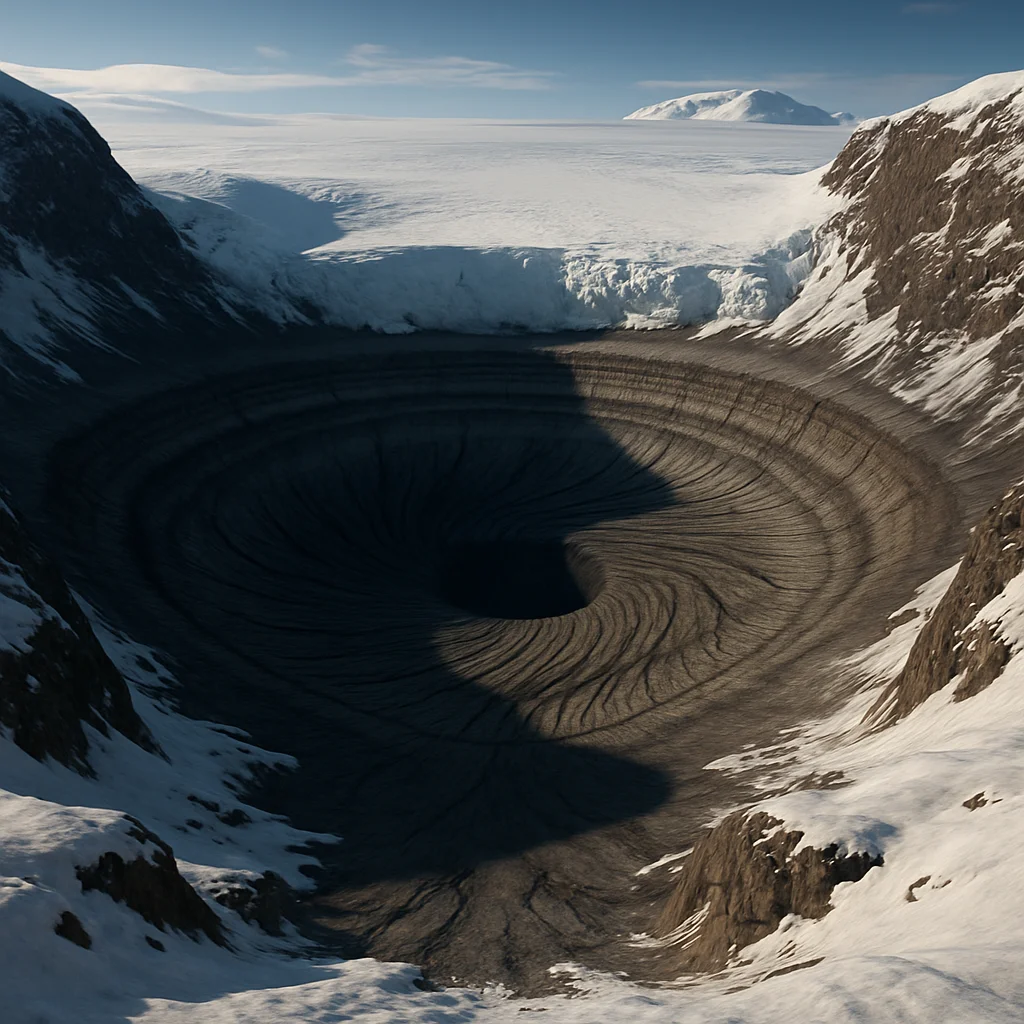
Visualization
Beneath the unyielding expanse of the East Antarctic Ice Sheet—a glacial mass obscuring over 99% of the continent's underlying geology—lies a geomorphological enigma whose true vastness is only now coming into focus. Through the synthesis of high-resolution seismic reflection profiles, airborne gravity anomalies, and cutting-edge topographic models derived from extensive radio-echo sounding compilations, a pan-European team led by Egidio Armadillo (University of Genoa) has mapped a colossal, fan-shaped subsurface province that unites many of East Antarctica’s most prominent subglacial basins within a single tectonic framework.
This physiographic entity, formally designated as the East Antarctic Fan-Shaped Basin Province (EAFBP), extends laterally from Prydz Bay on the Antarctic coast to the Transantarctic Mountains and coheres north-south across the continent—encompassing an arc over 2,000 km long, with the province’s notional apex pointing toward the South Pole. Armadillo et al. leverage recent advances in radio-echo sounding—enabling sub-ice topographic mapping with vertical resolutions below 10 m and horizontal spot sizes of less than a kilometer—to reveal a remarkably coherent V-shaped alignment of subglacial basins. These basins, including the Wilkes and Aurora, and the depression underlying Lake Vostok (Earth’s largest subglacial lake), display consistent north-south structural trends and geometric relationships that call for a unified tectonic interpretation.
Spatial analysis of the continent-ocean boundary, marked in potential field data and topography, reveals a striking semi-circular arc geometry, truncating the northern sector of the province. The fan-like topography—unparalleled at this scale elsewhere on the planet—suggests a highly organized crustal origin. By integrating regional gravity field modeling, the researchers infer density contrasts indicative of deep crustal thinning and sedimentary fill, consistent with extended continental lithosphere.
Central to the team’s interpretive thesis is the model of distributed rotational extension, a process wherein stretching occurs radially from a pivot or fixed point, analogized to the splaying of a hand: the base of the thumb representing the pivot and the fingers, the divergent structural basins. Contrary to the simpler paradigm of linear rift propagation, the mathematical representation of rotational extension involves an angular velocity field \(\omega\) about the pivot, resulting in a local extensional strain rate \(\dot{\varepsilon} = \omega \cdot r\), where \(r\) is the radial distance from the center of rotation. Such mechanics yield a series of triangular (transtensional) basins between rotational 'fingers', an arrangement elegantly mirrored by the mapped basin alignments across the EAFBP.
Geohistorical context places the nucleation and development of this fan under the broader tectonic regime governing the evolution and dispersal of Gondwana. The researchers propose that multiphase extension during Gondwana’s later stages—and specifically the initial rifting episode that ultimately separated Antarctica from Australia—imparted this fan-shaped tectonic architecture, possibly with feedbacks that facilitated the continental breakup itself.
Yet the implications of this discovery extend beyond tectonic narrative. The physical bedrock relief, frozen in ancient crustal stretching, exerts contemporary control over the dynamics of the overlying ice—modulating regional ice flow, dictating the configuration of subglacial lakes and hydrologic networks, and imposing first-order boundary conditions on the stability of the East Antarctic Ice Sheet. Given the increasing vulnerability of certain Antarctic ice sectors to climate-driven perturbations, the newfound understanding of the EAFBP’s influence on basal topography injects a fresh variable into projections of future ice-sheet response.
Armadillo et al. acknowledge outstanding questions—most notably, the precise chronostratigraphy of the structure and the dynamic coupling between ancient tectonics and current glaciological regimes—but the magnitude of their revelation is clear: Beneath the ice, Antarctica harbors not just a repository of buried terrains, but one of the globe’s most gigantic and intricate records of continental stretching, mapped today as a fan whose imprint may define not only paleoenvironmental histories, but the continent’s climatic future. This study, published in Nature Geoscience, establishes the EAFBP as both a geodynamic phenomenon and a critical boundary condition on the evolving Antarctic system.