Field: Technology
Ancient Seafloor Canyons Helped Preserve Some of Earth’s Oldest Animal Fossils, New Study Says
Published | Technical Staff
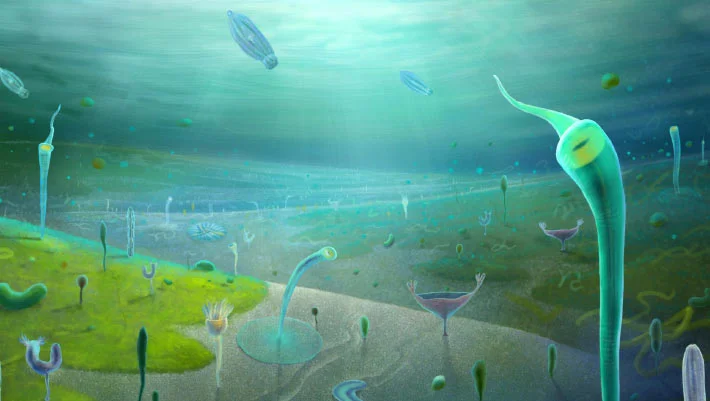
Visualization
In a groundbreaking study led by researchers from the University of Adelaide, new insights into the preservation mechanisms of some of Earth’s earliest complex animal fossils have emerged from examinations of the Ediacaran period strata in South Australia. The findings suggest that the interplay of fluctuating sea levels significantly contributed to the exceptional preservation of these ancient life forms, particularly in the context of dramatic underwater geography changes induced by significant tectonic and climatic events.
The research, spearheaded by Dr. Karol Faehnrich, delves into the underpinnings of the Ediacara Member, a noted rock layer that has yielded one of the richest assemblages of Ediacaran fossils, dating back more than 540 million years. The current topography of this region starkly contrasts the primordial landscape, which featured extensive underwater canyons intersecting a continental shelf. The study posits that these canyons, some reaching depths of 280 meters and widths approaching 6 kilometers, were formed under conditions of low global sea levels, when riverine systems interacted with the newly exposed continental shelf.
To elucidate these geological transformations, the team meticulously logged over 3,000 meters of rock sections, employing high-resolution satellite-derived elevation models to map the underlying terrain. The result revealed a complex network of deep, southeast-oriented valleys whose serrated landscape features a capsule of preserved sediment depicting ancient marine environments. The composition of these valleys suggested significant sediment displacement, indicative of underwater landslides and sediment-laden current activity. Such conditions raised questions regarding the morphology of these canyons, challenging previous assumptions that they were exclusively river-cut features.
Dr. Faehnrich and his colleagues argue convincingly that the scale and depth of these structures were unlikely to have been achieved by fluvial processes alone. Rather, they propose that these valleys originated as submarine canyons during periods of lowered sea levels, subsequently modified by sediment deposits resulting from violent marine events as sea levels rose dramatically. This flooding is postulated to have buried the canyon structures beneath layers of sediment, effectively quarantining them from the erosive forces of storm activity. The subsequent environmental conditions during this time were crucial for the preservation of soft-bodied organisms—yielding delicate impressions that are characteristic of Ediacaran fossils.
The ramifications of this research extend beyond Australian shores. The observed patterns of fluctuating sea levels, with notable rises following periods of decline, have been identified in analogous geologic formations across Eastern Europe and other regions. This synchronicity suggests that these climatic and sea-level oscillations were potentially global phenomena, thus redefining our understanding of marine ecosystems during this pivotal period in Earth’s history.
Co-author Dr. Diego Garcia-Bellido emphasizes the necessity of both natural and geological processes in shaping the ancient basin, highlighting how these oscillations opened a narrow window—environmental conditions that were uniquely conducive to preserving soft-bodied life forms. Such fossil remnants only survive under specific, optimal conditions, and the scientific implications of this study reinforce the significance of geological history in transcending mere fossil discovery to reconstructing ancient biodiversity and its evolution.
Published in the esteemed journal Earth and Planetary Science Letters, this study provides a detailed account of how ancient seafloor canyons and fluctuating marine environments conspired to foster the emergence of one of the earliest fossil-rich horizons. In an era where paleoecology informs our understanding of current biodiversity and ecosystem resilience, the insights gleaned from these Ediacaran records are invaluable, shedding light on the intricate relationship between geological transformations and the evolutionary milestones of life on Earth.