Field: Technology
Ancient Resin Rewrites Timeline of Plant Evolution: 385-Million-Year-Old Amber from China
Published | Technical Staff
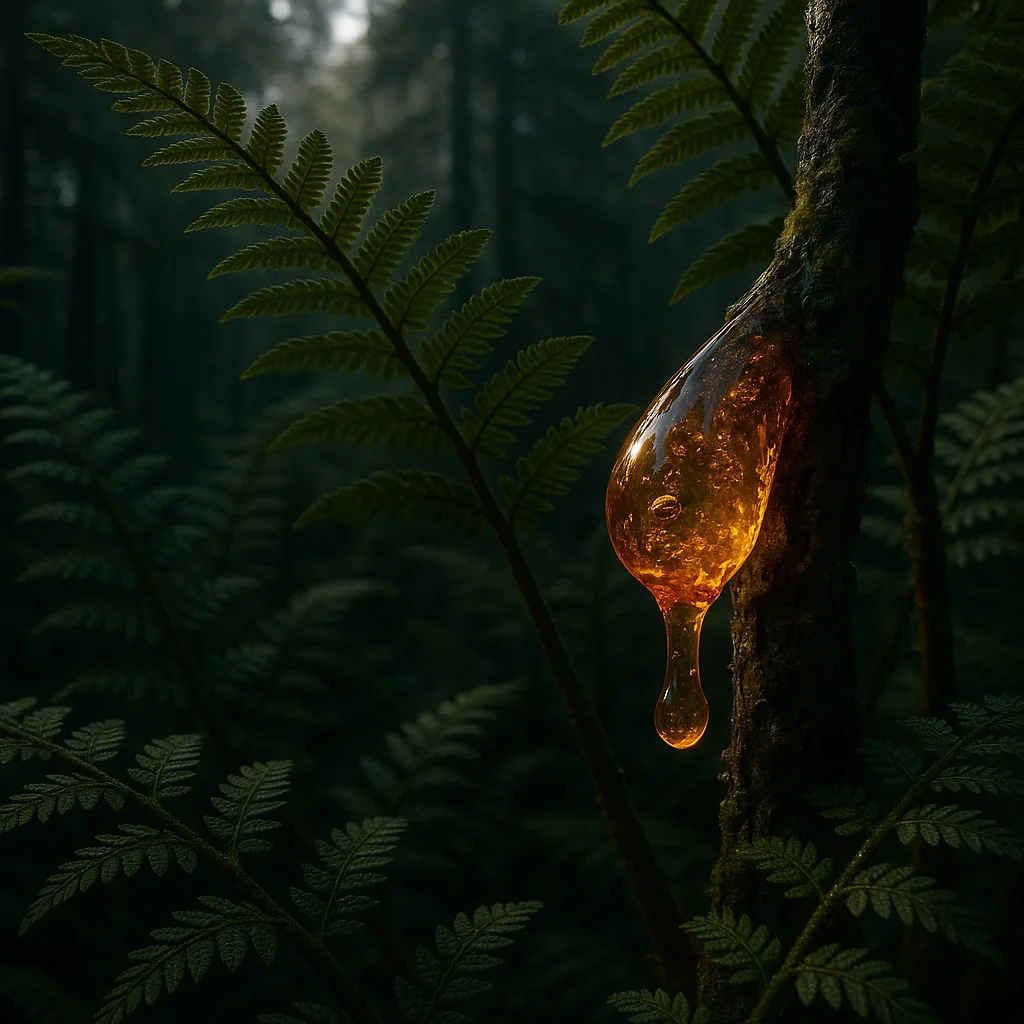
Visualization
The discovery of fossil resin embedded deep within the coal seams of Xinjiang’s Hujiersite Formation has yielded a mesmeric artifact of Earth's primordial biosphere: minuscule fragments of amber, chemically dated to the Middle Devonian, approximately 385 million years ago. This advance, led by Dr. Cihang Luo of the Nanjing Institute of Geology and Palaeontology, disrupts long-held orthodoxies in paleobotany, predating the world’s oldest previously confirmed amber by nearly 65 million years. Notably, this epoch precedes the evolutionary advent of seed plants, thus suggesting that the molecular machinery for resin production was operating in terrestrial flora long before spermatophytes began to diversify.
Careful fieldwork involved the retrieval of some 10 kilograms of coal matrix from Hujiersite, adjacent to Hoxtolgay, which researchers painstakingly dissected under stereomicroscopy. With the aid of ultraviolet fluorescence, they uncovered and hand-extracted 241 discrete amber grains, each no more than 0.5 mm across. Photonic analysis revealed hues from pale ochre to umber, and under UV light, the samples emitted a distinctive blue fluorescence — an optical signature correlated with conjugated organic molecular structure in fossilized resins.
The geological stratum harboring these fossils is unambiguously dated to the Middle Devonian, utilizing both stratigraphic correlation and radiometric chronology. This predates well-known Carboniferous amber localities — such as those in the United States (320 Ma, Cordaitales) and Canada (300 Ma, pteridosperms) — by tens of millions of years, and places the genesis of these exudates well before the widespread proliferation of seed plants in the Late Devonian (Famennian, 372–359 Ma).
The core of the present study turns on the chemistry. Chemical analyses drew upon Fourier-transform infrared spectroscopy (FTIR), which revealed dominant peaks characteristic of terpenoid moieties, and gas chromatography–mass spectrometry (GC–MS), which further resolved the complexity of the resin, fingerprinting molecular species analogous to those secreting from extant conifers. These analyses conclusively demonstrated the presence of tricyclic diterpenes, notably labdanes and abietanes, and phenolic residues consistent with gymnosperm origin. However, given the absence of preserved seed plant macrofossils from the measured section, and in the context of Devonian paleobotany, the source flora were more plausibly identified as progymnosperms—an extinct stem group diverging prior to seed plants—or perhaps tree-like lycopsids, whose structurally complex tissues are attested in the Hujiersite Formation’s plant fossil inventory.
Terpenoid resin biosynthesis is a physiochemical adaptation now recognized as pre-dating seed plants, refuting the textbook assertion that amber is the exclusive preserve of the spermatophyte clade. Modern seed plants synthesize resin as a composite defense mechanism (via secretory canals in xylem, phloem, and rinds) against pathogens, insect predation, and abiotic trauma such as wildfire wounds. In the Devonian context, resin likely conferred wound-sealing and antifungal advantages, as significant herbivorous insect activity appears only in Carboniferous strata. The process of amberification—requiring protracted burial under increased pressure and temperature—would ensue through diagenesis and catagenetic transformation, ultimately yielding the vitrified amber observed in these tiny fossils.
The Hujiersite amber’s spectral and chromatographic signatures closely mirror those of later coniferous ambers. Yet, their Middle Devonian provenance, well antecedent to the rise of the spermatophytes, builds an unassailable case for pre-seed plant resin evolution. If corroborated, the implications are considerable: Hujiersite amber marks the earliest incontrovertible fossil resin yet uncovered, compelling a wholesale revision of plant secondary metabolite evolution and deepening our understanding of the Devonian terrestrial biosphere’s complexity.
Published in Science Advances (Lu et al., 2026), this research not only pushes back the origin of amber, but also prompts new inquiries into plant biochemical innovation during the Devonian. The blue-fluorescing, micron-scale grains from Xinjiang’s depths thus illuminate an unexpected chapter in the evolutionary arms race of early land plants—an adaptive leap destined to influence terrestrial ecology for eons to come.
Reference: Lu, Cihang, et al. "The earliest amber from the Middle Devonian of China." Science Advances 12, no. 29 (2026): e.aeh1266. doi:10.1126/sciadv.aeh1266