Field: Technology
Ancient Outskirts and Cosmic Forensics: Isotopic Evidence Reveals Origin of Interstellar Comet 3I/ATLAS
Published | Technical Staff
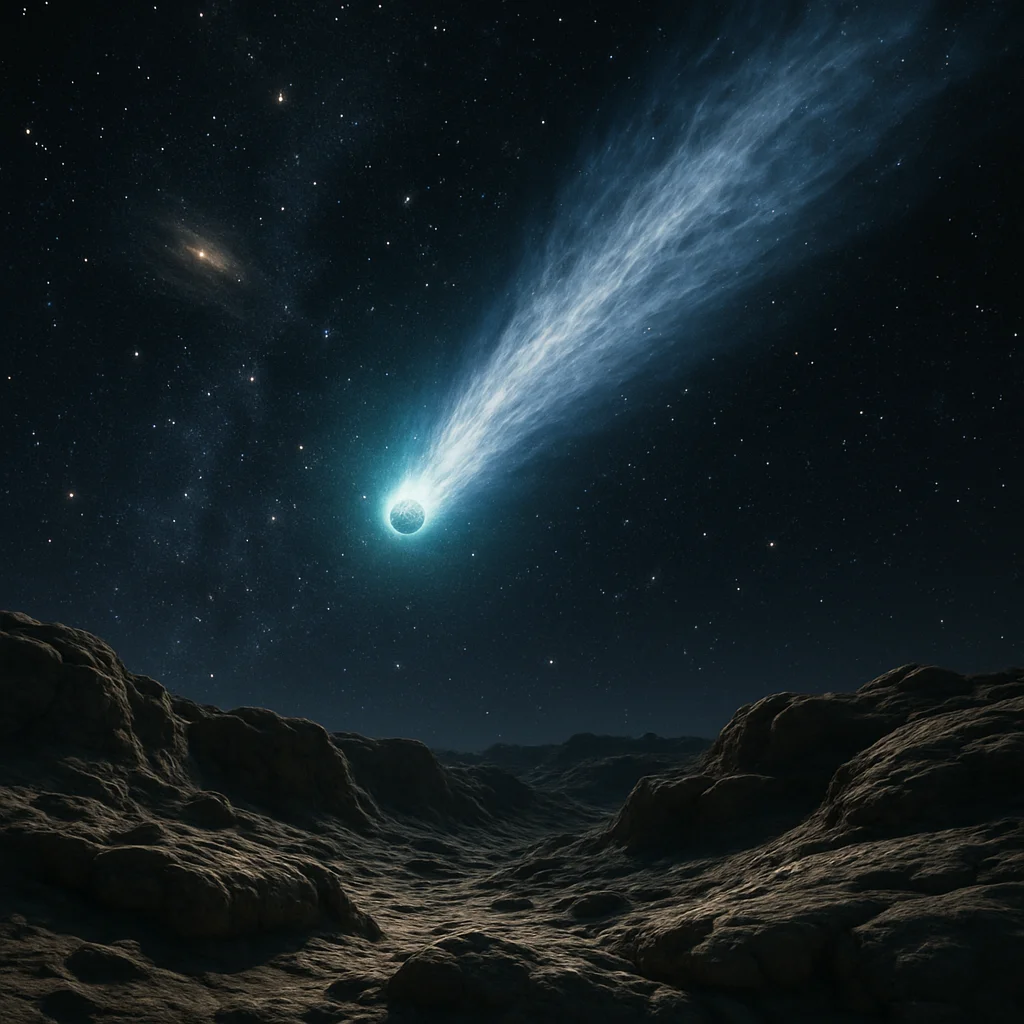
Visualization
In the winter of 2025, as comet 3I/ATLAS sliced across the backdrop of the Solar System, astronomers seized a fleeting opportunity to peer into the history of planetary systems predating our own. The team, led by Dr. Cyrielle Opitom of the University of Edinburgh, marshaled the formidable capabilities of the European Southern Observatory’s Very Large Telescope (VLT) to dissect the isotope ratios embedded within the vaporizing gases of this interstellar wanderer—only the third such object ever detected, after the enigmatic 1I/‘Oumuamua and the dust-laden 2I/Borisov.
Interstellar objects, cast adrift from their natal planetary systems, are more than mere curiosities; they serve as chemical ambassadors from distant realms whose solar and chemical histories diverged dramatically from those of the Solar System. As 3I/ATLAS accelerated away from its perihelion, Dr. Opitom’s group targeted its evolving coma using the VLT’s Ultraviolet and Visual Echelle Spectrograph (UVES). Their quarry: the faint emission bands of cyanogen (CN), from which the fingerprints of carbon and nitrogen isotopes could be meticulously discerned.
The process relied on the principle that small mass differences between isotopes affect how molecules absorb and emit light—resulting in measurable spectral shifts. Thus, by recording high-resolution spectra between December 6 and 26, 2025, the investigators extracted the carbon-12/carbon-13 (\(^{12}\mathrm{C}/^{13}\mathrm{C}\)) and nitrogen-14/nitrogen-15 (\(^{14}\mathrm{N}/^{15}\mathrm{N}\)) ratios locked within the CN gas. Their findings were unparalleled in the domain of extrasolar small bodies: a \(^{12}\mathrm{C}/^{13}\mathrm{C}\) ratio of approximately 151 and a \(^{14}\mathrm{N}/^{15}\mathrm{N}\) value near 363.
Contrast these results with canonical values for Solar System comets, which typically cluster around 90 for \(^{12}\mathrm{C}/^{13}\mathrm{C}\) and 150 for \(^{14}\mathrm{N}/^{15}\mathrm{N}\). The pronounced enrichment in light isotopes, particularly the nitrogen ratio more than double that of local comets, is a striking testament to a markedly different chemical environment. In Solar System formation models, such isotopic ratios are signatures of temperature, radiation field, and heritage. Isotope fractionation—whereby photochemistry and low-temperature ion-molecule reactions preferentially skew the isotopic makeup—leads to compositional gradients within a protoplanetary disk.
Galactic chemical evolution models (see, e.g., Wilson & Rood 1994) predict that stars forming from the primordial, metal-poor gas of earlier cosmic epochs should exhibit higher \(^{12}\mathrm{C}/^{13}\mathrm{C}\) due to the gradual build-up of \({}^{13}\mathrm{C}\) through secondary nucleosynthetic processes over time. The measured value for 3I/ATLAS fits squarely with these predictions, implicating a host star formed long before the Sun, in a galactic environment where heavy elements (metals) were comparatively scarce.
The enhanced \(^{14}\mathrm{N}/^{15}\mathrm{N}\) ratio is equally revelatory. Nitrogen isotopic anomalies can only efficiently arise at the cold periphery of a protoplanetary disk, or within the cold molecular clouds preceding star birth, where isotope-selective reactions are suppressed by low temperatures. Indeed, the value seen in 3I/ATLAS approximates those observed in the interstellar medium—hinting at an origin far from the warmth of a young parent star. Nitrogen in the Solar System comets has likely been processed and homogenized in warmer environments, leading to relatively lower ratios.
Thus, the isotopic architecture of 3I/ATLAS encodes a narrative of ancient and distant origins. The comet likely condensed in the frigid outskirts of a disk orbiting a star both older and more metal-poor than the Sun; this is consistent with models suggesting that planetesimal formation, even around such stars, can proceed efficiently enough to launch fragments into unbound, interstellar trajectories. Its volatile inventory remained largely unaltered by stellar radiation or planetary migration, preserving primordial signatures lost in many Solar System bodies.
In providing the first isotopic analysis of gases from an unambiguous interstellar comet, the work by Dr. Opitom and colleagues delivers a milestone: interlacing galactic chemical evolution, the physics of disk chemistry, and planetary system formation on cosmological timescales. The story told by 3I/ATLAS is one of ancient genesis, cold chemistry, and the enduring promise of interstellar visitors as messengers from epochs and environments vastly removed from our own. This discovery, announced in Nature Astronomy (doi:10.1038/s41550-026-02921-7), fortifies the emerging view that the Solar System is but one node in a galaxy-wide network of planetesimal production, exchange, and ejection—a cosmic diaspora inscribed in isotope ratios, awaiting the next silent passerby.