Field: Technology
Ancient Fossil Reveals Mammalian Live Birth Origin is 90 Million Years Older Than Believed
Published | Technical Staff
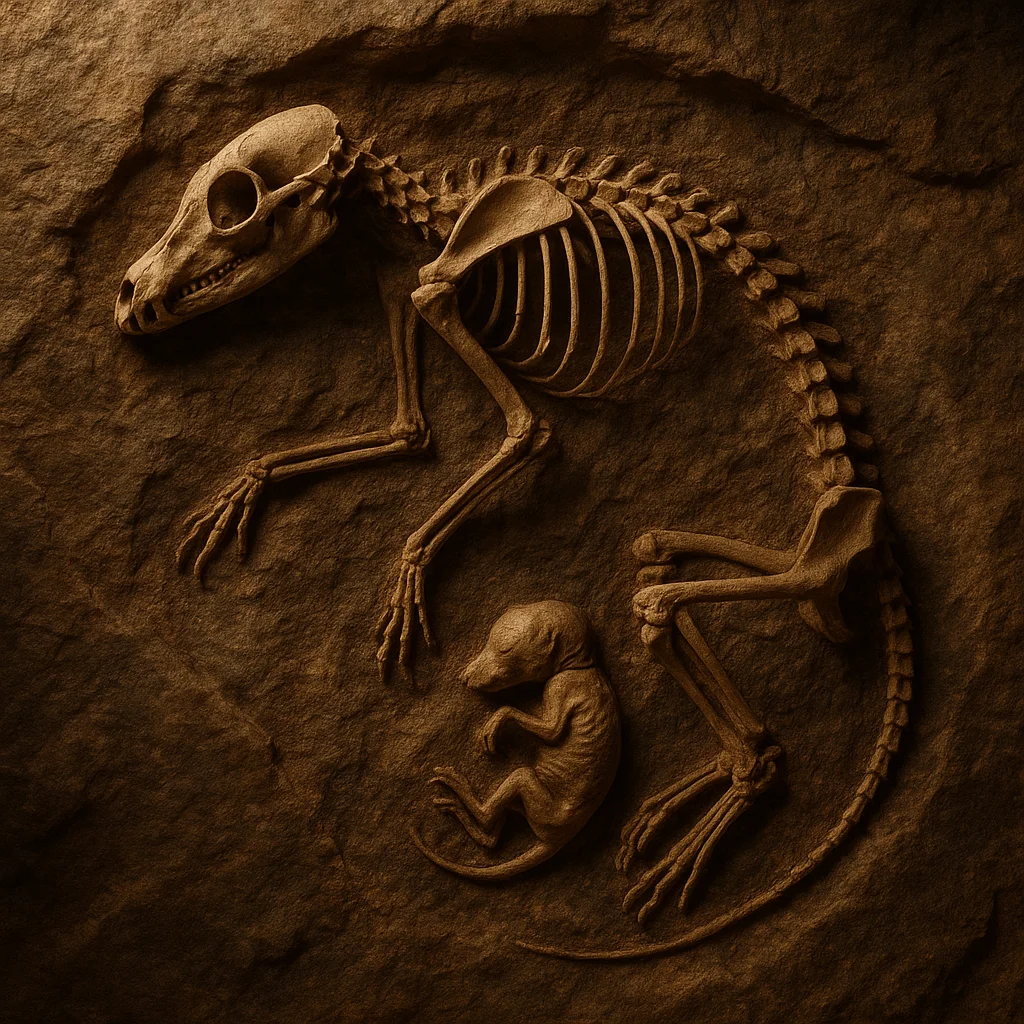
Visualization
A fossil specimen unearthed from the Triassic strata of northwestern Argentina has yielded transformative insight into the reproductive evolution of mammals—pushing the emergence of live birth, or viviparity, almost 100 million years further back in time than previously established. This revelation, stemming from the meticulous osteohistological analysis of a 236-million-year-old Chiniquodon theotonicus fossil, challenges orthodoxies about early mammalian ancestry and raises new questions about the tempo and mode of reproductive innovation among mammal predecessors.
Chiniquodon theotonicus, a cat-sized carnivorous cynodont, occupied Gondwana’s prehistoric landscapes during the mid-Triassic epoch. Notably, cynodonts represent a deeply significant clade bridging the evolutionary transition from reptilian synapsids to true mammals. Until now, it was widely held that all non-mammaliaform cynodonts practiced oviparity, the plesiomorphic (ancestral) reproductive mode in vertebrates, only for viviparity to arise within the therian crown group—the lineage leading to marsupials (Metatheria) and placentals (Eutheria).
Lead author Dr. Leandro Gaetano and his colleagues from the National Scientific and Technical Research Council (CONICET) uncovered evidence to the contrary by examining bone microstructure in the fossilized femur and ulna of C. theotonicus. Thin-section histology revealed a distinct “neonatal line,” a histological landmark formed by a sudden transition in bone tissue at the moment of birth. This feature, analogous to the neonatal lines robustly documented in living placental mammals, has never before been identified in a stem-mammalian fossil.
To quantify the implications of this feature, the investigators measured the circumference of the long bones at the neonatal line and applied established allometric scaling equations—\( M = a \cdot (C)^b \), where \( M \) is body mass, \( C \) is bone circumference, and \( a \) and \( b \) are empirically derived constants. Results indicated a neonatal mass of approximately 1.68 kg, contrasted against an estimated adult mass near 12 kg. This yields a birth weight to adult ratio spanning 10–20%, congruent with modern eutherian mammals, in which neonates are often born at a substantial fraction of adult size—considerably larger, proportionally, than the fragile hatchlings of marsupial, monotreme, reptilian, or avian clades. For perspective, extant monotremes such as the platypus (Ornithorhynchus anatinus) produce offspring at less than 1% of adult body mass, reinforcing the ancient cynodont’s affinity with viviparous reproductive investment.
Corroborating these findings, the paleo-biological team conducted a phylogenetic and statistical meta-analysis, integrating osteohistological data across an expansive comparative dataset: 1,900 mammals, 2,600 reptiles, and 780 birds. Algorithmic clustering of trait variables consistently classified C. theotonicus in close proximity to placental mammals.
The derived inference directly upends the prevailing hypothesis that live birth in mammals materialized as a late evolutionary event, exclusive to the therian branch. According to Dr. Gaetano, “We show for the first time that live birth was present in at least one mammalian ancestor, Chiniquodon theotonicus, which lived approximately 236 million years ago. This implies that viviparity among early cynodonts originated in the mammalian lineage at least 90 to 95 million years earlier than previously thought.”
Two scenarios now emerge: one posits independent origination of viviparity in the C. theotonicus lineage and, convergently, in therians—a possibility echoing the propensity for viviparity to evolve independently over 150 times among vertebrate taxa, as documented in evolutionary biology. The alternative scenario, no less plausible, argues for a single, ancient emergence of live birth deeply rooted in the cynodont-mammalian stem lineage, with certain “primitive” mammals such as monotremes subsequently reverting to oviparity, rather than never having acquired viviparity at all.
Interestingly, monotremes today display vestigial hints of viviparity-related adaptations, including limited forms of placentation—specifically via absorption of oviductal secretions, in contrast to the elaborate yolk sac or chorioallantoic placentas of therians. This embryonic interface suggests a retained, if truncated, evolutionary memory of a viviparous ancestor, potentially aligning living monotremes with the reversal hypothesis advanced by Gaetano’s team.
While more fossil evidence is required to resolve whether C. theotonicus is an isolated representative or an early beacon of a broader transition, the implications for understanding the suite of mammalian reproductive synapomorphies are profound. Viviparity is closely tied to mammalian success, serving as a foundation for subsequent innovations: placentation, lactation, and their intricate endocrine oversight.
This pivotal discovery conflates the narrative of mammal evolution, suggesting that key life-history strategies emblematic of modern mammals—internal gestation, high neonatal investment, and interactive parental care—may have deep evolutionary antecedents that traverse much farther back than the dawn of therians. “It is very well possible that Chiniquodon theotonicus does not represent an isolated case,” Dr. Gaetano cautions, “but it could be evidence of the general switch from laying eggs to giving birth to live young early on in the mammalian lineage. Still, we need more evidence to test this hypothesis.” Yet, the anatomical and developmental footprints of this ancient cynodont resonate with striking modernity, uncovering another tantalizing chapter in the story of mammal origins.
The full study appears in the latest issue of *Frontiers in Mammal Science* (Gaetano et al., 2026, doi: 10.3389/fmamm.2026.1845319), offering a new lens through which to view the evolutionary enigma of live birth and its pivotal role in the ascent of mammals.
Chiniquodon theotonicus, a cat-sized carnivorous cynodont, occupied Gondwana’s prehistoric landscapes during the mid-Triassic epoch. Notably, cynodonts represent a deeply significant clade bridging the evolutionary transition from reptilian synapsids to true mammals. Until now, it was widely held that all non-mammaliaform cynodonts practiced oviparity, the plesiomorphic (ancestral) reproductive mode in vertebrates, only for viviparity to arise within the therian crown group—the lineage leading to marsupials (Metatheria) and placentals (Eutheria).
Lead author Dr. Leandro Gaetano and his colleagues from the National Scientific and Technical Research Council (CONICET) uncovered evidence to the contrary by examining bone microstructure in the fossilized femur and ulna of C. theotonicus. Thin-section histology revealed a distinct “neonatal line,” a histological landmark formed by a sudden transition in bone tissue at the moment of birth. This feature, analogous to the neonatal lines robustly documented in living placental mammals, has never before been identified in a stem-mammalian fossil.
To quantify the implications of this feature, the investigators measured the circumference of the long bones at the neonatal line and applied established allometric scaling equations—\( M = a \cdot (C)^b \), where \( M \) is body mass, \( C \) is bone circumference, and \( a \) and \( b \) are empirically derived constants. Results indicated a neonatal mass of approximately 1.68 kg, contrasted against an estimated adult mass near 12 kg. This yields a birth weight to adult ratio spanning 10–20%, congruent with modern eutherian mammals, in which neonates are often born at a substantial fraction of adult size—considerably larger, proportionally, than the fragile hatchlings of marsupial, monotreme, reptilian, or avian clades. For perspective, extant monotremes such as the platypus (Ornithorhynchus anatinus) produce offspring at less than 1% of adult body mass, reinforcing the ancient cynodont’s affinity with viviparous reproductive investment.
Corroborating these findings, the paleo-biological team conducted a phylogenetic and statistical meta-analysis, integrating osteohistological data across an expansive comparative dataset: 1,900 mammals, 2,600 reptiles, and 780 birds. Algorithmic clustering of trait variables consistently classified C. theotonicus in close proximity to placental mammals.
The derived inference directly upends the prevailing hypothesis that live birth in mammals materialized as a late evolutionary event, exclusive to the therian branch. According to Dr. Gaetano, “We show for the first time that live birth was present in at least one mammalian ancestor, Chiniquodon theotonicus, which lived approximately 236 million years ago. This implies that viviparity among early cynodonts originated in the mammalian lineage at least 90 to 95 million years earlier than previously thought.”
Two scenarios now emerge: one posits independent origination of viviparity in the C. theotonicus lineage and, convergently, in therians—a possibility echoing the propensity for viviparity to evolve independently over 150 times among vertebrate taxa, as documented in evolutionary biology. The alternative scenario, no less plausible, argues for a single, ancient emergence of live birth deeply rooted in the cynodont-mammalian stem lineage, with certain “primitive” mammals such as monotremes subsequently reverting to oviparity, rather than never having acquired viviparity at all.
Interestingly, monotremes today display vestigial hints of viviparity-related adaptations, including limited forms of placentation—specifically via absorption of oviductal secretions, in contrast to the elaborate yolk sac or chorioallantoic placentas of therians. This embryonic interface suggests a retained, if truncated, evolutionary memory of a viviparous ancestor, potentially aligning living monotremes with the reversal hypothesis advanced by Gaetano’s team.
While more fossil evidence is required to resolve whether C. theotonicus is an isolated representative or an early beacon of a broader transition, the implications for understanding the suite of mammalian reproductive synapomorphies are profound. Viviparity is closely tied to mammalian success, serving as a foundation for subsequent innovations: placentation, lactation, and their intricate endocrine oversight.
This pivotal discovery conflates the narrative of mammal evolution, suggesting that key life-history strategies emblematic of modern mammals—internal gestation, high neonatal investment, and interactive parental care—may have deep evolutionary antecedents that traverse much farther back than the dawn of therians. “It is very well possible that Chiniquodon theotonicus does not represent an isolated case,” Dr. Gaetano cautions, “but it could be evidence of the general switch from laying eggs to giving birth to live young early on in the mammalian lineage. Still, we need more evidence to test this hypothesis.” Yet, the anatomical and developmental footprints of this ancient cynodont resonate with striking modernity, uncovering another tantalizing chapter in the story of mammal origins.
The full study appears in the latest issue of *Frontiers in Mammal Science* (Gaetano et al., 2026, doi: 10.3389/fmamm.2026.1845319), offering a new lens through which to view the evolutionary enigma of live birth and its pivotal role in the ascent of mammals.