Field: Technology
An Ice Age Bestiary Emerges from the Submerged Depths of Texas
Published | Technical Staff
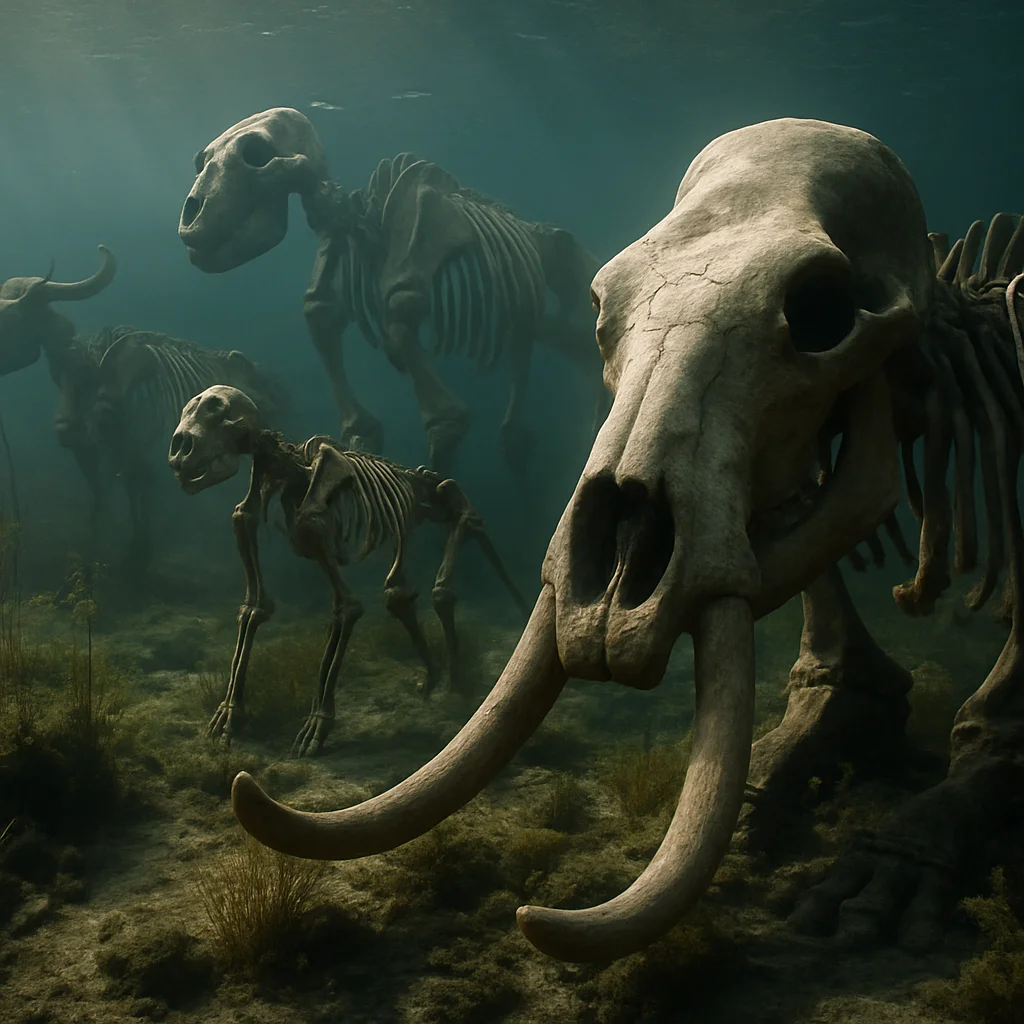
Visualization
In a flooded labyrinth beneath the limestone expanse of the Edwards Plateau, a paleontological revelation has surfaced: a bone-littered archive that may chronicle a climatic episode Central Texas has never before yielded to science. Bender’s Cave, a water-carved conduit lying hidden within private land in Comal County, has disgorged a fossil assemblage comprising giant tortoises (Hesperotestudo sp.), the awe-inspiring ground sloth (Megalonyx jeffersonii), the armadillo-reminiscent pampathere (Holmesina septentrionalis), scimitar-toothed cats (Homotherium serum), and representatives of horses, camels, and mastodons. Their very presence in these subterranean corridors upends long-held paradigms about the region's late Pleistocene climates and faunal communities.
The story begins with caver John Young and University of Texas at Austin paleontologist John Moretti, who—eschewing traditional excavation—collected these Pleistocene relics by donning snorkels and goggles, crawling the sinuous streambeds of Bender’s Cave. “There were fossils everywhere, just everywhere, in a way that I haven’t seen in any other cave,” Moretti observed, the sheer density of remains forming a nearly continuous layer atop the cave floor. The sedimentological context indicates that these bones were introduced en masse, likely during episodic flooding and erosional sinkhole events, an inference strengthened by their matched degrees of ferruginous mineralization, abraded surfaces, and uniform rounding—a taphonomic fingerprint suggestive of contemporaneous deposition.
Recovered from 21 discrete collection zones, the fossils, though waterworn, retain diagnostic features requisite for taxonomic identification. The community composition itself is striking: species such as Hesperotestudo sp., which requires relatively mesic conditions for survival, and the pampathere Holmesina, whose historical range traces the southern Pleistocene biomes, align poorly with our prior understanding of local paleoenvironments. The presence of megafaunal taxa such as Mastodon and Megalonyx jeffersonii, known elsewhere from terminal Pleistocene contexts, threads an additional layer of complexity upon the region’s paleoecological tapestry.
The chronological resolution pivots on sedimentological and geomorphological evidence, as well as biostratigraphic comparison. Moretti’s analysis interprets the fossil deposit as representing the last interglacial, the so-called Marine Isotope Stage 5e (MIS 5e), around 125,000–100,000 years before present. This assignment is underpinned by the species assemblage and sedimentary characteristics, particularly the absence of cold-adapted forms and the coexistence of mammals demanding relatively warm and stable open habitats. If corroborated by future radiometric dating—uranium-series or optically stimulated luminescence methods might be deployed given the cave environment—this would be the inaugural evidence of a last interglacial megafaunal community in Central Texas.
This site, therefore, opens an unprecedented window: the possibility that, unlike the steppe-tundra mosaics classically implicated for mid-latitude North America’s late Pleistocene, the Edwards Plateau sustained a warm, possibly humid-adapted biota during the Eemian. The implications for regional paleoclimate trajectories are profound, suggesting intervals of faunal expansion and contraction that respond to orbital-scale climate forcing (Milankovitch cycles), rather than static or uniform glacial-age environments.
Colleagues unaffiliated with the study, such as Dr. David Ledesma of St. Edwards University, emphasize the finding’s significance—“even in an area as well documented as Central Texas, there are new things to find.” The interdisciplinary potential is immense, demanding integration of paleoecological modeling, stable isotope analysis (δ^18O, δ^13C from enamel or bone collagen), and high-resolution stratigraphic correlation to reconstruct the microclimates that supported such a diverse and unexpected faunal guild.
As published in Quaternary Research (Moretti & Young, 2026; doi:10.1017/qua.2025.10071), the Bender’s Cave discoveries press a challenge to prevailing reconstructions of late Quaternary ecosystems in the American Southwest. These fossil-rich aquifers—accessible through the most elemental methods, by touch and sight alone—may yet herald a deeper understanding of Ice Age North America, not as a monotonous sprawl of giants, but as a place of nuanced ecological flux and resilience, punctuated by windows of warmth and biological novelty, submerged and silent until now.