Field: Technology
An ancient ocean full of giant predators reveals a surprising twist in evolution
Published | Technical Staff
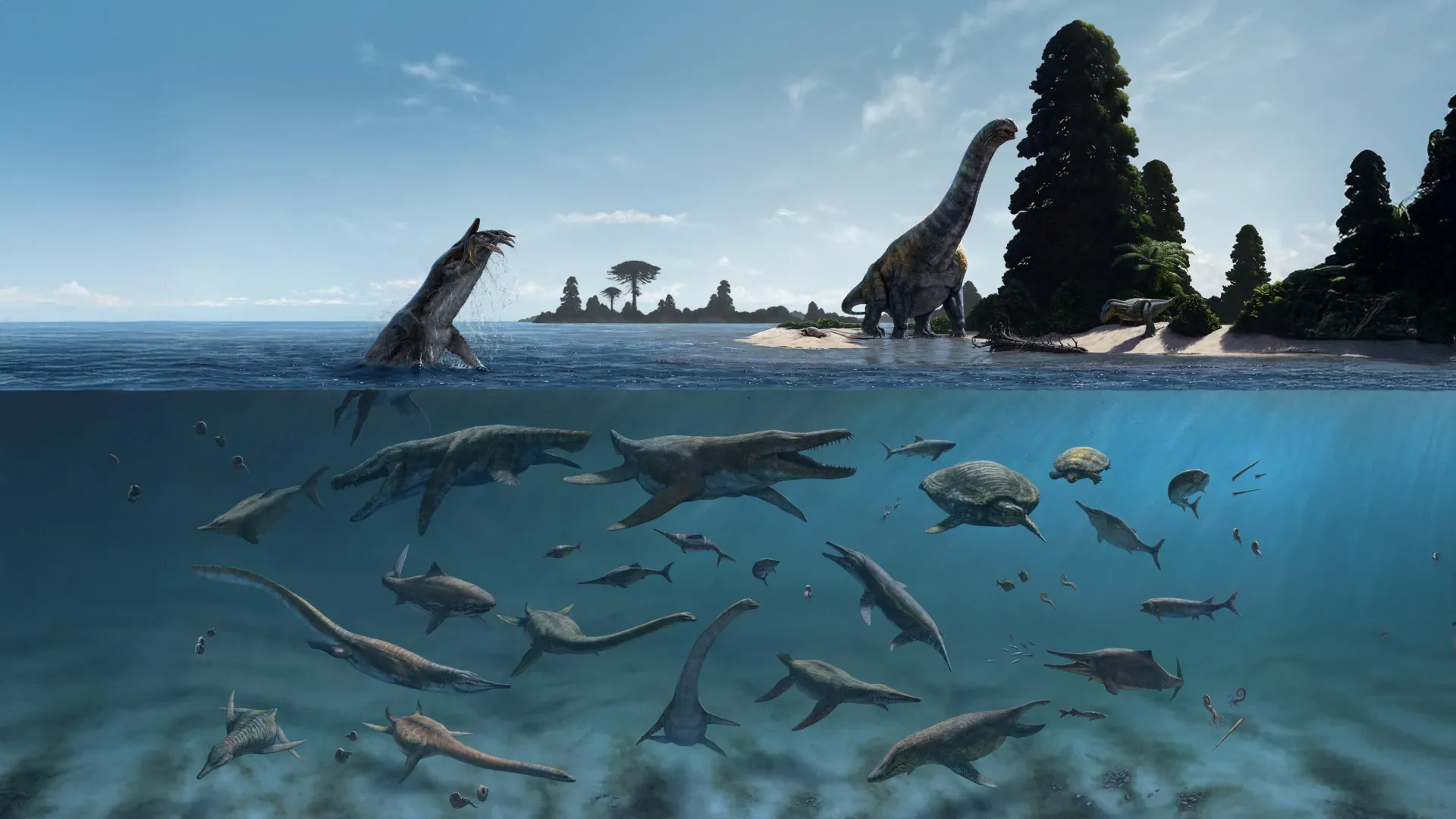
Visualization
In a breathtaking revelation that challenges established paradigms in evolutionary biology, researchers from McGill University and the Centro de Investigaciones Paleontológicas (CIP) have unearthed an extraordinary collection of fossils in the Paja Formation of Colombia. This ancient marine ecosystem, teeming with a remarkable diversity of life, serves as a critical window into a pivotal chapter of Earth’s biological history, indicating that significant evolutionary transformations can manifest without the catastrophic backdrop of mass extinctions.
Among the myriad of fossils excavated from the Paja Formation, scientists have documented a complex assemblage of marine life that includes imposing long-necked plesiosaurs, marine reptiles akin to crocodiles, various species of turtles, formidable sharks, and a rich tapestry of crustaceans and other organisms. This assemblage, classified as the Paja Biota, has been heralded as one of the most ecologically sophisticated marine communities encountered to date, embodying a rich intersection of pre-existing Jurassic groups and emerging Cretaceous lineages.
Professor Hans Larsson and doctoral candidate Dirley Cortés, key figures in this research, have posited the existence of what they term a "Biotic Inflection." This concept describes an evolutionary juncture where older taxa, edging towards extinction, coexist and interact with nascent lineages that are beginning to flourish. This recognition of coexistence presents a profound reconsideration of how biodiversity dynamics operate, especially during periods of significant ecological upheaval.
The Paja Formation not only crystallizes a moment of coexistence but also elucidates the environmental conditions that made such a rich tapestry of life possible. The research team posits that a unique convergence of factors—specifically elevated greenhouse temperatures, rising sea levels, and nutrient-enriched coastal waters—created conditions that favored ecological complexity. Moreover, the formation of new oceanic connections between the eastern Pacific and the early Atlantic facilitated this interplay of marine life.
Larsson articulated this notion, describing the Paja Formation as a setting where a "perfect storm" of environmental factors coalesced to bolster biodiversity. Against the backdrop of an ancient biosphere poised for restructuring, these ecological parameters allowed for an intricate web of marine life to thrive, wherein varied lineages not only survived but generated a vibrant and diverse community.
The meticulous examination of interactions within the Paja Biota has unveiled a remarkably intricate food web, distinguished by an extensive array of apex predators. Utilizing advanced methods in paleontological reconstruction, the researchers mapped these feeding relationships, emphasizing the ecological complexity that characterizes this ancient marine habitat. The insights derived from the Paja Formation render it an invaluable resource for understanding the mechanisms through which ecosystems adapt in response to declining lineages and the establishment of new groups.
As this research continues to unfold, it casts a fresh light on Earth's evolutionary narrative, proposing that not all significant biodiversity changes are driven by extinction events. Rather, the phenomenon of Biotic Inflection suggests that evolutionary transitions can parallel periods of remarkable biodiversity, complicating previously held views regarding species turnover and ecological resilience.
In light of these findings, Larsson acknowledges the necessity for further investigations to ascertain the prevalence of such patterns across Earth's geological history. These initiatives will encompass additional fossil recoveries, an exhaustive dating of specimens, and comparative analyses with geological formations globally. The implications of the Biotic Inflection present a compelling narrative that local ecosystems may have undergone similar transitions throughout history, fundamentally altering the trajectory of life's evolution on our planet.
The research has secured funding from prominent institutions including the Natural Sciences and Engineering Research Council of Canada and the Smithsonian Tropical Research Institute, among several others, enabling this groundbreaking work to advance.
As we chart the depths of ancient marine ecosystems, the exploration of the Paja Formation not only enhances our understanding of biodiversity dynamics but also invites us to reconsider the rhythm of life on Earth, unveiling the persistent interplay of persistence and innovation that characterizes the ever-evolving tapestry of existence.