Field: Technology
A tiny defect in a crystal reveals a big quantum surprise
Published | Technical Staff
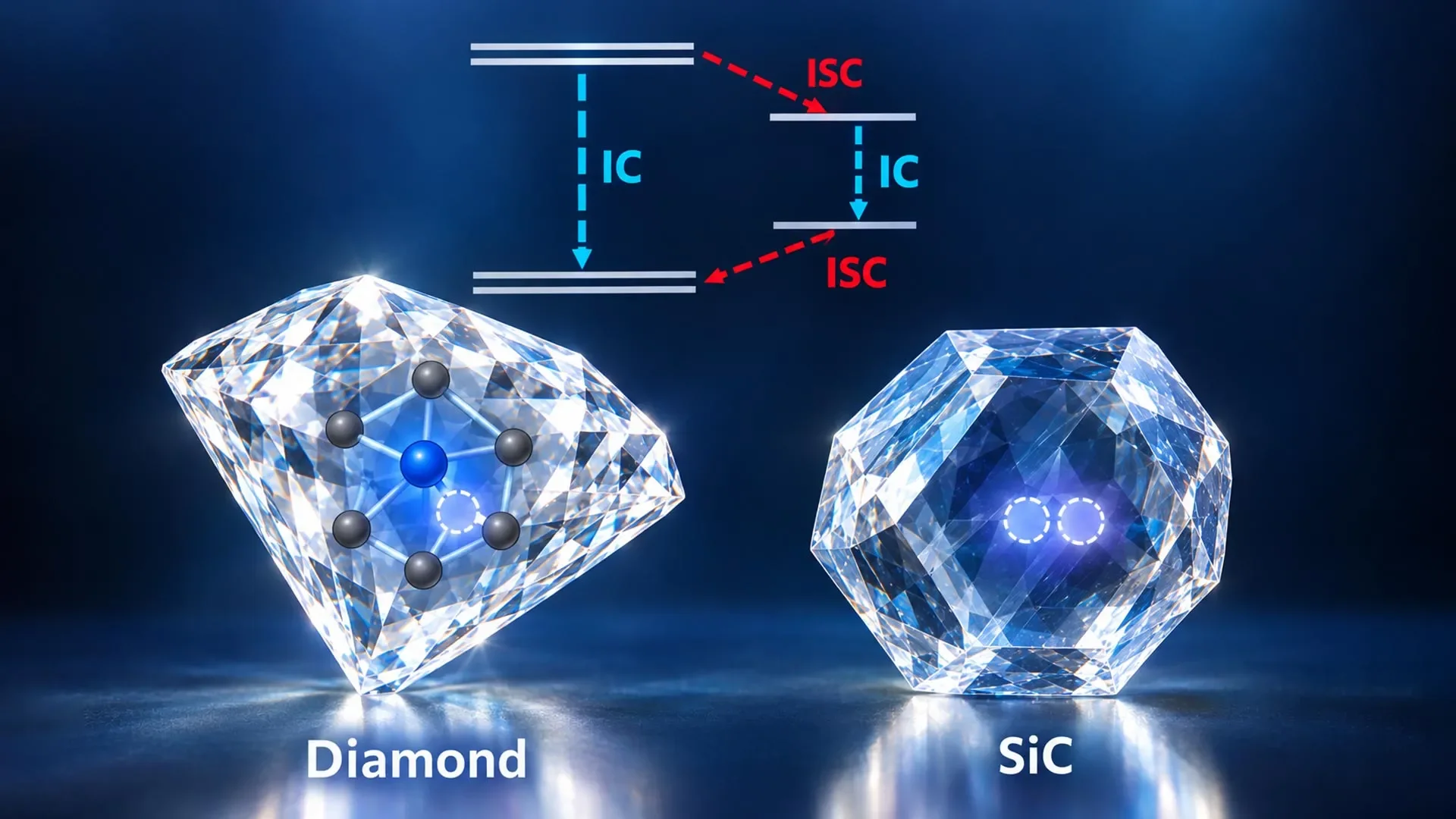
Visualization
In the heart of quantum mechanics lies a tantalizing realm where the properties of matter can be manipulated at laughably small scales. Recent breakthroughs from the Galli Group at the University of Chicago Pritzker School of Molecular Engineering have illuminated a previously obscure pathway of energy loss within spin defects in materials such as silicon carbide—critical substrates for the next wave of quantum technologies.
The excitation of electrons amidst the structural imperfections within these crystals holds the promise of solid foundational qubits for quantum computing and enhanced sensing capabilities. Predominantly, researchers have struggled to grasp the dynamic behavior of these spin defects under optical stimulation—an interaction that can excite electrons into higher energy states before they eventually relax back to equilibrium. The complexities arise from the multifaceted nature of these processes, and in particular, the challenge posed by internal conversion, where energy is dissipated as vibrational energy in the surrounding lattice.
Internal conversion, a phenomenon notoriously difficult to capture in computational models, occurs when an excited electronic state decays to a lower energy level while simultaneously imparting energy to atomic vibrations—a process defined mathematically through many-body wavefunctions. Traditionally, simulating this behavior demanded a brute force approach applied to extensive atomistic models, requiring significant computational resources and yielding limited success. Giulia Galli and her team have circumvented such computational roadblocks by leveraging a suite of techniques honed over years, ultimately culminating in a comprehensive framework capable of simulating the entirety of the optical cycle of spin defects in realistic solids.
Crucially, the Galli Group's investigations began with the nitrogen-vacancy center in diamond—a well-studied defect that provided a baseline for their advanced computations. Their calculations confirmed pre-existing theories: while internal conversion remained a minor contributor to energy loss in triplet states, it evolved into a predominant mode in singlet states, encapsulating the expected behaviors articulated by previous research. However, as they transitioned to explore the divacancy defect in silicon carbide, a surprising revelation unfolded—a much greater influence of internal conversion on the defect's excited triplet state lifetime than previously appreciated.
This insight significantly reconciles longstanding discrepancies between theoretical calculations and experimental findings, allowing scientists a clearer lens through which to forecast the performance of silicon carbide in future quantum applications. Spearheading this endeavor were postdoctoral researcher Stefano Villani and Yu Jin, who both contributed to developing an integrated workflow within WEST, an open-source simulation software optimized for performance on graphics processing units. Their work armed researchers with the computational tools necessary to parse the interactions of electrons with surrounding atomic vibrations, thereby facilitating the calculation of energy dynamics in complex materials.
Even as the research community begins to utilize this framework, Galli and her colleagues are already pursuing enhancements to improve efficiency, exploring the potential of artificial intelligence to streamline energetic calculations further. The scope of their inquiry has potential implications not just for quantum computing but extends into energy technologies, where understanding the mechanics of energy transfer and loss remains a pivotal concern. The internal conversion pathway they have elucidated could pave the way for innovative designs in renewable energy systems, particularly as scientists strive to optimize the performance and longevity of energy-conversion materials.
Through their groundbreaking work, the Galli Group has successfully pieced together a cornerstone of the optical cycle of spin defects. This step constitutes more than just a significant advancement in theoretical modeling; it arms industry leaders and researchers alike with actionable insights that can navigate the landscape of quantum technology and renewable energy solutions in ways that were once thought unattainable. The revelations born from seemingly inconsequential crystal defects may, in fact, unlock profound advancements in both computation and sustainable energy.