Field: Technology
A quantum breakthrough makes light behave like both a solid and a liquid
Published | Technical Staff
Visualization
In an unprecedented development that blurs the lines between distinct states of matter, researchers have reported the successful observation of a supersolid—a state that combines the ordered structure of a crystal with the frictionless flow characteristic of a superfluid—all at room temperature. This pivotal work comes from an international consortium, the TopoLight project, involving the Faculty of Physics at the University of Warsaw, the Military University of Technology in Poland, IBM Research Zurich, and the French National Centre for Scientific Research (CNRS). The implications of this discovery extend beyond theoretical physics into practical applications in the realms of optical computing and ultra-sensitive sensing technology.
Traditionally, investigations into peculiar quantum states like supersolidity demanded extreme experimental conditions, particularly temperatures approaching absolute zero. Under such conditions, particles behave in non-intuitive ways, enabling phenomena such as superfluidity, where internal friction vanishes and fluids flow unimpeded through minute channels. In classic superfluid systems—exemplified by the behavior of helium at low temperatures—turbulent instabilities manifest as quantum vortices when certain threshold velocities are attained.
Theoretical interest in supersolids dates back to the 1960s, leading to rigorous examinations of how a superfluid could theoretically exhibit a crystalline structure derived from its quantum mechanical properties. However, empirical confirmations of supersolid behavior remained elusive until the advent of ultra-cold atomic systems, such as Bose-Einstein condensates, which revealed this fascinating state of matter for the first time in 2017.
The research team in this recent study, instead of relying on ultracold atoms, harnessed the concept of exciton polaritons—exotic quasiparticles that arise when light interacts intensely with matter within an optical microcavity. The study utilized novel liquid crystal configurations that permitted this hybridization without necessitating extreme cooling. An optical microcavity was crafted with a specially engineered liquid crystal serving as the host medium, subsequently layered with an organic semiconductor to facilitate a strong interaction between light and matter.
The Froissart theorem indicates that exciton polaritons exhibit brief lifetimes, surviving only for picoseconds, yet their transience presents a unique opportunity for collective quantum behavior akin to that of a Bose-Einstein condensate. This adaptability allows these particles to organize into a supersolid state under conditions that would previously confound traditional systems. Profoundly, this particular experimental setup enables operations at temperatures as high as 60°C, or 140°F, a remarkable leap from the icy landscapes typically required for quantum experiments.
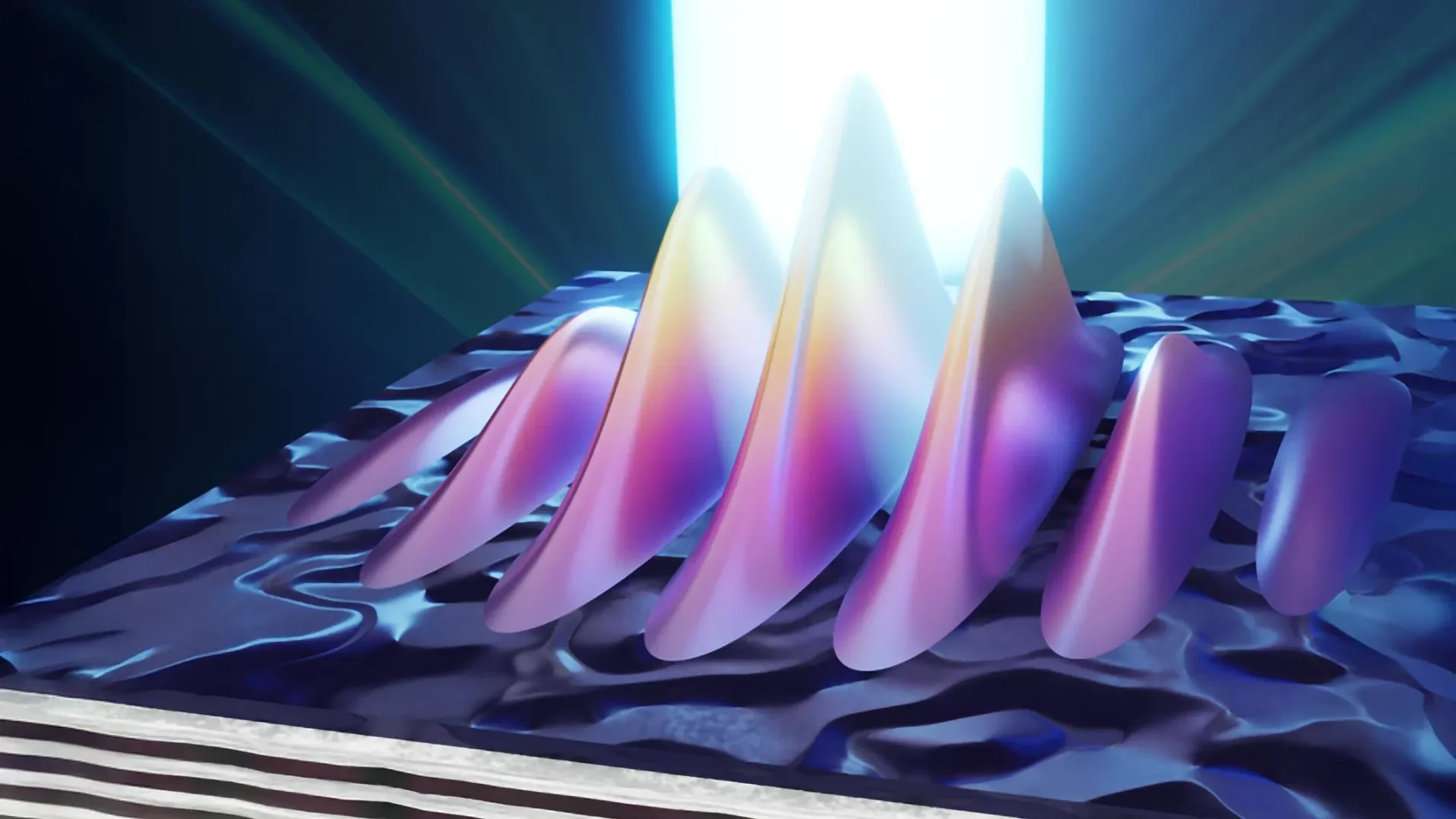
Observation of the emergent supersolid state was made possible by analyzing the light emitted from the microcavity. As the system transitioned into this unusual phase, distinct periodic bright fringes emerged—a signature of coherent density fluctuations indicative of a crystal-like order arising within the condensate. Furthermore, the researchers noted an intriguing dynamism in the observed light patterns, where the bright fringes shifted locations with each pulse of the laser. This fluctuation represents a compelling manifestation of spontaneous symmetry breaking—a phenomenon wherein systems exhibit multiple equivalent configurations before converging on one specific arrangement.
In tandem with the changing intensities of the emitted light, the condensate also displayed a persistent spin helix in the polarization of the emitted light, further underlining the simultaneous presence of multiple order parameters—one governing the intensity and another dictating the polarization attributes of the light. Prof. Guillaume Malpuech elucidates this through the framework of spontaneous symmetry breaking, noting that the selection of various potential states supports the theoretical foundations of supersolid behavior.
Confronting practical challenges, the research team had to confront the ephemeral nature of their sample, as the organic semiconductor would chemically interact with the liquid crystal over time, convolving the experimental timeline into a high-stakes race against the clock. With only a few hours of functional measurement time after the intricate fabrication of their setup, rigorous pre-experimental planning was paramount. Each aspect of measurement had to be meticulously designed, pivoting on sequential setups that could not allow for repeat trials without crafting entirely new sample configurations.
Critical measurements were extensively conducted at IBM Research Zurich, where thin layers of materials were deposited to precisely configure the experimental framework. Central to the success of this extraordinary achievement is the ability to observe, in conditions vastly more accessible than before, the spontaneous emergence of a supersolid—a discovery that not only enriches the foundational understanding of quantum mechanics but also illuminates pathways toward future technologies that leverage the peculiarities of quantum states for advanced computational and sensing applications. The implications of this work could fundamentally redefine the frontiers of material science and quantum engineering. As researchers continue to unravel the complexities of this behavior, the fusion of light and matter is set to transform the fabric of technological innovation.