Field: Technology
A Planetary-Mass Exomoon Redefines the Architecture of Distant Worlds
Published | Technical Staff
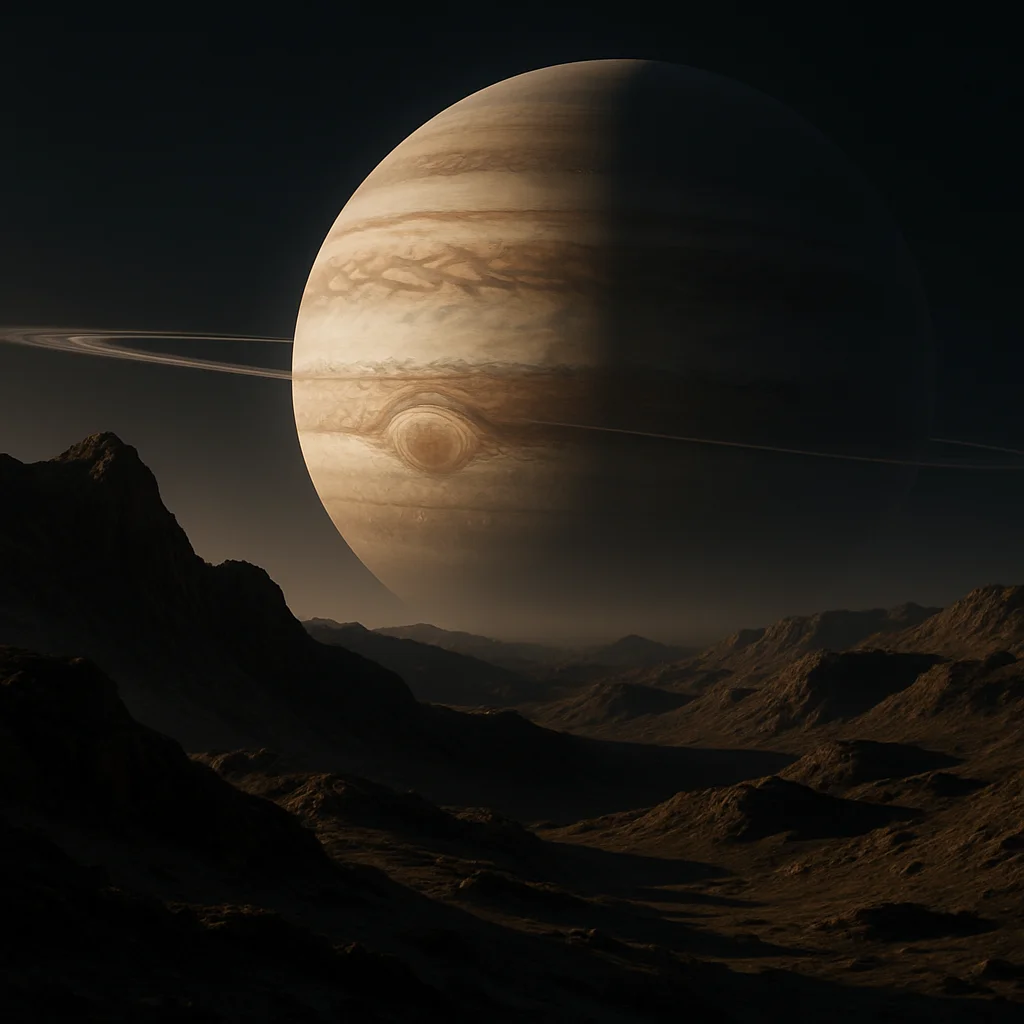
Visualization
The demarcation between star, planet, and subplanetary companion—a taxonomy long reinforced by the clear structure of our Solar System—now stands significantly blurred by the recent discovery in the stellar system CD-35 2722. Utilizing the acute sensitivity of the CRIRES+ instrument on the European Southern Observatory’s Very Large Telescope (VLT), astronomers have identified what appears to be a planetary-mass "exomoon" in orbit around a brown dwarf, both of which in turn circle a star half as massive as our Sun.
CD-35 2722, cataloged also as TIC 201426753, lies some 73 light-years from Earth in the constellation Columba. At the heart of the system orbits a low-mass star, gravitationally bound to an enigmatic companion: a brown dwarf with a mass estimated at 37 MJ (Jupiter masses). Brown dwarfs, occupying the mass range between the heaviest gas giant planets and the lightest stars (~13 MJ < M < 80 MJ), often challenge the classical dichotomy between star and planet by virtue of their substellar, non-fusing cores.
The protagonist of this discovery, however, is not the brown dwarf itself, but a subordinate companion now confirmed to circle it. This exomoon exhibits a minimum mass of approximately 0.9 MJ—an order of magnitude greater than the largest moons of our own Solar System, and indeed rivaling or exceeding many known exoplanets. Its orbital period has been measured at roughly 170 days, a relatively wide orbit in the context of natural satellites.
The detection was achieved via high-resolution near-infrared spectroscopy supplied by CRIRES+, exploiting the radial velocity method. This approach identifies periodic Doppler shifts in the spectral lines of the brown dwarf, symptomatic of its reflex motion induced by the gravitational tug of the orbiting exomoon. The measured semi-amplitude of this velocity "wobble," together with the brown dwarf’s mass and the system’s orientation, allows for derivation of the companion’s minimum mass \( (M_{\rm c} \sin i) \) as follows:
\[
K = \left(\frac{2\pi G}{P}\right)^{1/3} \frac{M_c \sin i}{(M_{\rm BD} + M_c)^{2/3}}
\]
where \( K \) is the measured semi-amplitude, \( P \) the orbital period, \( G \) Newton’s gravitational constant, \( M_c \) the exomoon’s mass, \( M_{\rm BD} \) the brown dwarf’s mass, and \( i \) the orbital inclination. The observed oscillations exclude confounding signals such as stellar variability or systematic instrumental noise, confirming that the brown dwarf is indeed gravitationally influenced by a massive, yet unseen, partner—one unable to procure its own deuterium fusion, and thus falling below the canonical brown dwarf threshold.
The architectural ambiguity of this system confronts the IAU’s familiar planet–moon dichotomy. As ESO astronomer Kevin Hoy remarks, “the exosatellite is clearly massive enough to be a planet, but it does not orbit a star, though it orbits an object that orbits a star.” In Solar System parlance, the term “moon” conjures up primarily small, rocky bodies, not gaseous giants nearly akin to Jupiter. Here, the nomenclatural challenge is manifest: should such companions, massive and gaseous, be considered satellites, sub-planets, or even planets in their own right?
This “third wheel” identity, as Hoy terms it, marks the first candidate for a true exosatellite detection—a finding anticipated but not previously confirmed by methods robust enough to exclude alternate explanations. Dr. Alice Zurlo of Universidad Diego Portales underscores the system’s uniqueness: “The satellite we report is a giant gaseous body orbiting a highly massive companion, itself several times the mass of Jupiter.” The orbital hierarchy—star, brown dwarf, and planetary-mass satellite—transgresses traditional models of planetary system formation, and furthers the need for theoretical treatment of such architectures.
In essence, the CD-35 2722 system substitutes classical symmetry for a nested complexity. No longer can models of celestial architecture derive exclusively from Solar System analogs. The planetary-mass exomoon detected here inaugurates a new class of companions: objects massive enough to stand as planets, yet circling substellar primaries whose own status as failed stars casts them inevitably in the penumbra of classification. As exoplanetary surveys deepen and techniques like high-precision infrared velocimetry advance, a population of such exosatellites may no longer remain the exotic exceptions, but increasingly, the paragon of planetary diversity in our galaxy.