Field: Technology
A nuclear blast could save Earth from an asteroid, but there's a catch.
Published | Technical Staff
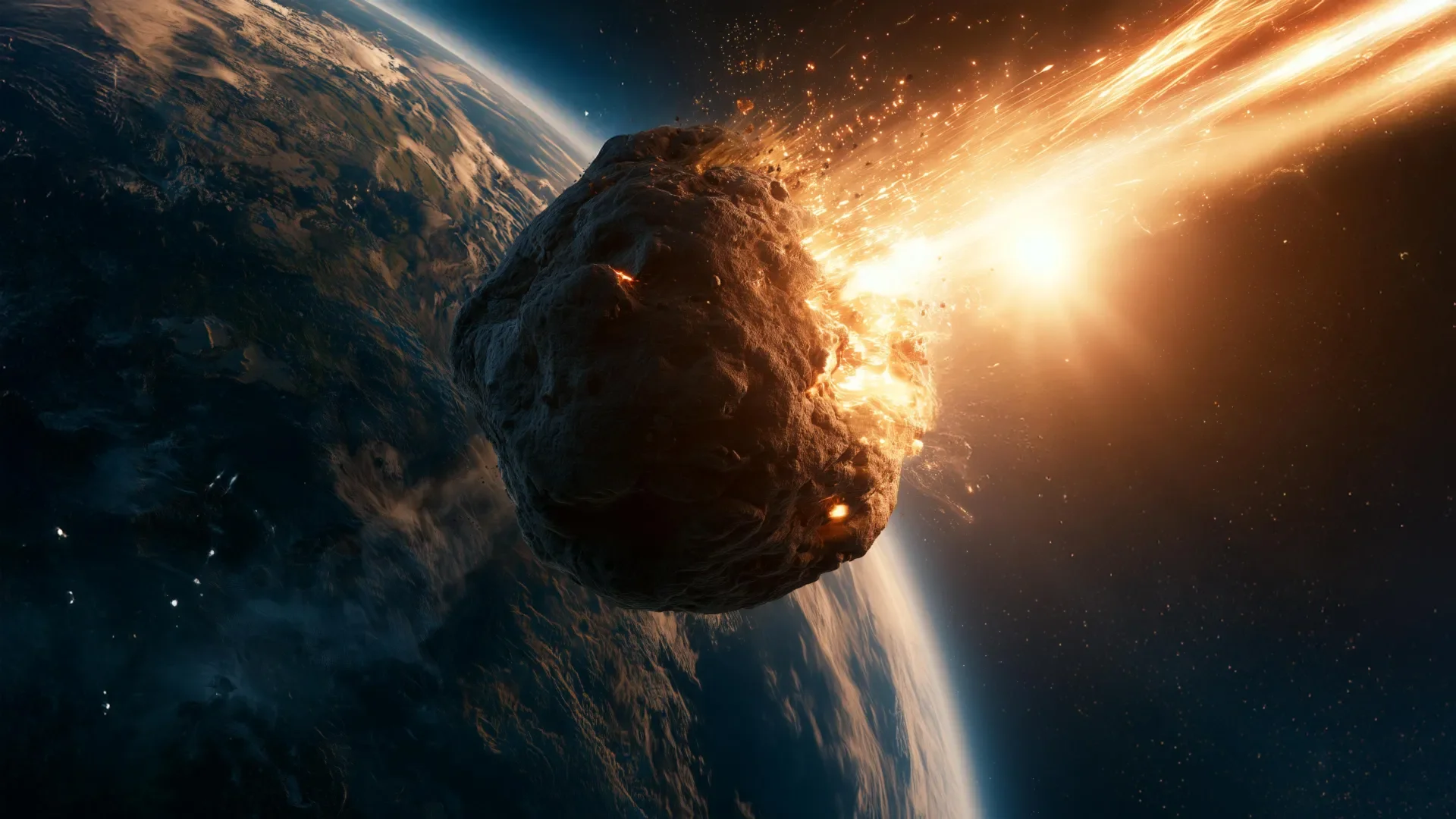
Visualization
As the likelihood of a catastrophic asteroid collision with Earth looms, the scientific community is exploring novel planetary defense strategies with growing urgency. Recent investigations led by researchers at Sandia National Laboratories illuminate a critical detail in the potential use of nuclear explosions to alter the trajectory of an impending celestial threat: the crucial variance in effectiveness based on the chosen interaction point with the asteroid. Utilizing a sophisticated multidimensional approach, researchers uncovered that the complex, often irregular geometries of asteroids are quintessential in predicting their responses to concentrated X-ray bursts, a technique that promises to redefine our approach towards asteroidal impacts.
Through rigorous simulations outlined in the journal Icarus, a novel computational model revealed a striking fivefold variation in the asteroid's deflection velocity, a quantitative measure of how much the asteroid's speed alters upon irradiation from different angles. In a striking demonstration, simulations indicated that an X-ray burst directed at one facet of an asteroid could induce a speed change of 3.9 millimeters per second, contrasting starkly with merely 0.8 millimeters per second when directed from an alternative position. Furthermore, the same irregular geometry that impacts translational speed could also drastically affect the asteroid’s rotational dynamics—one model showcased a difference in spin-up rates of up to 17 times based on the azimuthal orientation of the blast.
Nathan Moore, the leading physicist behind this innovative exploration, emphasized the monumental implications of these findings, stating, “We expected aim to matter. What surprised us was how much.” His remarks underscore the necessity for precise targeting when contemplating the redirection of hazardous asteroids akin to FY 2026's impending threat.
However, the implications of this research extend beyond just the mechanics of deflection. Acknowledging that most prior models oversimplified asteroidal shapes into smooth spheres for ease of calculation, Moore and his team embarked on constructing a far more nuanced simulation environment. They accomplished this breakthrough by ingeniously merging the capabilities of two disparate simulation frameworks: ALEGRA, tailored for high-energy dynamics aboard Sandia’s Z machine, and SPARTA, ordinarily purposed for simulating slower, more gradual forces like those encountered by spacecraft due to solar wind.
This innovative algorithm improved computational efficiency over 1,600 times, paving the way to simulate the intricate 3D geometries of actual asteroids based on high-resolution imagery from reconnaissance missions. Such advancements allow for detailed analyses of the local surface effects post-X-ray interaction, forming complex heat distribution maps that predict the vaporization of asteroid materials. Significantly, it assesses the resultant thrust vectoring effects and potential momentum changes while steering clear of disastrous fragmentation which would yield countless smaller, equally perilous space debris.
Nevertheless, diligence and foresight are paramount as researchers continue to face challenges in fully modeling how the entirety of an asteroid body would react to aerospace detonations. Current computational limits restrict predictive capabilities exclusively to surface fracturing phenomena. "Right now, our computer model only considers breakup of rocks on the surface. We can't predict breakup of the entire asteroid body accurately yet," Moore clarified, acknowledging the intricacies involved in capturing simultaneous physical responses.
Aiming towards future planetary defense initiatives, Moore's research underscores the necessity of precision in nuclear engagements with threatening asteroids. The propensity for an off-target blast could result in catastrophic failure, a veritable 'bad day' for Earth. As the dawn of potential asteroid deflection initiatives beckons, adapting this cutting-edge simulation technology could enhance mission planners' ability to accurately calculate the most effective nuclear engagement configurations—including explosive yield, standoff distance, and directional targeting.
The stakes of such exploratory ventures are astronomical, yet the operational challenges remain profound. In a real-world scenario, the exigency of accurately assessing an asteroid’s morphology while simultaneously executing a flawlessly orchestrated nuclear placement presents formidable hurdles. As these technologies and methodologies mature, they forge a pathway toward a visceral understanding of how best to safeguard our planet from the silent threats lurking within the cosmos, redefining our approach to celestial defense amidst the vast expanse of space where every millimeter matters.