Field: Technology
A mysterious 93-billion-mile cosmic structure may be the wreckage of colliding worlds
Published | Technical Staff
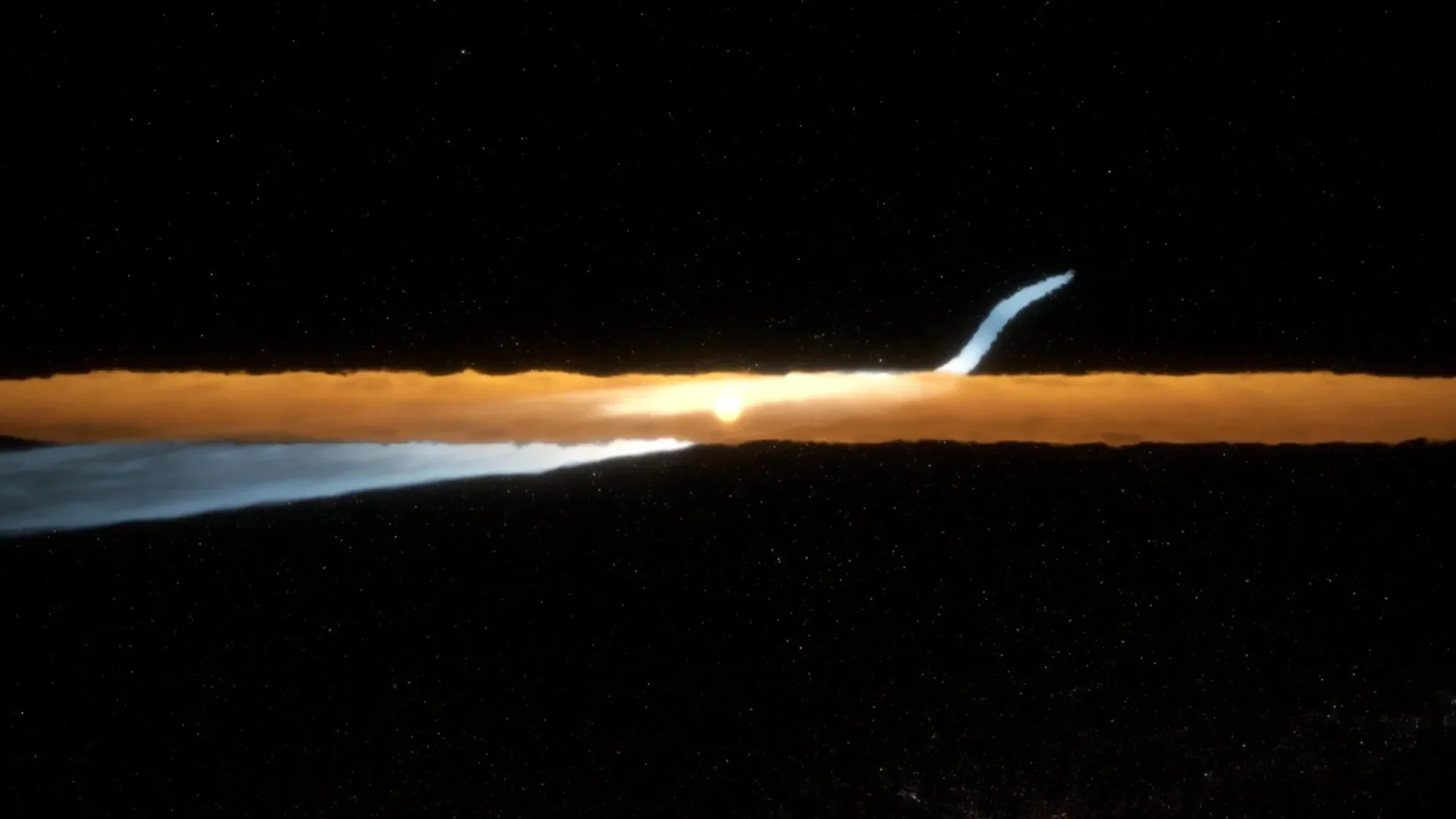
Visualization
A profound revelation unfurls within the depths of our universe, captured by NASA's Hubble Space Telescope, as astronomers unravel the enigmatic "Cat's Tail." Stretching an astonishing 93 billion miles—approximately 1,000 astronomical units—the Cat's Tail is a colossal cloud of dark, fluffy dust conceivably forged from violent collisions between massive planetary bodies. This discovery, which intrigues and challenges our understanding of planetary formation, has emerged from a detailed investigation led by University of Arizona planetary scientist Arin Avsar, revealing a dynamic scene that echoes the chaotic beginnings of our solar system.
Located roughly 63 light-years away in the obscured constellation Pictor, the Cat's Tail invites parallels to our own solar system's formative years, when a juvenile sun sat embedded within a roiling disk of gas and dust. This primordial environment was rife with collisions among rocky progenitors—an environment structured quite differently from the predictable paths taken by contemporary planets. The violent interactions of these early celestial bodies ultimately birthed the very planets we now inhabit, yet also left a trail of debris and destruction.
The intricate dance of dust and fragments surrounding Beta Pictoris, a youthful stellar system, lies at the core of Avsar's study. What is striking about the Cat's Tail is not merely its vast expanse but the peculiarities of its composition. Observations from Hubble reveal its structural integrity: primarily composed of organic refractory material, an ensemble of carbon-based compounds, these dark grains absorb visible light, creating their characteristically opaque visage.
Prior to Hubble's pioneering insights, the Cat's Tail was identified through infrared analysis by the James Webb Space Telescope, but its visibility in the optical spectrum remained an enigma. Avsar articulates the unique challenges posed by the dust’s material properties. As a material composed largely of complex carbon chains, its absorption spectrum led to the structure's invisibility in shorter wavelengths—a phenomenon many in the scientific community found perplexing until this recent study illuminated hidden details.
The researchers meticulously compiled Hubble's new visible light images with data amassed over more than 14 years, thus reshaping the narrative surrounding the Cat's Tail. Scaling the dimensions of this cosmic formation further complicates its nature. If one could fathom 93 billion miles, a line measuring apples to apples would equal a staggering 200 trillion house cats, succinctly encapsulating its immensity. Each individual particle, measuring merely a micron in diameter, possesses a striking porosity, akin to lightweight, fluffy structures rather than dense solid grains.
The present inquiry into the nature of the Cat's Tail invariably leads to probing questions concerning its origin. Was it indeed conjured through cataclysmic collisions? Avsar speculates here: collisions so violent they could create vaporized carbon, which, upon cooling, recondensed into these unexpectedly porous grains. These theoretical conditions would illuminate how dust of such scale and texture could form, yet, as co-author Kevin Wagner explains, the impact velocities must have been extraordinary, warranting further observations and computational modeling to fully elucidate this complex narrative.
Moreover, the interpretation of the Cat's Tail's three-dimensional structure has undergone critical reevaluation. By integrating Hubble's observations with findings from the James Webb Space Telescope, the spatial orientation of the Cat's Tail has shifted under scientific scrutiny. The prevailing notion that it extended far behind Beta Pictoris has been replaced by a new perspective: the structure may spread primarily across the similar plane of the firmament rather than extending directly into the void of space. This realignment suggests a flattened geometry rather than a grand arch of material, aiding astronomers in reconstructing the dynamics of the cosmic event that may have birthed such a remarkable structure.
The findings presented in The Astrophysical Journal Letters not only underscore a definitive aesthetic surprise—showing a striking example of the turbulent and often violent nature of cosmic evolution—but also reaffirm the utility of space-based observations in portraying the chaos alongside the beauty of planetary formation. Such revelations extend beyond mere descriptions, ultimately beckoning fresh inquiries into the birth of complex planetary systems across the cosmos. Every observation adds a new layer to the intricacy of our universe, ensuring that the Cat's Tail, while a seemingly isolated structure, serves as a touchstone for our understanding of celestial mechanics and the violent artistry embedded in the tapestry of space.