Field: Technology
A mysterious 4,000-year-old wall is rewriting North Africa’s history
Published | Technical Staff
Visualization
In the rugged terrain of north-west Morocco, the burgeoning Oued Beht site has become a nexus for archaeological insight, painting a vivid portrait of ancient civilizations that thrived millennia ago. It is in this context that a monumental discovery—an enigmatic defensive structure dating back approximately 4,000 to 3,500 years—comes to light, challenging long-held perceptions regarding the social and architectural sophistication of prehistoric communities in the Maghreb region.
Previous research efforts led by the Oued Beht Archaeological Project unveiled what is believed to be the earliest and largest agricultural complex outside the Nile Valley, dating back to around 5,400–4,900 years ago. The site has since emerged as a focal point for deeper exploration, revealing a tapestry of interconnected human activities that hint at an intricate societal framework. The latest excavations carried out in 2023, which I was privileged to partake in, have amplified our understanding of this critical juncture in North Africa's archaeological timeline.
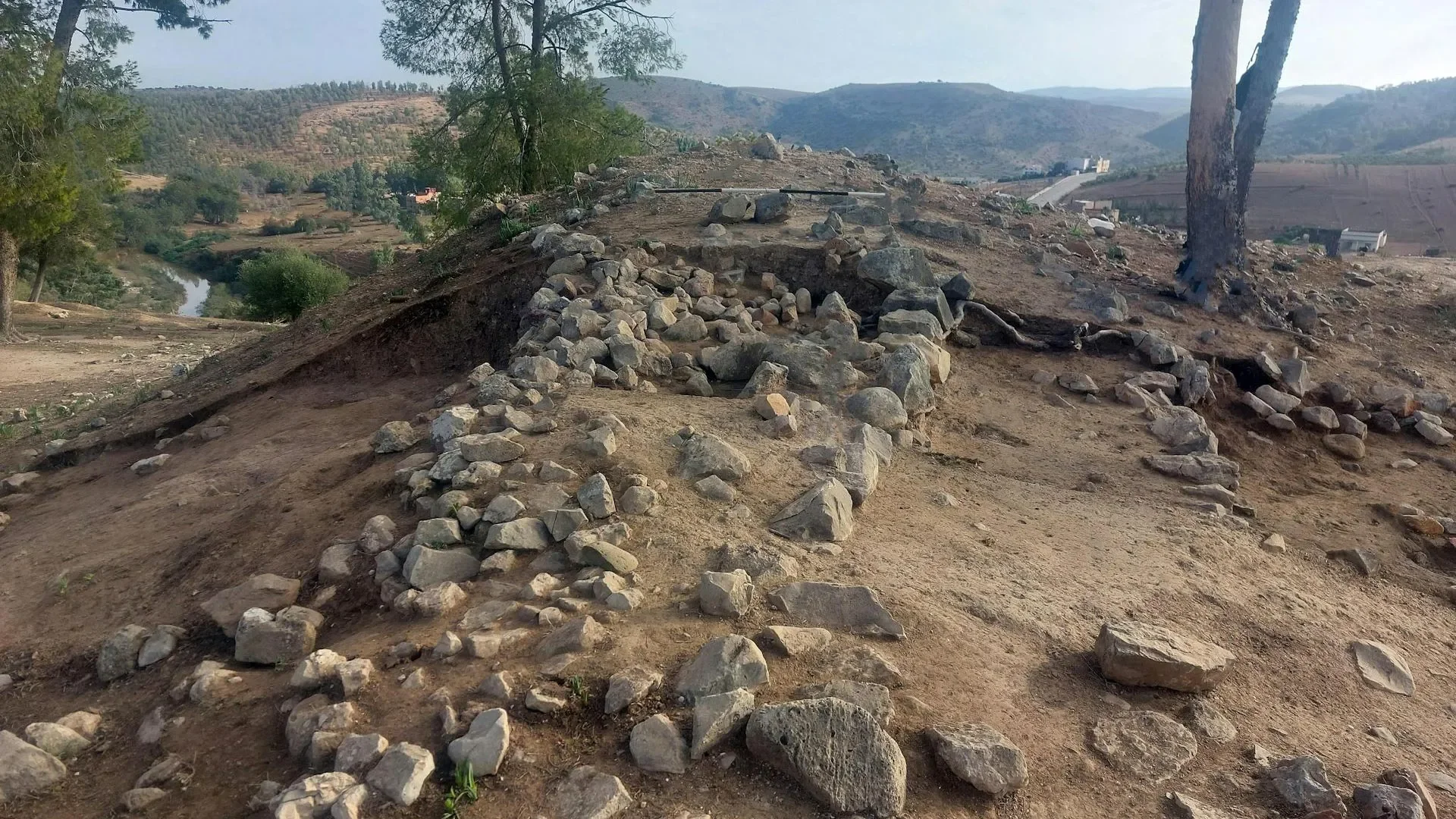
Central to these findings is the construction of an extensive defensive wall, a feature that marks a significant advancement in organized architecture in the region. Radiocarbon analysis of stratified deposits signal this defensive architecture's origins during a period emblematic of the Bronze Age across the western Mediterranean, establishing it as the earliest recognized structure of its kind beyond Egypt. With dimensions suggestive of a structured communal endeavor, this installation prompts us to reconsider the dynamics of competition and territoriality in ancient societies, suggesting that the impetus for its construction may stem more from intra-community tensions over resources than from external invasions.
Engaging in a meticulous excavation of the site elucidated a complex arrangement of earthworks, including a notch or trench, ramparts, and the wall itself, which strategically traverses a narrow section of the ridge located between the river and the adjacent ravine. The multi-phase nature of these constructions reveals a sophisticated understanding of defensive architecture, with a utility that likely extended beyond mere protection—possibly serving as a means of asserting control over valuable land and pathways vital for trade and movement.
At the heart of this discovery lies the need to mobilize labor and resources, a hallmark of advanced social structures. Such operations insinuate not only the presence of organized communities capable of executing large-scale projects—but also a transformation in settlement patterns indicative of more complex societal interactions. Having previously immersed in a broader, open layout during the earlier Neolithic era, the concentration on this narrower, defensible space signals a strategic pivot responding to evolving threats and resource competitions.
The significance of the Oued Beht site further extends to its ties with contemporary Mediterranean developments. Archeological insights reveal that the second millennium BC was characterized by considerable transformation across the region, with the emergence of complex societies in southern Iberia. Contemporary settlements, marked by advanced metallurgy and hierarchical social structures, suggest that communities in the Maghreb were not operating in isolation but were engaging in a dynamic interplay of cultural exchange and resource competition. The architectural advancements seen at Oued Beht illuminate the interconnectedness of these ancient societies, shifting the narrative away from a Europe-centric perspective of civilization towards a more inclusive view that incorporates the rich tapestry of North African history.
Subsequent to the decline of the prehistoric settlement at Oued Beht, medieval remnants have surfaced, evidencing that the ridge retained its significance as a landscape chosen repeatedly by different communities over time. The presence of reconstructed defensive structures during the medieval era alongside ancient burial sites creates a continuum of societal evolution that invites further exploration into how these communities navigated changing socio-political landscapes across millennia.
In bridging the past to the present, the discoveries at Oued Beht sharpen our focus on the complexity of human social structures that emerged long before the advent of written records. As we push the boundaries of our understanding, it becomes increasingly clear that the narratives surrounding ancient North African civilizations are not merely footnotes in history—they are integral chapters that reshape our comprehension of human development across regions. The ongoing research at this pivotal site thus promises to unlock further revelations, offering a refined lens through which to view the evolution of human societies in the Maghreb and beyond.