Field: Technology
A massive new simulation reveals how the universe emerged from darkness
Published | Technical Staff
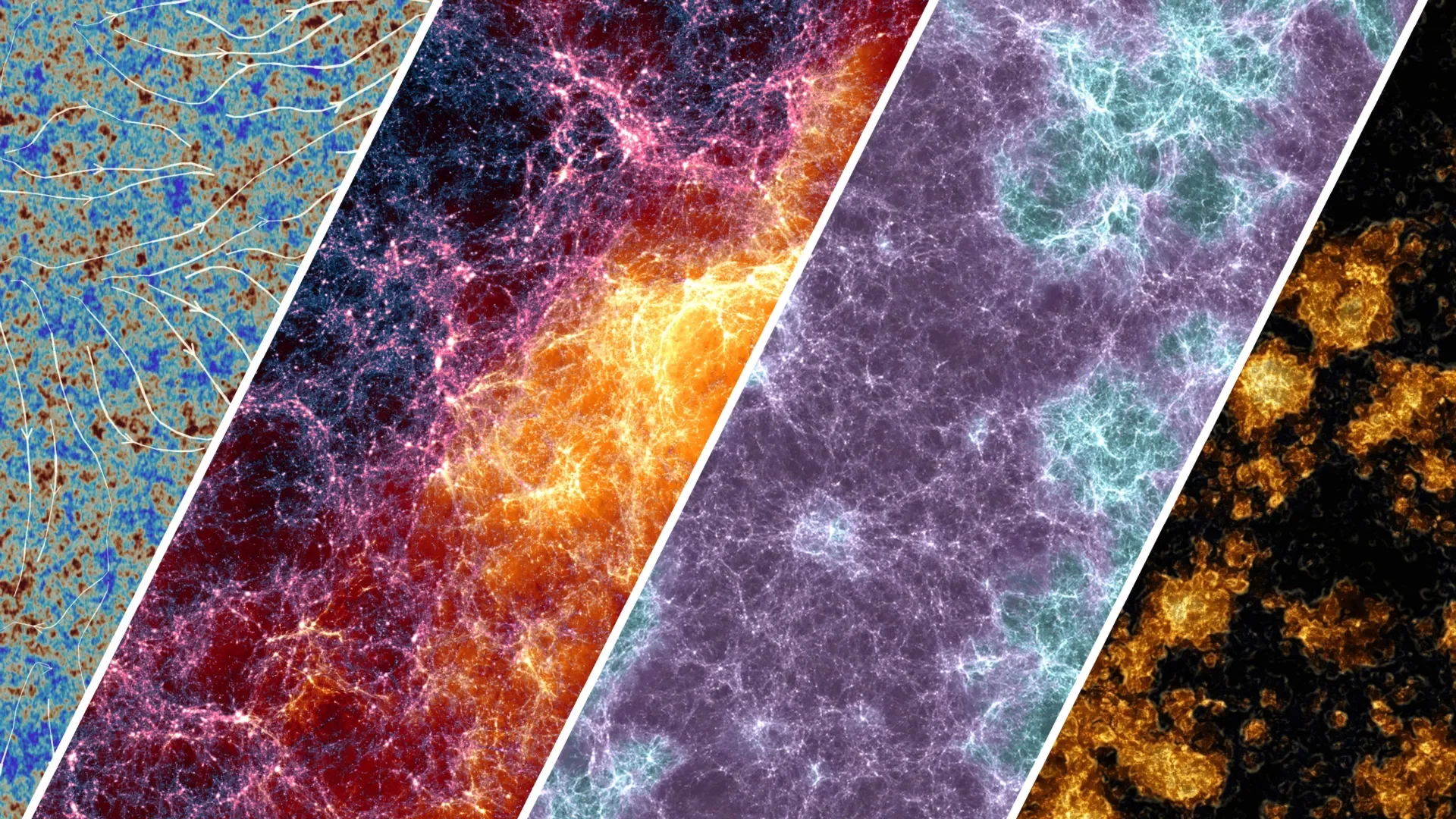
Visualization
In an extraordinary leap in computational astrophysics, a groundbreaking supercomputer simulation named Lumina has illuminated the ancient tapestry of our universe's birth, unraveling the enigma of its cosmic dark age. This monumental project, a product of collaborative efforts spearheaded by researchers at the Massachusetts Institute of Technology and Harvard University, spans an astonishing 1.6 billion light-years, meticulously recreating 2 billion years of pivotal early cosmic history. By surpassing the limitations of previous simulations, Lumina casts new light on the mechanisms that catalyzed the emergence of stars, galaxies, and black holes, facilitating the universe's transition from the pall of obscurity into a dazzling expanse filled with luminous structures.
At the heart of this inquiry lies the Big Bang, a cataclysmic event that birthed the universe in an intensely hot, dense plasma of subatomic particles. As the universe expanded, it began to cool, leading to the formation of neutral hydrogen approximately 380,000 years post-explosion. This heralded the onset of the cosmic dark age—an epoch characterized by a universe devoid of stars, with neutral hydrogen absorbing certain radiation wavelengths, resulting in a stygian expanse.
Lumina’s simulation framework allows researchers to dissect this primordial cosmos, elucidating how the first stars and galactic formations began clearing away the dense veil of neutral hydrogen that had previously enveloped it. The simulation deploys an innovative radiation transport model to calculate the dispersion and interaction of ultraviolet radiation, a feat managed by an intricate ensemble of half a trillion elements—dark matter particles, gas cells, and more—strung together in rich detail and extraordinary resolution, achieving roughly 30 times the fidelity of earlier models.
A pivotal result from the Lumina project is its exploration of two significant phases: hydrogen re-ionization and helium re-ionization. As the earliest stars and galaxies ignited, they unleashed a torrent of ultraviolet radiation capable of stripping electrons from neutral hydrogen, thus re-ionizing it. The transition through which hydrogen transformed from a neutral state into a charged, ionized state, marked a critical threshold in cosmic evolution; as more hydrogen was ionized, the universe grew increasingly transparent to the ultraviolet light, creating pathways for radiation to traverse vast distances.
Helium re-ionization, on the other hand, presents a more arduous challenge, requiring radiation of higher energy to liberate electrons from helium atoms. Notably, Lumina suggests distinct driving forces behind these transformations—while early stars and proto-galaxies primarily dominated the hydrogen ionization landscape, the more formidable task of helium re-ionization seems to have been propelled by the intense radiation generated by supermassive black holes. This dual representation of re-ionization mechanisms encapsulates a broader cosmic narrative, shedding light on formative events that occurred eons before the inception of our solar system.
The scale of Lumina’s inquiry—encompassing a volume 100 times greater than the most sophisticated preceding simulations—was only made possible thanks to the computational might of the Frontier supercomputer at Oak Ridge National Laboratory. With resources aggregating to over 100,000 CPU cores and 15,000 GPUs, the simulation's architecture not only capitalizes on sheer power but also embodies an extraordinary achievement in engineering, allowing trillions of data points to evolve interactively over cosmic time frames.
Researchers initialized Lumina at a temporal juncture approximately 45 million years after the Big Bang, under conditions discerned from prevailing scientific understanding of that nascent era. Through intricate calculations and adaptive modeling, the simulation subsequently unveiled how gas and dark matter mingled while tracking the emergence and spread of radiation from nascent stars. The result is a virtual universe ripe for exploration; a gradual illumination that chronicles how the first galaxies forged their identities and marked the end of the cosmic dark age.
With Lumina's extensive predictive capabilities, scientists stand poised to enhance our understanding of the formation of early cosmic structures by aligning simulation data with observational insights derived from both extant and forthcoming astronomical telescopes. As the mysteries of the universe continue to unfold, Lumina paves the way for an enriched dialogue in astrophysics, nudging humanity closer to comprehending the fundamental nature of our cosmic origins.