Field: Technology
A massive asteroid slammed into the North Sea and unleashed a 330-foot tsunami
Published | Technical Staff
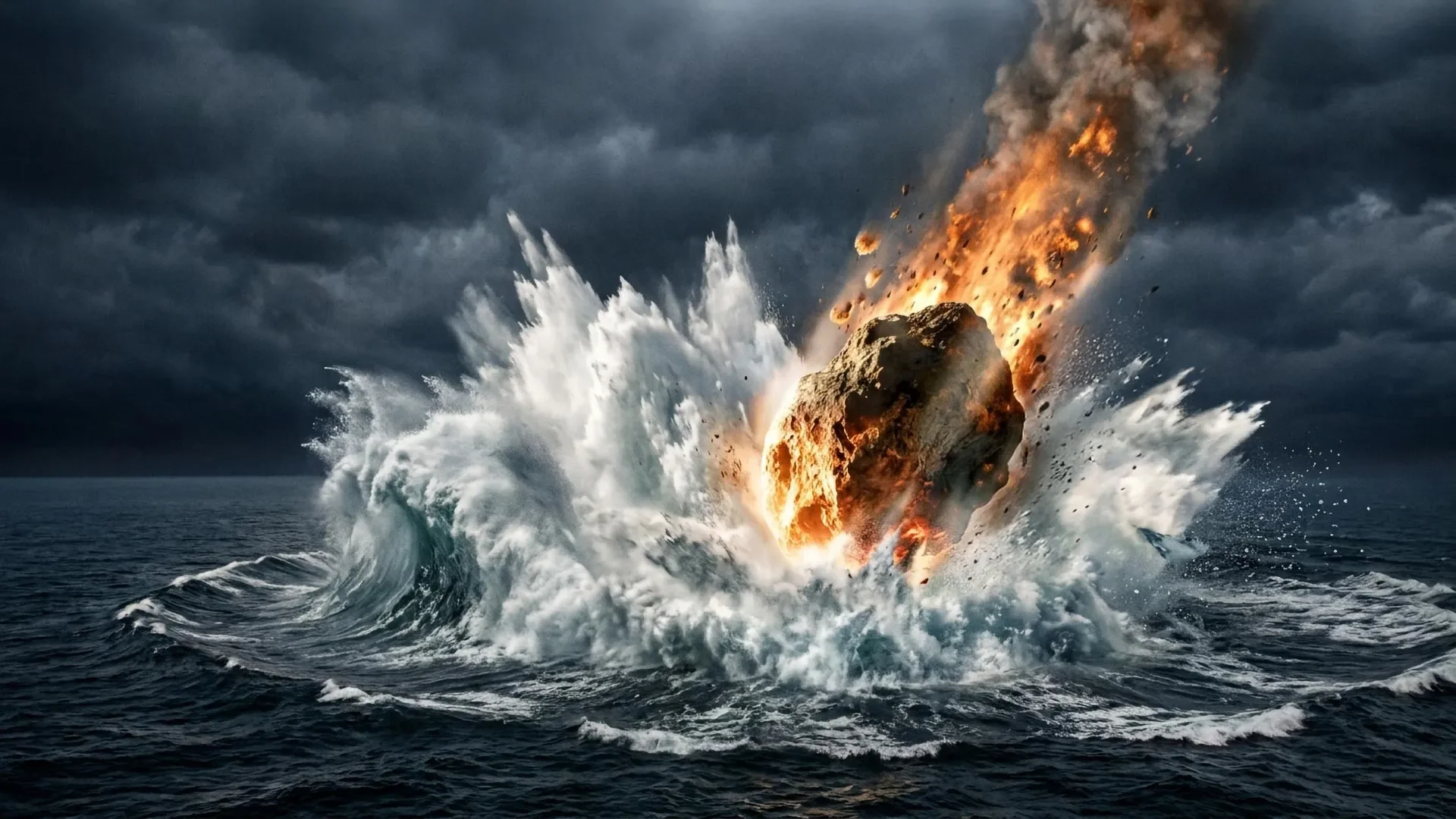
Visualization
In an epochal revelation to our understanding of ancient terrestrial cataclysms, researchers have confirmed a long-debated hypothesis surrounding the origins of the Silverpit Crater, located approximately 700 meters beneath the surface of the North Sea. This scientific inquiry has unearthed evidence that not only elucidates the crater’s formation but also highlights the tumultuous processes that informed prehistoric marine and geological landscapes.
The Silverpit structure, measuring around three kilometers in diameter, has intrigued geologists since its discovery in 2002. Even as its near-circular boundary and elevated central peak suggested an impact origin, fierce skepticism clouded its interpretation. For over two decades, prominent theories contended that geological processes — particularly the movement of subterranean salt deposits and volcanic activity — could account for the unique topography, fostering an enduring scientific debate that even led to an electoral showdown among geologists. However, recent findings spearheaded by Dr. Uisdean Nicholson and his team at Heriot-Watt University have decisively tilted the scales towards the asteroid impact hypothesis.
Utilizing advanced seismic imaging techniques that exploit the propagation of sound waves through the Earth's layers, the researchers illuminated a complex internal structure embedded within the Silverpit Crater. Their exploration revealed not merely the macroscopic features but delved deep into the composition of the impacted material. The key finding emerged from rock samples retrieved from a nearby oil well, which contained rare mineral signatures termed "shocked quartz" and "shocked feldspar." These minerals, formed under extreme pressure conditions as high as 20 GPa, are characteristic of violent impacts but remain elusive occurrences in ordinary geological processes.
Dr. Nicholson's assertion that these shocked minerals were found at the same geological level as the crater floor serves as a profound validation of the impact theory. The minute crystals bore signatures of intense stress, confirming the violent interaction of the asteroid with the Earth’s crust. In a practical sense, the detection of such features can be likened to finding a unique artifact in a rubble of indistinguishable fragments—a scientific “needle-in-a-haystack” endeavor.
To supplement these examinations, the team employed sophisticated numerical models, which replicate the dynamics of impact events through simulations grounded in fundamental physical laws. The model proposed that a roughly 160-meter-wide asteroid approached from the west and collided with the North Sea bed at a shallow angle. This scenario posits that the impact was sufficient to displace vast volumes of rock and seawater, resulting in the generation of a cataclysmic curtain of debris reaching heights of 1.5 kilometers. Such a tumultuous explosion momentarily thrust considerable terrestrial material skyward before it succumbed to gravity and descended back into the ocean, culminating in the formation of an awe-inspiring tsunami over 100 meters in height.
Unlike conventional wind-driven waves characterized by more predictable oscillations, tsunamis represent the abrupt movement of substantial water masses. The force generated by the displaced seawater during an asteroid strike showcases a paradigm of destruction that can ensue from planetary collisions, reinforcing the idea that the cosmos is inextricably intertwined with terrestrial dynamism.
As experts reflect upon the ramifications of this paradigm-shifting research, figures such as Professor Gareth Collins from Imperial College London express relief at the resolution of this scientific impasse. Collins, instrumental in current numerical simulation models, acknowledges the elegance and simplicity of the impact hypothesis in explaining the physical observations consistent with the crater’s formation. He heralds the conclusion of a long-standing conflict in the geological community and emphasizes the newfound opportunity for researchers to study the subterranean implications of high-velocity impacts. With the Silverpit Crater's geological narrative finally mapped, we find ourselves with fresh lenses through which we can better comprehend how such cataclysmic events indelibly inscribe themselves upon our planetary history.
The investigation not only cements the Silverpit Crater as one of the confirmed impact features on Earth but also opens new chapters in planetary science. The preserved characteristics of the crater allow scientists an unparalleled view into the subterranean responses from such explosive events, offering insights that could extend well beyond our own planet, illuminating impact phenomena elsewhere in the solar system. Thus, the Silverpit Crater stands not merely as an artifact of ancient aggression from the cosmos, but as a vital source of knowledge guiding our understanding of planetary formation and evolution shaped by celestial forces.