Field: Technology
A hidden star is plowing through Betelgeuse’s atmosphere, new evidence suggests
Published | Technical Staff
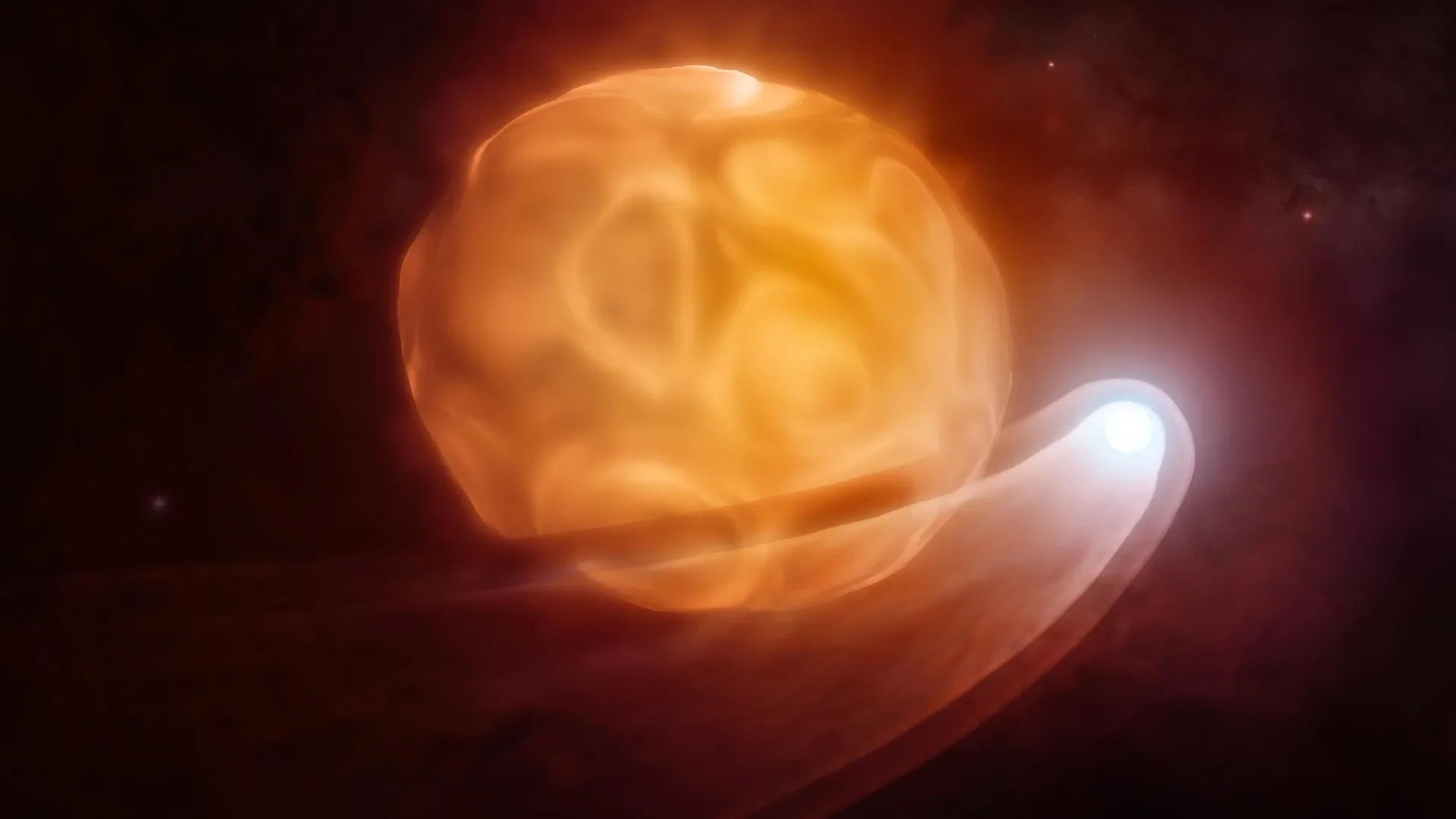
Visualization
A most captivating mystery unfolds in the vast cosmos, drawing focus to one of the most iconic stars observed from Earth—Betelgeuse. Recent observations have unveiled compelling evidence of a hidden companion star, designated as Siwarha, which is suspected to be traversing the expansive atmosphere of the red supergiant, causing noticeable perturbations in its outer layers. This phenomenon presents an extraordinary opportunity to probe into stellar dynamics at unprecedented scales.
Nestled within the constellation Orion, Betelgeuse has long intrigued astronomers due to its illuminating size and remarkable luminosity. Yet it became the subject of heightened scrutiny during the Great Dimming between late 2019 and early 2020, an unprecedented event characterized by a dramatic decline in brightness, prompting questions regarding the processes governing this massive star. The latest radio frequency observations from the Karl G. Jansky Very Large Array (NSF VLA) and the Atacama Large Millimeter/submillimeter Array (ALMA) lend credence to theories proposing that fluctuations in the star's atmosphere are attributable to the gravitational influence of Siwarha.
Dr. Lynn D. Matthews of MIT Haystack Observatory orchestrated a collaboration with an international team, acquiring data across frequencies ranging from 22 GHz to an astonishing 485 GHz, thereby enabling a multi-layered analysis of Betelgeuse's outer atmosphere. The distinct radio frequencies allow for the observation of varying depths, effectively reconstructing the atmospheric structure that stretches from the visible surface to several multiples of the star's radius. Matthews observed, “It was the combination of the incredible data from the NSF VLA and ALMA that gave us a convincing result here,” emphasizing the transformative nature of these high-resolution data sets.
During the observational campaign extending from 2021 to 2026, the researchers noted that Betelgeuse’s atmospheric temperature rebounded following the Great Dimming, attaining values around 3,500 Kelvin at approximately 2.7 times the star's radius—similar to Betelgeuse’s core radiative temperatures. Previous work suggested that a shock wave, induced by turbulent convection within the star, may have propagated outwards, leading to atmospheric disruptions and the ejection of substantial solar material that contributed to the observed dimming.
A notable discovery was the identification of a distinctly cooler region within Betelgeuse's atmosphere, specifically situated between the photosphere and the chromosphere, with temperatures dipping to around 2,200 Kelvin. This cooler layer, referred to as the "MOLsphere,” consists of molecular gas that had only been indirectly observed before. New radio measurements from ALMA allowed for a substantial advancement in exploring this elusive region, substantiating the long-suspected "temperature minimum."
The character of Betelgeuse’s shape has also provided pivotal clues regarding Siwarha’s orbit. The companion star, suggested as a contributor to the periodic changes in Betelgeuse's brightness cycle—approximately every 2,100 days—appears to voyage remarkably close to the star itself, traversing only twice the radius of Betelgeuse. Siwarha embodies a companion that disruptively interacts with the red supergiant's atmospheric gas, analogous to a boat slicing through water, creating an extended wake. Such motions may yield subtle changes in Betelgeuse’s shape, rendering it less than perfectly spherical—an aspect detected through careful analysis of ellipticity across various observational epochs.
Mathematical modeling of Betelgeuse’s distortion, observed particularly when Siwarha is positioned for maximum apparent separation, reveals an intriguing gravitational influence at play. The atmosphere manifests an elongated, oval form correlating to the presence of the hidden companion, while becoming rounder when the star transitions relative to our vantage point. Thus, the undetectable companion reveals its existence through the impact it has on the observable characteristics of Betelgeuse's atmosphere.
The study presents a groundbreaking exploration into the dynamics of stellar companions, quantifying the intricate gravitational dance occurring in the depths of Betelgeuse's monumental atmosphere. In an era where indirect observations often yield vital insights into stellar environments, Betelgeuse and Siwarha’s interactive narrative unlocks new pathways toward understanding the evolution and behavior of massive stars. As these observations continue to evolve, the implications may extend far beyond the ephemeral ether of Betelgeuse, inviting further investigation into the myriad forces shaping the cosmos.