Field: Technology
A Half-Century Hunt Unveils the Gentle Wind from Sagittarius A*, the Milky Way's Central Black Hole
Published | Technical Staff
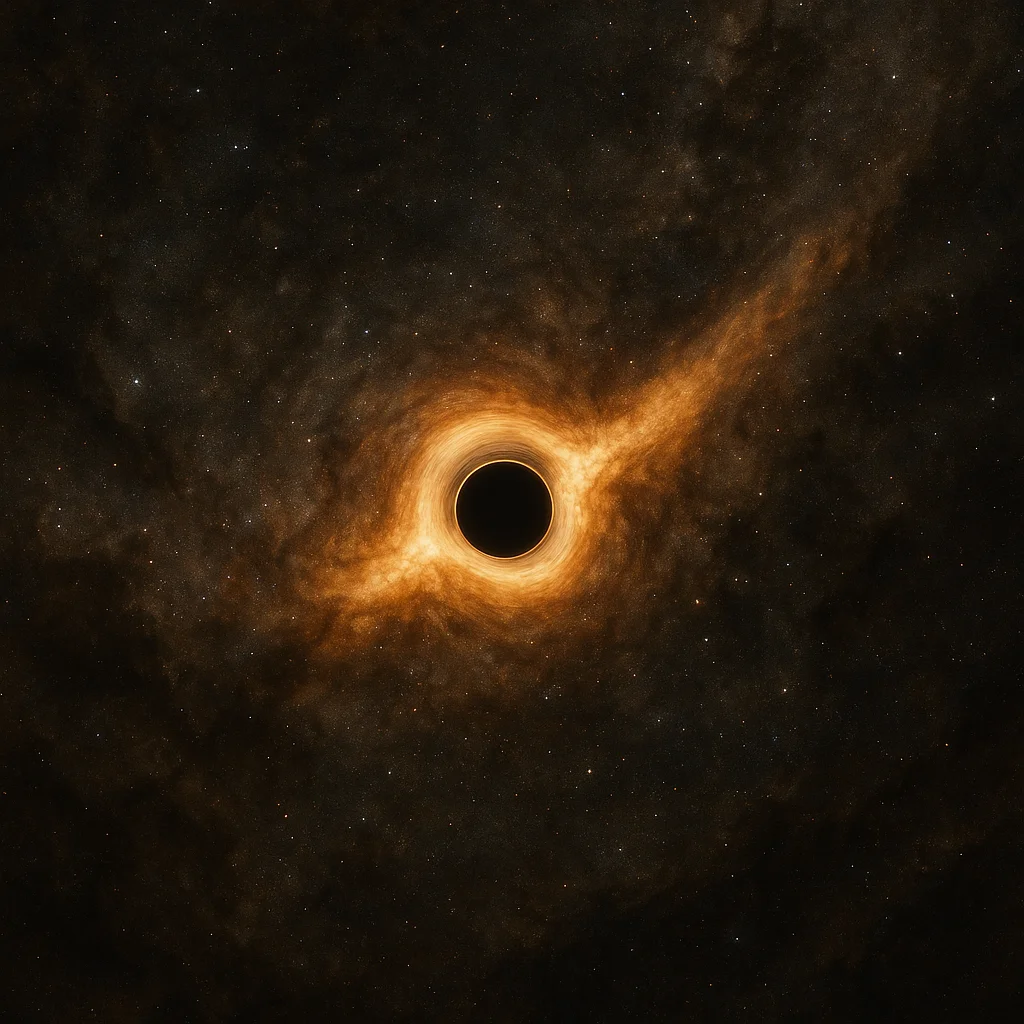
Visualization
For over fifty years, astrophysicists have grappled with an unresolved paradox: if the 4.3-million-solar-mass behemoth, Sagittarius A*, at the heart of the Milky Way, accretes even modest amounts of gas, then basic prescriptions of accretion physics—rooted in energy conservation and angular momentum transfer—demand the concomitant expulsion of material in the form of winds or jets. While spectacular relativistic outflows are a routine spectacle around more voracious active galactic nuclei (AGNs), our Galaxy’s core has eluded direct confirmation of such activity, provoking debate on whether our own supermassive black hole was somehow anomalous or merely quiescent beyond the reach of existing instrumentation.
Recent findings have at last resolved this conundrum. Through a meticulous synergy of observations, astronomers have now delineated the shadowy imprint of a black hole wind: a cone-shaped void within cold molecular gas, oriented directly toward Sagittarius A*, its silhouette resounding in two distinct wavelengths and thus confirming the long-postulated but never directly imaged galactic wind.
The observational campaign, conducted over half a decade with the Atacama Large Millimeter/submillimeter Array (ALMA), relied on mapping the emission line signatures of carbon monoxide (CO), the canonical molecular tracer of cold gas, across a region spanning roughly one parsec (∼3.26 light-years) from the Galactic Center. The principal challenge arose from Sagittarius A*’s prodigious and variable radio emission, which threatened to drown out the subtle, diffuse glimmer of gas at these scales. To surmount this, the data reductions involved sophisticated modeling and subtraction of the black hole’s own flux, yielding an unprecedentedly deep and sharp reconstruction—ALMA’s CO map is reported to be a full two orders of magnitude more sensitive and eightyfold higher in spatial resolution than any prior survey of this inner region.
Superimposed upon this molecular atlas was archival data from NASA’s Chandra X-ray Observatory. Here, a spatial correlation emerged with striking clarity: the cone-like cavity bereft of cold molecular gas in ALMA’s orange-hued landscape was precisely filled by a plume of hot, X-ray emitting plasma seen in blue. This overpressure cavity, carved into the molecular medium, aligns exactly along the radial vector connecting to Sagittarius A*, matching the predicted footprint of a black hole-driven wind. The X-ray diagnostics exclude alternative origins for the cavity; it is not a relic of supernova feedback or stellar activity, but is best explained as a persistent export of energy from accretion into Sagittarius A*.
The morphology and energetics of the wind, deduced from the density and extent of the evacuated cavity, imply a gentle but sustained outflow. Whereas classic radiatively-efficient AGN are known to launch powerful, highly-collimated relativistic jets (with kinetic powers L_wind ∼ η˙M c², where η ≈ 0.1 and ˙M approaches Eddington rates), Sagittarius A*’s wind is muted, consistent with radiatively inefficient accretion models (RIAF/ADAF), in which outflows carry off a significant fraction of the inflowing mass before it nears the event horizon. Estimates place the wind’s duration at a minimum of 20,000 years—indicative of quasi-steady low-luminosity AGN activity, rather than an explosive event.
This discovery provides empirical weight to a longstanding tenet of black hole feedback in galaxy evolution models: even underfed supermassive black holes are not dormant, but drive multiphase circulation in their immediate vicinity. Observational constraints from the Milky Way, at a distance of only 8 kiloparsecs, become a touchstone for understanding the bulk of cosmic black hole activity, which rarely manifests in the fireworks of powerful AGN jets seen at cosmological distances. As Dr. Lena Murchikova, co-author of this study, remarks: “Sagittarius A* finally gives us a window into the life of a black hole in this quiet state,” offering vital insight into the dominant, subdued phase of black hole evolution.
The corollary is sobering and humbling: the quiet wind scouring the Galactic Center is neither unique nor anomalous, but a local expression of the universal mechanisms by which black holes regulate their environments. This finding not only vindicates decades of theoretical work, but augurs a new era wherein high-fidelity interferometry and multi-wavelength synergy can dissect even the faintest heartbeat of the cosmos' most enigmatic engines. The results, now published in *Astrophysical Journal Letters*, underscore the central lesson of contemporary astrophysics: in the relentless search for the subtle, patience and precision can lay bare even the unseen winds at the heart of a Galaxy.