Field: Technology
A Forgotten Particle May Explain Why the Universe Exists
Published | Technical Staff
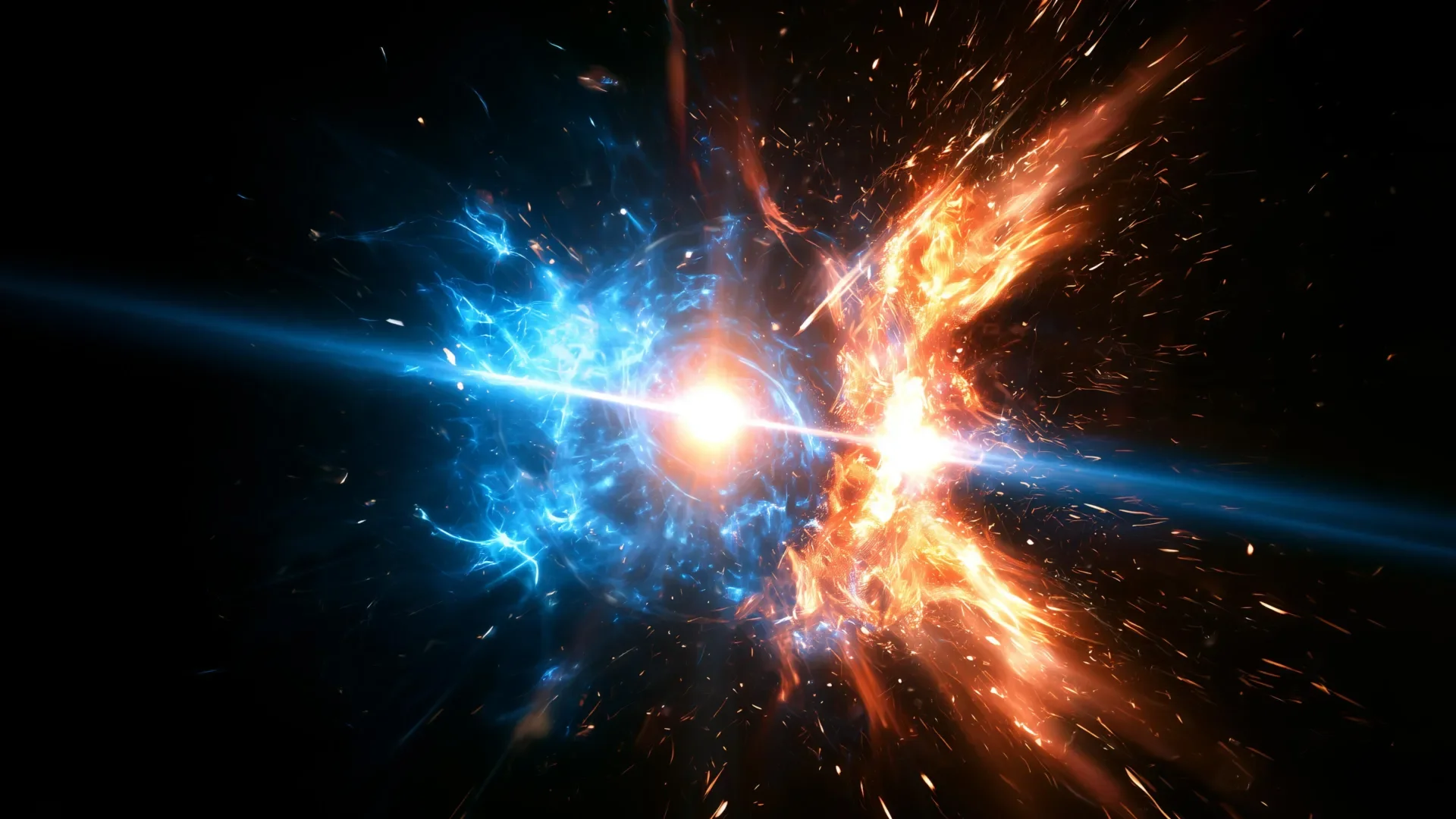
Visualization
Emerging from the fringes of contemporary particle physics, a previously overlooked theoretical construct, designated as the ‘decoupled heavy neutrino,’ is garnering renewed scrutiny as a pivotal component in resolving one of the cosmos's most profound enigmas: the persistence of matter after the Big Bang. Researchers from the University of Southampton and the Indian Institute of Technology Kanpur have recently elucidated a hypothesis suggesting that this elusive particle, dismissed for decades as inconsequential, may have decisively skewed the delicate balance between matter and antimatter in the early universe, facilitating the very existence of the structures we observe today—stars, planets, and life itself.
The crux of the matter lies in understanding the genesis of matter and antimatter. The standard cosmological narrative posits that both were generated in nearly equal proportions during the high-energy conditions ensuing from the Big Bang. According to the law of conservation, when particles of matter and their corresponding antiparticles meet, they annihilate each other, releasing energy, a process encapsulated in the famous equation \( E=mc^2 \). In a universe where matter and antimatter existed in perfect symmetry, the annihilation would have precluded the emergence of any stable matter, resulting in a void that bore none of the complex structures we now perceive.
In contrast to the negligible interactions of their conventional counterparts, heavy neutrinos possess a markedly extended lifespan due to their weak coupling with other elementary particles. Dr. Rishav Roshan, a prominent author of this groundbreaking study published in *Physical Review Letters*, asserts that the heavy neutrino may very well have dominated the energy density of the nascent universe at critical junctures during its cooling phase, effectively changing the dynamics of particle interactions. The implications of such dominance are manifold, not least of which is its potential to catalyze an imbalance in matter-antimatter symmetry.
What sets the decoupled heavy neutrino apart is its ability to influence fundamental interactions among particles at temperatures governed by the Standard Model Higgs boson, a pivotal agent that imparts mass to particles. The hypothesis posits that the presence of the heavy neutrino would effectively alter the temperature threshold at which electron-positron pairs and other charged leptons engaged their antimatter counterparts. This modification acts as a delicate switch, optionally tilting the scales toward matter in the critical moments when the universe’s temperature steadily decreased post-Big Bang.
The crux of the novel approach asserts that the heavy neutrino's protracted existence facilitated a temporary yet vital phase of matter dominance, thereby delaying the complete annihilation process and allowing a slight surplus of matter to persist. This enhanced matter-antimatter asymmetry, a fundamental aspect underlying the observable universe, is what enabled matter to survive the inherently annihilative environment of the early cosmos.
Moreover, the implications of the researchers' findings extend beyond mere theoretical musings. The potential existence and dominance of the heavy neutrino during the early epochs of cosmic evolution may have also left imprints on the universe's expansion history. Co-author Dr. Sudipta Show suggests that dramatic shifts in the early expansion were likely marked by uniquely detectable gravitational wave signals—ripples in spacetime generated by the high-energy phenomena in the infant universe. These primordial gravitational waves could carry rich data heralding information about the conditions prevalent at the universe's genesis.
As gravitational wave astronomy advances, the stark signatures left by fluctuations in the energy density due to the heavy neutrino may soon become amenable to empirical validation. Detecting anomalous patterns in the gravitational wave background may provide the essential clues to ascertain the validity of this hypothesis. The emergence of such evidence could illuminate the intricate tapestry of interactions that dictated cosmic evolution, ultimately reshaping our comprehension of matter's persistence amidst a primordial milieu primed for annihilation.
While this conjecture remains speculative at present, and requires rigorous experimental pursuit to substantiate its claims, it deftly navigates the strong currents of uncertainty that define contemporary cosmology. The study stands as a testament to the unyielding human quest for understanding—a narrative that urges us to consider that even the most unassuming entities in the quantum realm may play a crucial role in shaping the grand cosmos that cradles our existence. As the field progresses, a deeper understanding of these fundamental particles may finally reveal the underpinnings of why our universe exists at all.