Field: Technology
A dead star's mysterious rings reveal what could happen when our Sun dies
Published | Technical Staff
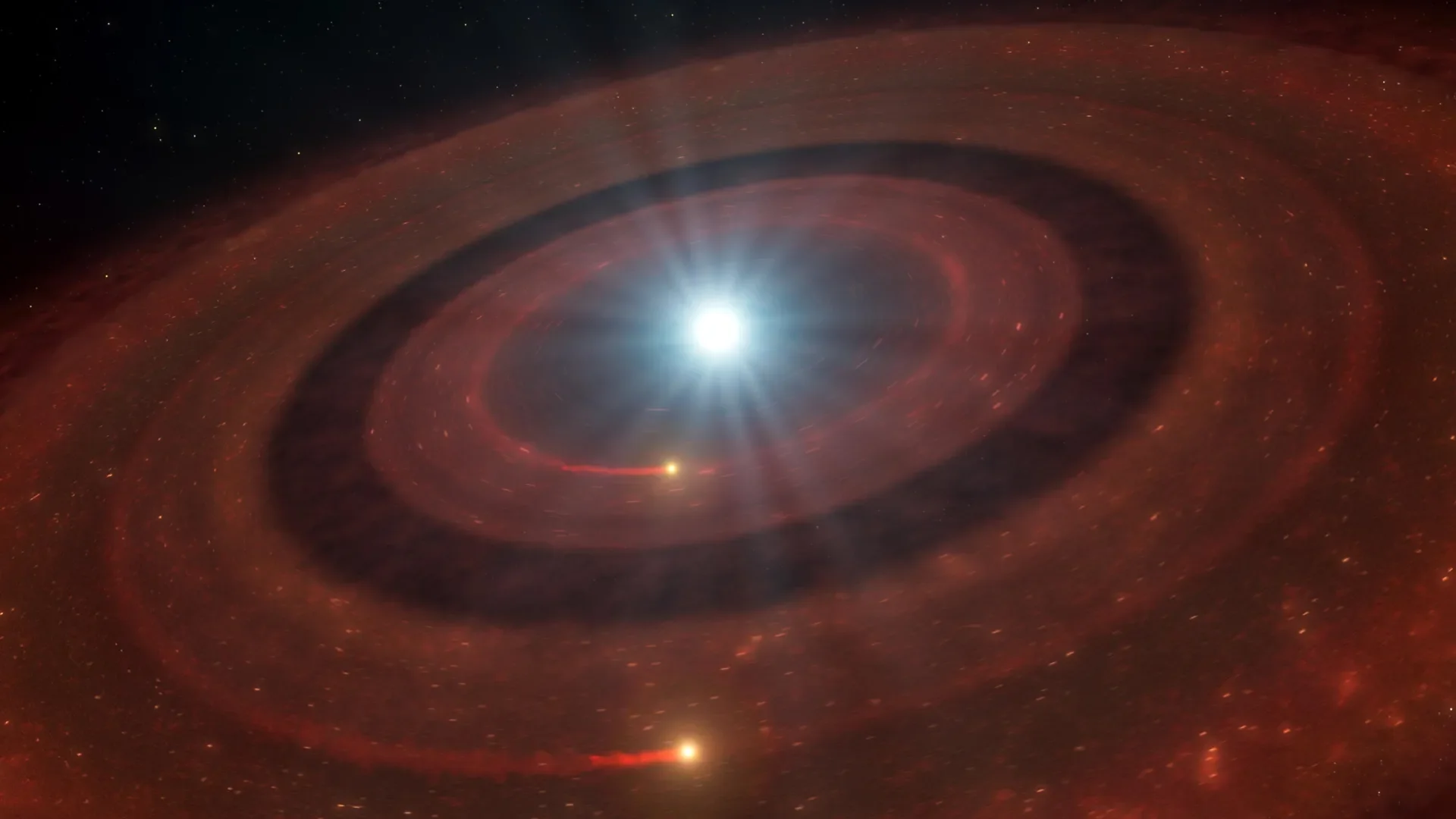
Visualization
Astrophysical observations have recently unveiled a riveting phenomenon surrounding the white dwarf J1328−1450, comprising an intricate system of dual debris rings that may serve as a harbinger for our own Solar System's long-term fate. This discovery, articulated by researchers utilizing the European Southern Observatory's Very Large Telescope, has broken novel ground in the study of planetary systems and their ultimate demise, presenting tantalizing implications for the destiny of Earth and its neighboring celestial bodies billions of years into the future.
At the crux of this phenomenon lies J1328−1450, the exposed stellar core of a once-sun-like entity that succumbed to gravitational collapse after exhausting its nuclear fuel. The star's terminal phase involved an explosive shedding of outer layers, a process that can, and often does, spell doom for nearby planetary systems. As the core is left unshielded, over time, the surviving remnants of these once-thriving worlds may coalesce into myriad forms of debris around the white dwarf, leading to a catalog of possible configurations—some reminiscent of what we observe detailed in J1328−1450.
Unlike prior observations that typically reproduced a singular, flat disc of planetary remnants, the remarkable observations concerning J1328−1450 reveal a dual-ring system that stands apart. Spanning distinct concentric annuli, the two rings maintain a discernable gap, possibly maintained by a couple of surviving planetesimals, which are believed to be holding their orbits against the chaos of the gravitational aftermath. The inner ring is inferred to be linked to an object on the order of just a few kilometers across, akin to the scale of asteroids, while the outer ring could be home to a more substantial body comparable to Pluto or our Moon. Verifying the presence of these planetesimals remains a critical undertaking, as their gravitational influence may well elucidate the stable separation of these rings.
Key to this research was the employment of the X-Shooter instrument on the VLT, which facilitates in-depth spectroscopic analysis across a range of wavelengths. The resultant data afforded insights into the motion and composition of the gaseous materials while discerning elemental constituents such as calcium, magnesium, oxygen, and iron, which are hallmark signatures of rocky planetary material. Intriguingly, the differing chemical compositions of the two rings suggest they may have originated from separate, now-extinguished planetary bodies, or perhaps from different layers of the same planet, further enriching the narrative of their destruction.
The stark compositional variance is particularly noteworthy, as the inner ring is replete with magnesium gas while the outer ring is observed to be particularly deficient in this element. This stylistic separation poses questions about the geological and atmospheric diversity of the worlds that once occupied the vicinity of J1328−1450. The implications are profound: such dual-ring structures offer an invaluable opportunity to probe the wreckage of a related planetary system and the myriad processes of destruction that can ensue post-stellar expiration.
As we contemplate the implications of these cosmic arrangements, we cannot help but ponder the inevitable transition facing our Solar System in a timeline measured in billions of years. Our Sun's journey through the red giant phase will evoke a profound metamorphosis, leading to the potential obliteration of inner planets, including Earth. However, the observations of the J1328−1450 system reveal that despite the tumultuous upheavals accompanying a star's demise, remnants of planetary systems may yet survive, orbiting the stellar remnant in elaborate structures akin to those exhibited in J1328−1450.
This research not only forms a foundation for understanding the continuation of planetary legacies beyond stellar death but also acts as a guiding light—an astronomical analogue for the potential future awaiting our own Solar System. As more stars progress toward their terminations, unraveling the complexities of remnants like J1328−1450 helps illuminate the enigmatic thread that binds evolved planetary systems to their antebellum selves—a cosmic tapestry woven with both destruction and continuity.