Field: Technology
A 2,700-year-old solar eclipse just revealed something surprising about Earth
Published | Technical Staff
Visualization
In a journey intertwining astronomy, ancient history, and modern science, a research team led by Hisashi Hayakawa of Nagoya University has resurrected the specifics of a solar eclipse that occurred on July 17, 709 BCE, revealing elements that illuminate Earth's former rotational dynamics and the Sun's historical behavior. This remarkable study employs advanced astronomical computation in tandem with historical geography to bridge time and extract new insights from an ancient event.
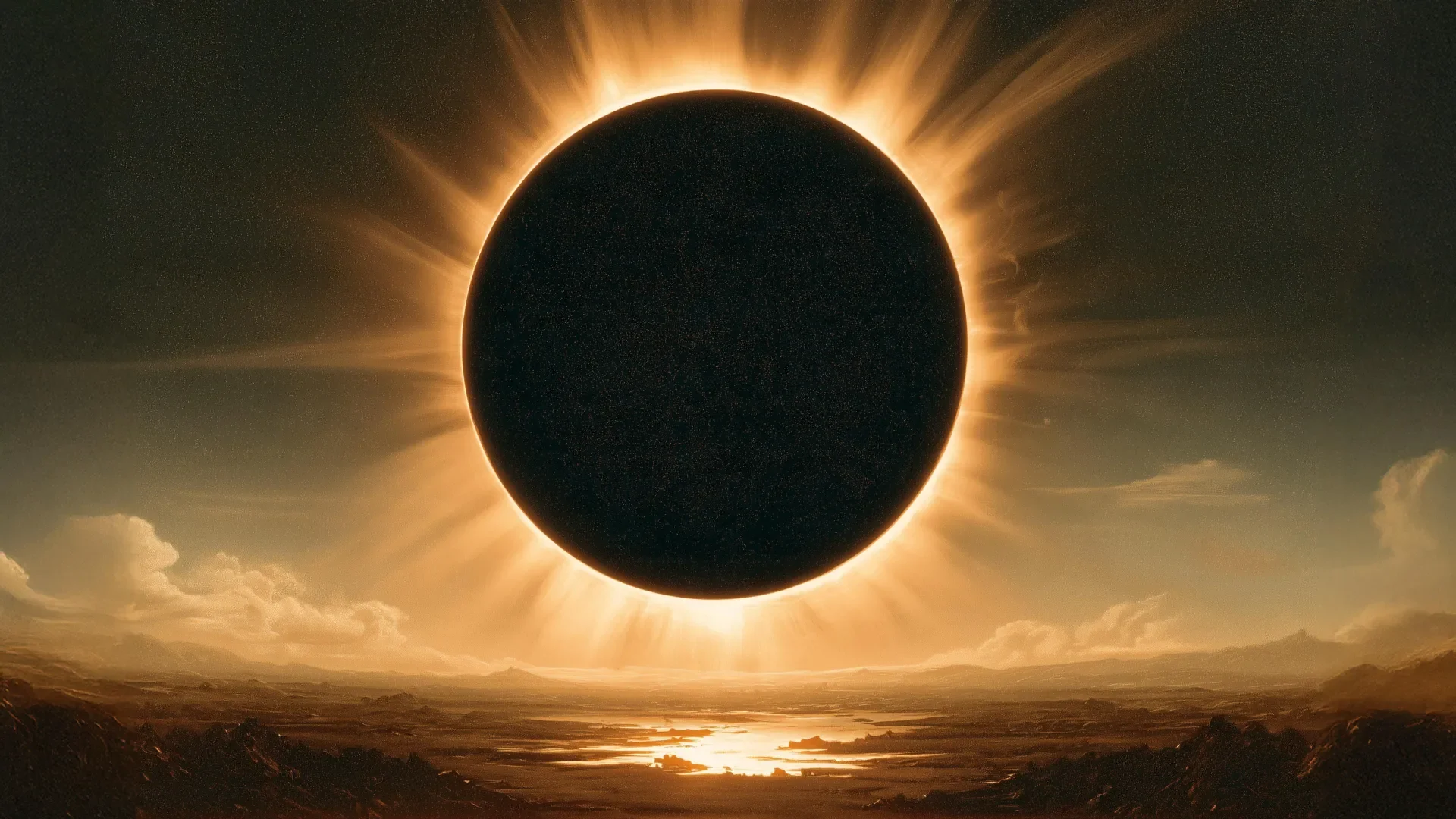
The eclipse, chronicled in the "Spring and Autumn Annals," presents not just a mundane astronomical occurrence but a finely delicatized testament of Earth's rotation mechanics. The original text, a record embellished with historical significance, simply indicates, "the Sun was totally eclipsed." However, deeper interpretations emerge from the Book of Han—created roughly seven centuries later—where an addendum describes the Sun during this remarkable event. This detail, wherein the eclipsed Sun is characterized as "completely yellow above and below," invites speculation that it could refer to the solar corona. If validated, this description could stand as one of the earliest instances of the solar corona being documented.
Delving into historical records led to initial discrepancies when present-day astronomical analysis confirmed that based on existing projections of Earth's ancient spin, a total eclipse should not have been viable from Qufu, where the Lu court resided. This conundrum forced a reassessment of Qufu's geographic coordinates, correcting an eight-kilometer miscalculation that eventually reoriented the observational lens. The correction was decisive, enabling the research team to reconstruct the eclipse's path accurately and in turn derive precise estimations of Earth's axial rotation during that era.
Hayakawa's assessment of the data yielded critical insights into Earth’s velocity of rotation. By modeling the rotation dynamics, the researchers could calculate delta T (ΔT), which represents time discrepancies in relation to a standardized temporal scale. Their analysis revealed that ΔT for the 709 BCE eclipse fell between 20,264 and 21,204 seconds, reflecting a more rapid Earth spin than contemporary measures. This finding is significant, as it recalibrates historical datasets concerning variations in Earth’s rotation, offering a clearer lens through which to evaluate other astronomical phenomena recorded throughout history.
The meticulous documentation of celestial events by ancient Chinese astronomers was motivated by the perception of solar and lunar phenomena as omens that could influence political and social conditions—a practice rooted deeply in the governance structure of successive dynasties. Such attention to the skies produced a treasure trove of records which serve as pivotal references for reconstructing ancient astronomical events. The surviving texts grant modern astronomers a tapestry woven with temporal precision, even while caution is advised regarding the interpretative leap from a historical account to the phenomenon of the solar corona.
The research illuminates not only the past trajectory of Earth’s rotation but also links it to the vigorous celestial life of the Sun. Historical data derived from radiocarbon signatures in tree rings had previously suggested varying solar activity cycles, a hypothesis further enriched by the potential corona observation from 709 BCE. Such a reference bolsters the integrity of solar activity reconstructions, fostering a correlated narrative between isotopic analysis and historical celestial phenomena.
As Earth’s rotational speed has consistently decelerated over millennia, largely due to tidal friction induced by the Moon's gravitational pull, these findings juxtapose an age long past with an evolving solar narrative. The implications ripple outward, embracing the broader cosmos while refining apples-to-apples comparisons across ancient astronomical records. Historical timepieces, bound within rings of wooden growth, gain newfound relevance as this wellspring of solar activity offers independent affirmation for models derived from radiocarbon studies.
Thus, the collaborative effort to reexamine a 2,700-year-old eclipse is not merely an academic exercise; it is a catalyst propelling the confluence of historical geography and modern astrophysics, revealing that even celestial events of antiquity can offer profound revelations regarding the fabric of our planet's motion and the sun's ancient activity cycle. As researchers continue to traverse the delicate tapestry of time, each finding propels forward our grasp of fundamental cosmic truths, melding the past with the ongoing journey of cosmic exploration.