Field: Technology
A 150-million-year-old bird had dinosaur teeth and a strange secret
Published | Technical Staff
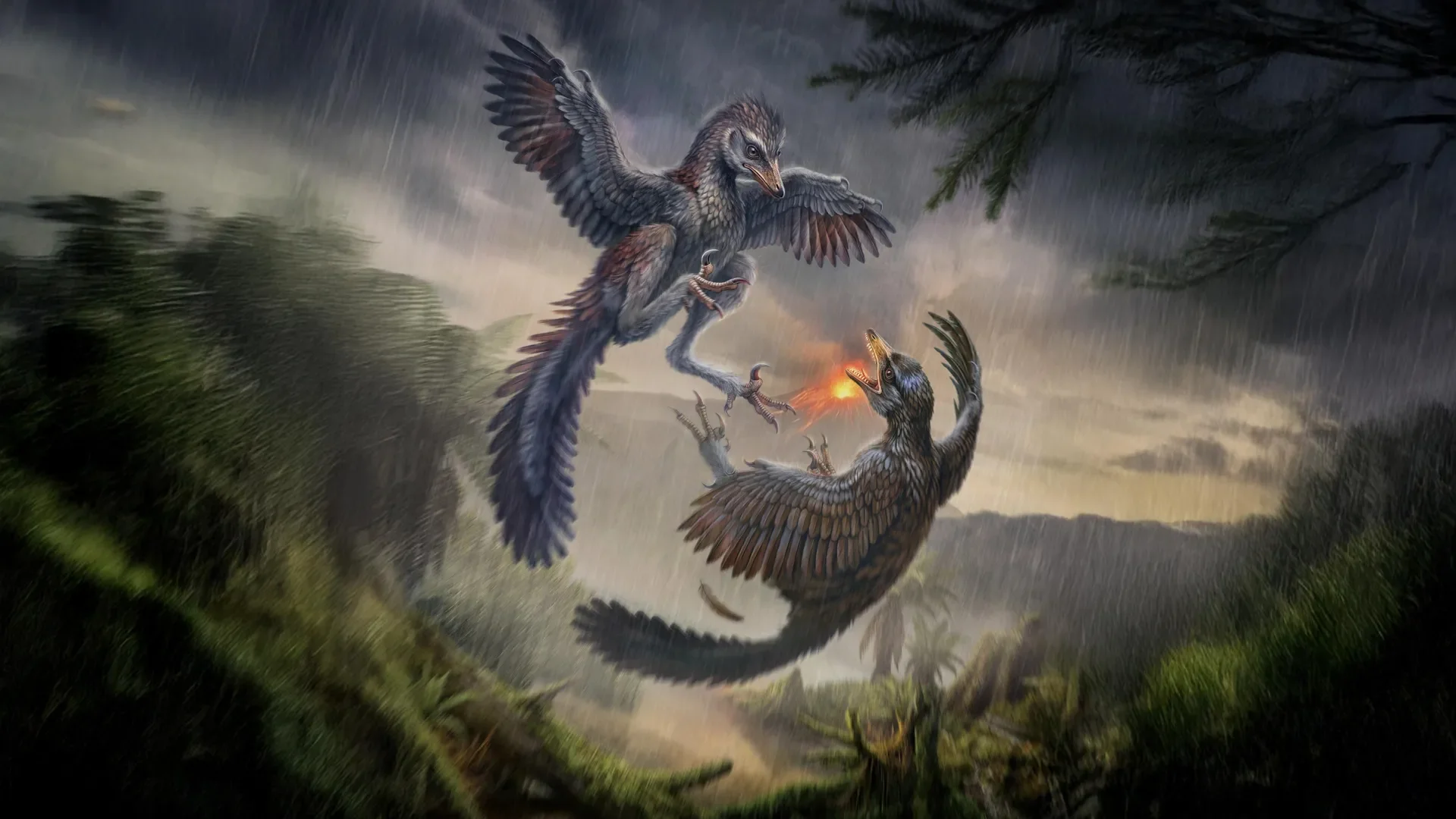
Visualization
In a remarkable revelation from the depths of the Jurassic era, the discovery of a 150-million-year-old fossil in China's Fujian Province has unsettled the traditional understanding of avian evolution. The peculiar bird, named Yuezhuornis yangyuanensis, behaves more like a terrestrial dinosaur than a soaring avian. With features including serrated teeth reminiscent of predatory dinosaurs and an adaptation towards life on the ground rather than the sky, this organism represents an early example of flight loss in birds, presenting an evolutionary conundrum that demands closer examination.
The study published in Nature reveals that Yuezhuornis existed during a tumultuous time in Earth’s history, approximately 150-148 million years ago, when the ancestral line of modern birds was just beginning to differentiate itself. Convincingly situated within Avialae—the clade that includes all modern birds and their immediate extinct relatives—the analysis led by a collaboration of researchers from the Institute of Vertebrate Paleontology and Paleoanthropology (IVPP) and the Fujian Institute of Geological Sciences indicates a far more complex avian evolutionary history than previously theorized.
At first glance, the anatomy of Yuezhuornis tells a multifaceted story. While it bears the skeletal traits characteristic of birds, the presence of closely spaced, serrated teeth harkens back to the dentition of deinonychosaurs, lineage allies of birds that were notable for their predatory prowess. These archaic teeth, coupled with an elongated second toe adorned with a sickle-shaped claw—akin to that of dromaeosaurids—suggest a creature well-adapted for hunting scuttling prey on the forest floor rather than high in the canopy.
Lead researcher Dr. Min Wang has emphasized the implications of such anatomical blendings. Characterizing it as an “extraordinary mix of features,” he highlighted Yuezhuornis’s bird-like pelvic and hindlimb structures juxtaposed against its dinosaurian predatory apparatus, illustrating an evolutionary experiment that thrived in various ecological niches. The extraordinary combination of traits implies both the adaptive versatility of early birds and questions the singular narrative of evolution favoring better flight.
To situate Yuezhuornis within the sprawling tree of avian evolution, researchers utilized sophisticated methodologies including maximum parsimony and Bayesian tip-dating techniques. While maximum parsimony simplifies evolutionary relationships to minimize changes in traits, Bayesian tip-dating integrates fossil timing into statistical models, enhancing our understanding of evolutionary trajectories. Despite employing different analytical frameworks, both methods consistently positioned Yuezhuornis precociously within Avialae, just below the well-known Archaeopteryx on the lineage map, thereby amplifying the significance of Yuezhuornis as an essential piece in the jigsaw of avian evolution.
Beyond its anatomical adaptations, a key question emerges: how did Yuezhuornis navigate its environment? The study measured limb proportions comparable to those found in modern ground-dwelling birds, revealing a morphology more suited for walking than for flight. This anatomical evidence strongly suggests that Yuezhuornis, unlike most of its flying contemporaries, was likely incapable of powered flight and instead flourished in terrestrial ecosystems.
The implications of this discovery stretch far beyond mere anatomical curiosity; they challenge long-cherished notions that the earliest birds uniformly progressed toward increasingly sophisticated flight capabilities. Instead, the evidence indicates that some avian lineages, including Yuezhuornis, made deliberate adaptations to terrestrial lifestyles, thereby debunking the singular narrative of avian evolution that predominated in scholarly discourse.
This pivotal finding also underscores the importance of the Zhenghe Fauna—a new fossil assemblage providing insight into an inadequately understood phase of bird evolution. The sediments yielding Yuezhuornis and potentially more undiscovered species indicate a gradual process of ecological diversification among avialans during the Late Jurassic, a period once thought predominantly concerned with flight adaptations.
Thus, rather than a linear progression towards refined flight, Yuezhuornis exemplifies a broader spectrum of evolutionary experimentation among early birds, revealing complexities that suggest the coexistence of grounded and airborne strategies during a critical evolutionary juncture. As further explorations in the Zhenghe Fauna unfold, the tapestry of early avian life will continue to unfurl, painting a more nuanced picture of the transition from dinosaurs to birds, a lineage fraught with variability and unexpected pathways toward ecological adaptation.