Field: Technology
35-Million-Year-Old Fossil Teeth from Thailand Reveal Rodent as Heavy as Large Dog
Published | Technical Staff
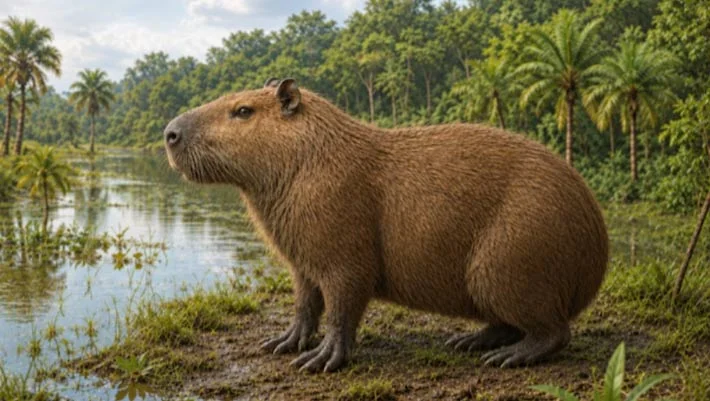
Visualization
In the verdant landscape of southern Thailand's Krabi province, an extraordinary paleontological discovery has emerged from the depths of a coal seam, unveiling critical insights into the evolutionary trajectory of rodents. The newly identified species, dubbed Yakamys sirindhornae, resonates with echoes of the past, challenging preconceived notions of rodent size and distribution throughout the epochs.
The fossil record has long provided glimpses into the vast diversity of ancient life, yet few finds evoke the intrigue surrounding giant rodents, often relegated to South America in recent geological history. In a paper penned by a team of researchers led by McGill University’s Professor Virginie Millien and published in Scientific Reports, it becomes clear that the evolutionary narrative of sizable rodents is far more intricate than previously understood.
Yakamys sirindhornae, dating back to the Late Eocene, approximately 35 to 34 million years ago, is resurrected through the analysis of two remarkably well-preserved fossilized teeth—a single lower molar measuring 11.6 mm by 11.3 mm and a fragment of a lower incisor. The dimensions of the molar alone dwarfed those of previously documented Asian relatives, whose molars measured less than half in size. The implications are monumental; estimates suggest that this rodent could have tipped the scales at around 30 kg, which positions it within the mass of a large canine. “This is only a ballpark figure,” Professor Millien cautiously notes, acknowledging the inherent uncertainty tied to the techniques of body mass estimation derived from fossil remains.
The research team classified Yakamys sirindhornae within the Ischyromyidae family, an early clade of rodents recognizable by its distinctive dental morphology and minuscule enamel structure. The incisor’s enamel, although formidable in size, showcases an unexpectedly thin layer of approximately 235 micrometers, an anomaly worthy of further investigation. Previous specimens, like Manitsha tanka from South Dakota's Oligocene epoch, presented a limited template for comparison. Notably, despite comparable body mass estimations between Yakamys sirindhornae and Manitsha tanka, a significant divergence in molar morphology suggests evolutionary pathways where multiple designs may have co-existed, challenging the notion of a standardized dental architecture among large ischyromyids.
The ramifications of confidently placing Yakamys sirindhornae within the evolutionary line of rodents extend beyond mere size predictions. As the study posits, this finding intimates that adaptations towards increased body size had commenced in rodents much earlier than previously recognized, preceding the emergence of their South American counterparts, such as the colossal Josephoartigasia monesi from the Plio-Pleistocene, whose estimated mass reached an astonishing 350 kg.
As the researchers mull over the evolutionary narrative inscribed within these fossils, they face an ongoing challenge. With the fossil record remaining sparse, elucidation of Yakamys sirindhornae's place within the broader spectrum of rodent evolution demands additional discoveries. Such efforts may unlock a treasure trove of understanding regarding not only the biological and ecological dynamics of this enigmatic species but also the intricate pathways through which gigantism evolved in isolated lineages.
The essence of Yakamys sirindhornae transcends its quantifiable measurements; it beckons the scientific community to pursue further explorations of paleontological sites across Southeast Asia. As the past and present collide within these fossilized remains, the age-old story of rodent evolution gains new chapters, rich with possibilities waiting to be discovered. Further research and excavations may illuminate these shadows, revealing a complex history rich with diversity and adaptation—a narrative that may forever alter our understanding of life on Earth during the tumultuous epochs of its distant past.