Field: Technology
237-million-year-old fossils reveal a bizarre armored sea amphibian
Published | Technical Staff
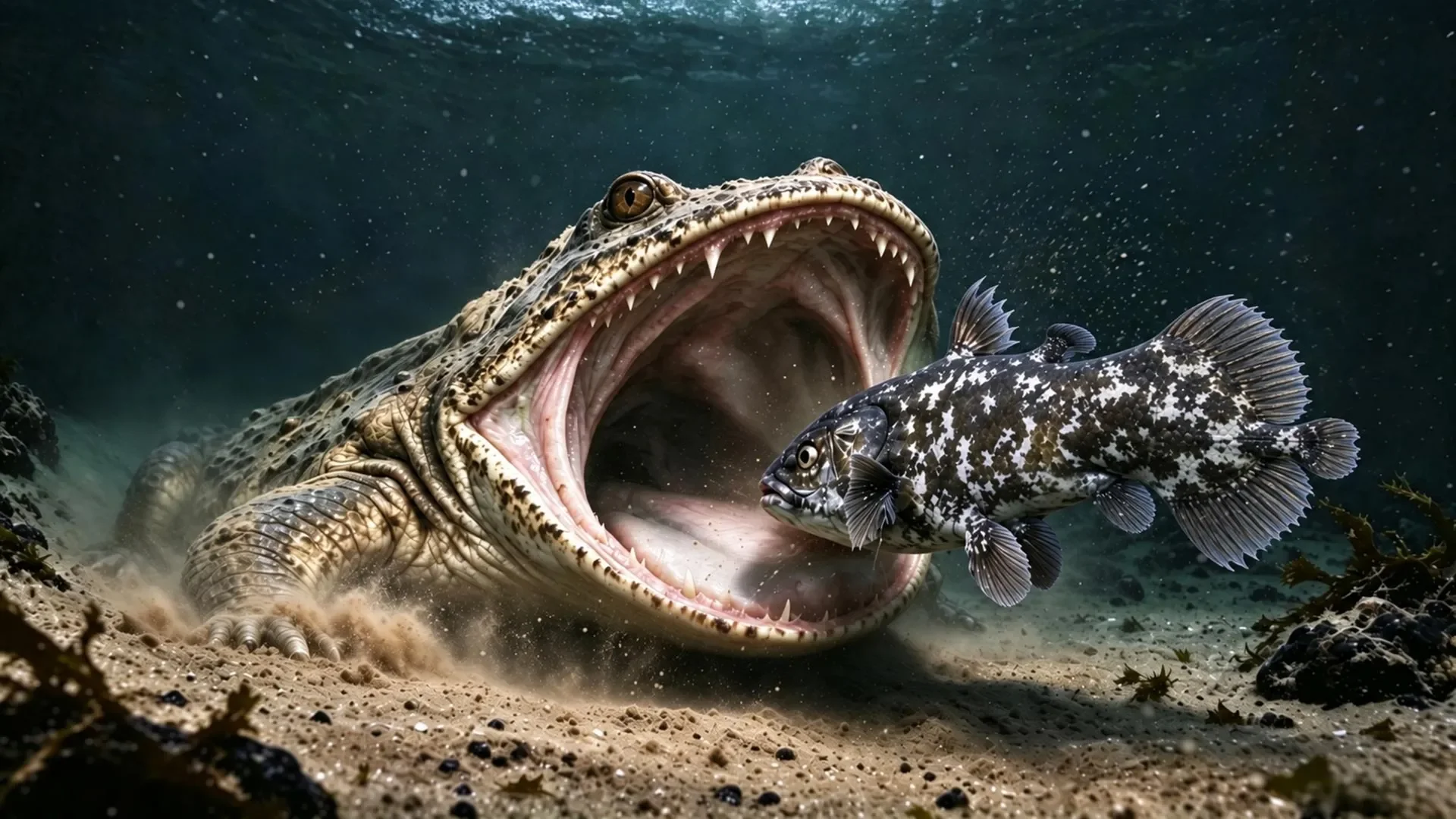
Visualization
In a groundbreaking paleontological discovery, researchers have unearthed fossils of an unusual amphibian from the Late Triassic period, approximately 237 million years ago, that raises compelling questions about the evolutionary pathways of amphibians. The creature, named Gerrothorax maritimus, was a considerable size, akin to that of a giant modern salamander, but it possessed striking adaptations that allowed it to thrive in marine environments—an arena from which today’s amphibians are notably absent.
Unearthed in the Guizhou Province of China—a region once submerged in ocean and distant from landmasses—the two nearly complete skeletons represent a crucial advance in our understanding of amphibian evolution. The discovery, courtesy of an international team led by specialists from the University of California, Davis, along with Peking University and the Geological Museum of Guizhou, has been documented in the journal Nature Ecology & Evolution. The fossils, characterized by their excellent preservation, reveal not just the morphology of Gerrothorax maritimus but also provide insight into its ecological role as a marine predator.
The anatomical structure of Gerrothorax maritimus deviates significantly from its contemporary amphibian counterparts. While modern amphibians average about 8,000 species, none have adapted to a fully aquatic, saline existence; most require freshwater habitats for survival due to their permeable skin, which poses challenges for osmoregulation in saltwater conditions. The evolution of G. maritimus represents a fascinating anomaly, suggesting a lineage capable of innovations allowing for a marine lifestyle. The creature measured nearly 90 centimeters in length, with a robust, flattened body shape—unlike the elongated morphology typical of modern salamanders. Its disc-shaped form and bony armor likely provided both structural protection and camouflage as it lay in wait on the ocean floor, evading predation while preparing for an ambush.
The adaptive morphology of G. maritimus suggests that it occupied a niche typically reserved for large marine predators. The anatomical features of its skull and body indicate an ambush predation strategy akin to that observed in the modern wobbegong shark. This hunting style implies its ecological strategy involved lying in wait until unsuspecting prey ventured too close, at which point it could utilize suction feeding to capture its meal.
The most perplexing question posed by the findings remains: how did G. maritimus survive in marine environments, given the physiological constraints faced by its modern relatives? The secret to its success likely lies in the extensive bony armor covering its body. Such a primary adaptation might have thwarted the transdermal absorption of saltwater, thereby reducing the necessity for drinking freshwater through the skin—a common mechanism observed in contemporary amphibians. This scale-like feature may have enhanced its ability to consume seawater safely. It is hypothesized that G. maritimus may have ingested seawater while filtering out necessary water through its digestive tract and utilized gills—previously identified in its lineage—to excrete excess salt, thereby mimicking systemic adaptations observed in ichthyic organisms.
Further substantiating the marine lifestyle of G. maritimus are the geological and chemical analyses of the sediments entombing the fossils. The well-preserved condition of the skeletons suggests a proximal death to their habitat, negating the possibility of transport post-mortem. Paleontological conventions dictate that fossilized remains typically suffer from hydrological loss if not immediately preserved. Remarkably, the appendages of G. maritimus remained intact, indicating minimal disturbance prior to burial, thus providing compelling evidence of its natural death at the ocean bottom.
Strontium isotope analysis supports the findings, revealing signatures aligned with oceanic strata from the Late Triassic epoch. The ratios of isotopes reflect the chemical profiles expected in marine environments, offering further verification that these ancient amphibians inhabited the seas as integrated components of their ecosystems.
Through the lens of this remarkable discovery, Gerrothorax maritimus serves not only as a relic of an amphibian lineage long adapted to complex existential challenges but also as an indicator of a critical evolutionary juncture within the broader tapestry of life on Earth. This fossil record underscores the adaptive capabilities of ancient organisms and the interplay of evolutionary circumstances, thereby reshaping our understanding of how vertebrates have engaged with marine ecosystems throughout geological time. The discovery opens a dialogue on the evolution of amphibians and serves as a pivotal reminder of the diverse pathways of life that have emerged in response to environmental pressures.
As researchers continue to explore the implications of this find, the marine realm of the Late Triassic becomes an increasingly rich tapestry, revealing secrets that challenge our current paradigms regarding amphibian adaptations and ecological niches. Through this interdisciplinary research, funded by the National Natural Science Foundation of China, we gain invaluable insights not only into G. maritimus but also into the evolutionary narrative that shapes all vertebrates today.